
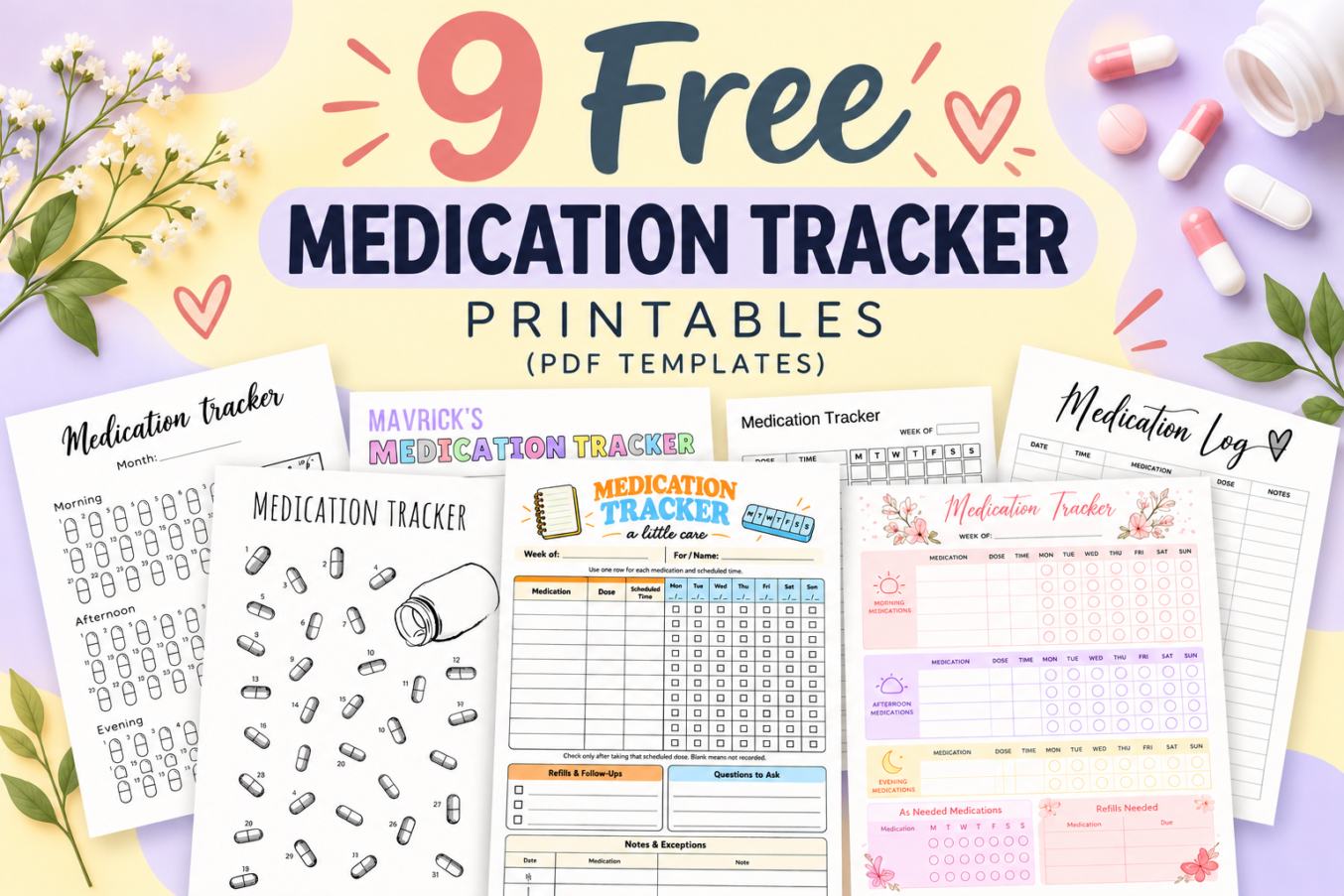

Keeping track of medications can become confusing, especially when you take different medicines at different times of the day. Remembering whether you’ve already recorded a dose, checking a weekly schedule, and keeping track of refills can involve a lot of little details.
These free medication tracker printables provide a convenient way to keep that information organized on paper.
I’ve put together 9 different medication tracking templates, including monthly pill trackers, weekly medication schedules, daily medicine logs, and charts with spaces for medication names, doses, and times.
Some designs are simple and visual, while others provide detailed tables for recording several medications. Whether you’re organizing your own medicine routine or helping a family member maintain a written record, you can choose the layout that best fits your needs.
Free Medication Tracker Printables
Everyone’s medication routine is different. Some people need a simple daily checklist, while others want a detailed medication schedule with separate spaces for morning, afternoon, and evening doses.
This collection includes nine different designs:
- Monthly medication tracker with morning, afternoon, and evening pill symbols
- 31-day medication tracker with numbered capsule illustrations
- Weekly medication tracker with a seven-day checklist, refills, and notes
- Colorful weekly medication tracker with separate daily medication sections
- Weekly medication schedule with dose and time columns
- Circular medication tracker with six visual tracking wheels
- Medication log with date, time, medication, dose, and notes columns
- Weekly medication chart with multiple daily dosage entries
- Floral medication tracker with daily schedules, as-needed medications, and refill reminders
Each design offers a different way to organize medication information. You can print fresh copies as needed and fill in the blank spaces by hand.
Why Use a Printable Medication Tracker?
A printable medication tracker gives you a dedicated place to record your medicine routine without relying entirely on memory.
Having a written record can be especially helpful when you take multiple medications, follow different dosing schedules, or help someone else organize their medication information.
- Organize daily medications. Keep morning, afternoon, and evening medicines in clearly labeled sections.
- Record completed doses. Mark a checkbox, circle, or pill illustration after recording a dose that has actually been taken.
- Follow weekly schedules. Use seven-day tracking charts to see medication records across the week.
- Keep a monthly record. Track medication entries across 31 numbered days with a monthly template.
- Record important details. Write down medication names, doses, times, and notes where the chosen template provides space.
- Remember refill-related tasks. Use the refill sections in selected designs to record prescriptions that need attention.
- Prepare for appointments. Bring a completed medication log when discussing your medicine routine with a healthcare professional.
A paper tracker is a helpful recordkeeping tool, but it should be used alongside the medication instructions provided by your doctor or pharmacist. It does not replace professional medical advice, prescribed dosing instructions, or reliable medication reminders.
How to Use These Medication Tracking Templates
Getting started is straightforward. Choose a design that matches your medication schedule, print the worksheet, and use it to record the information relevant to your routine.
- Choose your preferred design. Select a monthly tracker, weekly chart, or medication log depending on how much information you need to record.
- Download and print the PDF. Choose the corresponding printable and prepare a clean copy.
- Add the date or week. Fill in the month, week, or starting date if your template includes that field.
- Write down medication information. Enter the medication name, prescribed dose, and scheduled time wherever applicable.
- Record doses accurately. Mark the appropriate space only after confirming that the medication was taken.
- Add notes when needed. Record relevant observations or questions in the available notes sections.
- Review your tracker. Keep your completed pages organized and start a new sheet when the tracking period ends.
If you are tracking medications for someone else, make sure the information is accurate and that each entry clearly reflects what was actually taken. An unmarked box should not automatically be treated as proof that a dose was missed.
9 Free Printable Medication Tracker Templates
Below are all nine medication tracker designs. Each has a different layout, so you can compare the available sections and choose the most practical printable for your routine.
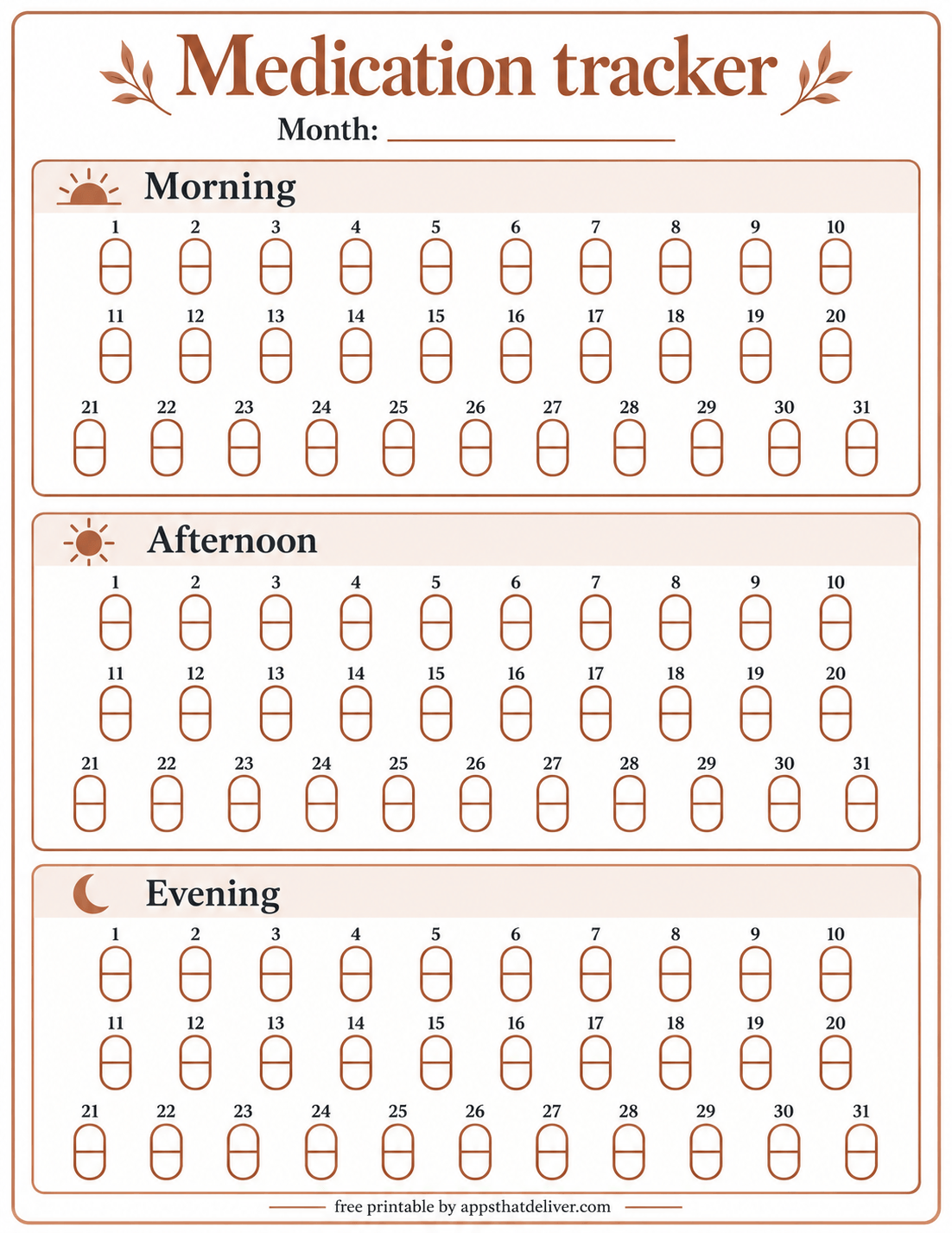
1. Monthly Medication Tracker with Morning, Afternoon, and Evening Sections
This minimalist monthly medication tracker uses small pill illustrations to create a visual record of medication tracking throughout the month.
The page is divided into three clearly labeled sections: Morning, Afternoon, and Evening. Each section contains numbered pill symbols covering days 1 through 31.
You can write the month at the top and mark the appropriate pill symbol as you record each day’s medication. The simple design makes it easy to view an entire month without working through a complicated table.
This printable is best suited to a straightforward routine where you want to track one entry for each time-of-day section. Because it does not provide separate medication-name or dose fields, keep those details in another record if you take multiple medicines during the same period.
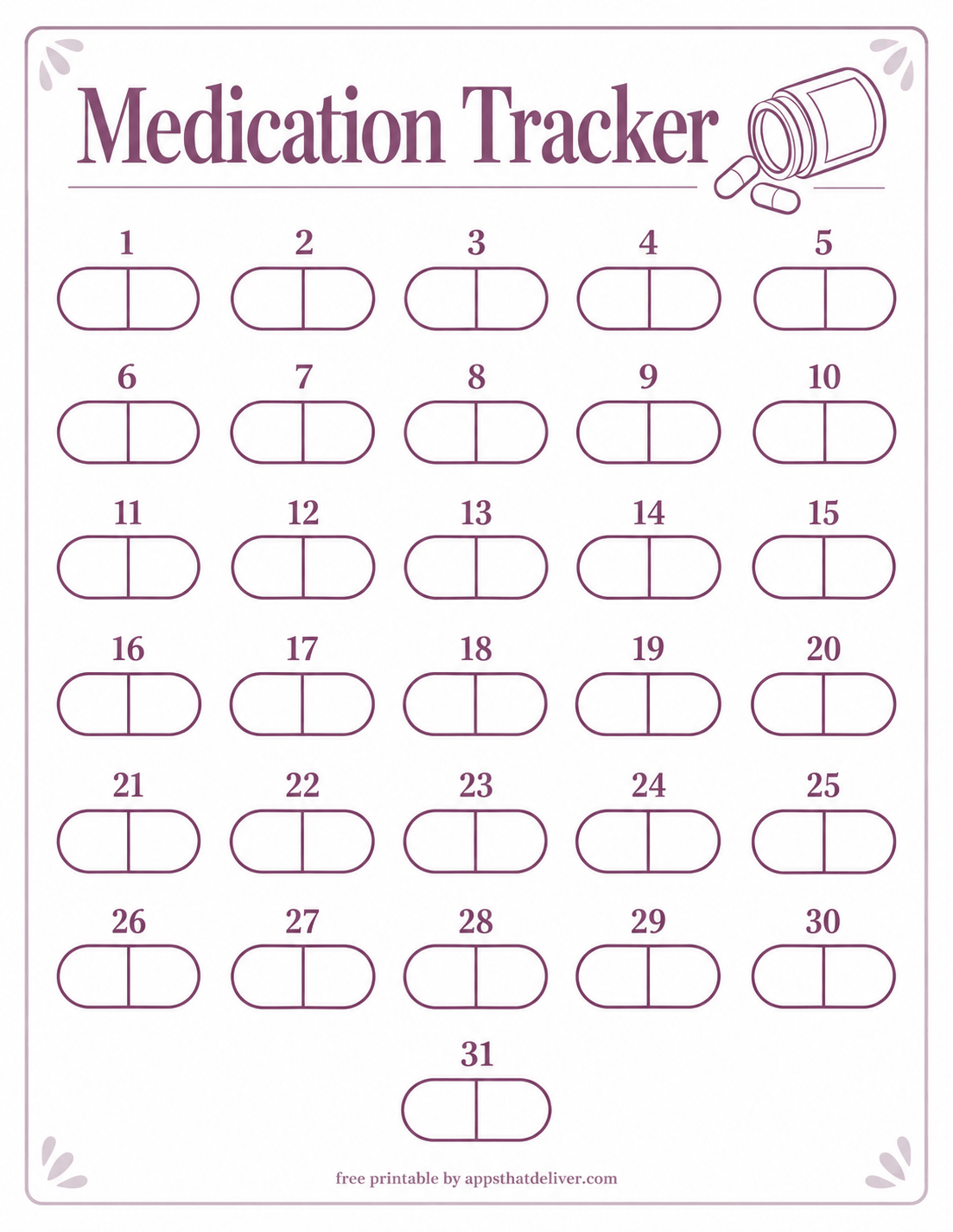
2. 31-Day Medication Tracker with Numbered Pill Illustrations
This creative 31-day pill tracker printable offers a different approach to recording medication activity.
Instead of using a traditional chart, the page features individual capsule illustrations arranged around a large drawing of an open medication bottle. Each capsule is numbered from 1 to 31.
You can color or mark the numbered capsules as you record your medication throughout the month. The scattered arrangement gives the worksheet a playful appearance while keeping the numbered days visible.
This is a good option for someone who enjoys visual tracking and wants a simple way to mark one medication-related entry each day.
Because the design does not include medication names, dose amounts, or scheduled times, it works best as a supplementary visual tracker rather than a complete medication schedule.
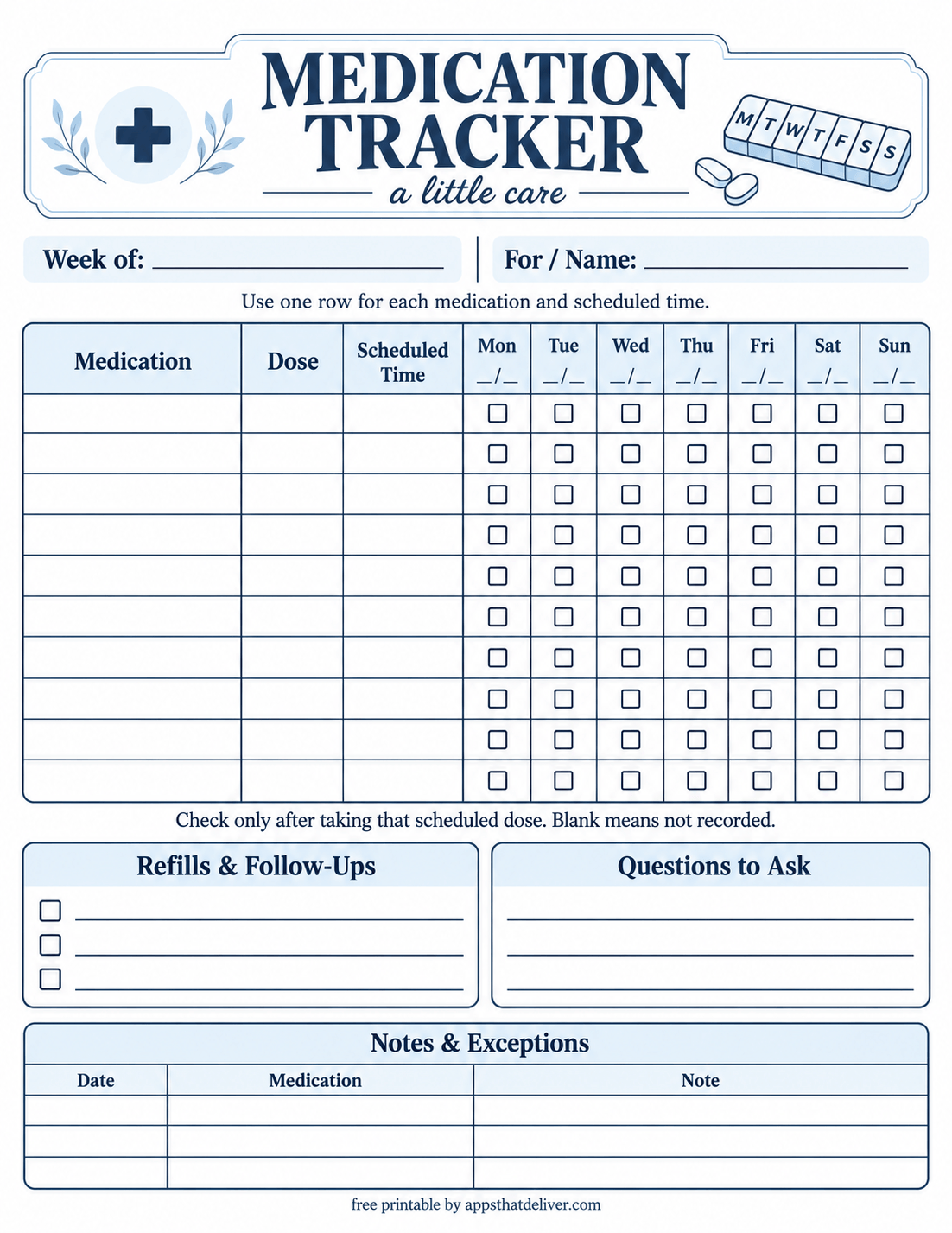
3. Weekly Medication Tracker with Refills, Questions, and Notes
This detailed weekly medication tracker printable combines a seven-day medication checklist with additional sections for managing medication-related information.
At the top, you’ll find spaces for the week and the person using the tracker. The main chart includes columns for medication, dose, scheduled time, and each day from Monday through Sunday.
Each medication row includes daily checkboxes, making it possible to record whether a scheduled dose has been taken.
Below the chart are separate sections for Refills & Follow-Ups and Questions to Ask. These provide space to record refill tasks, upcoming medication-related conversations, and questions for a healthcare professional.
A Notes & Exceptions table at the bottom includes columns for date, medication, and note, allowing you to document additional details.
This design is particularly useful when you want medication tracking and related administrative notes together on one page.
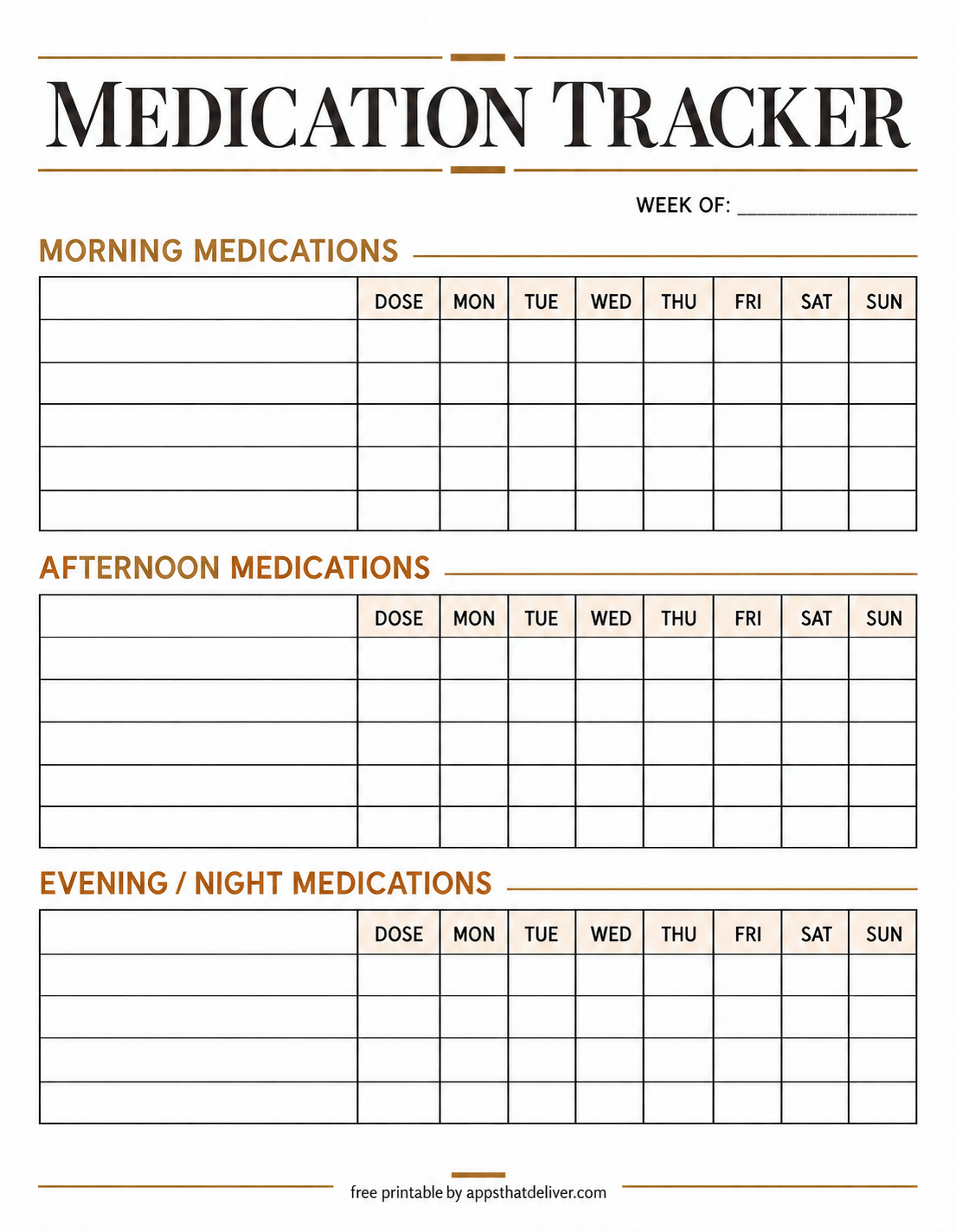
4. Colorful Weekly Medication Tracker with Morning, Afternoon, and Night Schedules
This colorful weekly medication schedule printable separates medicines into three time-of-day categories, making it easier to organize different parts of a daily routine.
The page includes three large tracking tables labeled Morning Medications, Afternoon Medications, and Evening / Night Medications.
Each table has space for medication information, a dose column, and seven weekday columns running from Monday through Sunday. Five blank medication rows are provided in each section.
The pastel-colored weekday headers help distinguish the days, while the spacious blank cells can be used to record medication completion.
This design is especially useful when you take different medications in the morning, afternoon, and evening and want to keep those schedules separate.
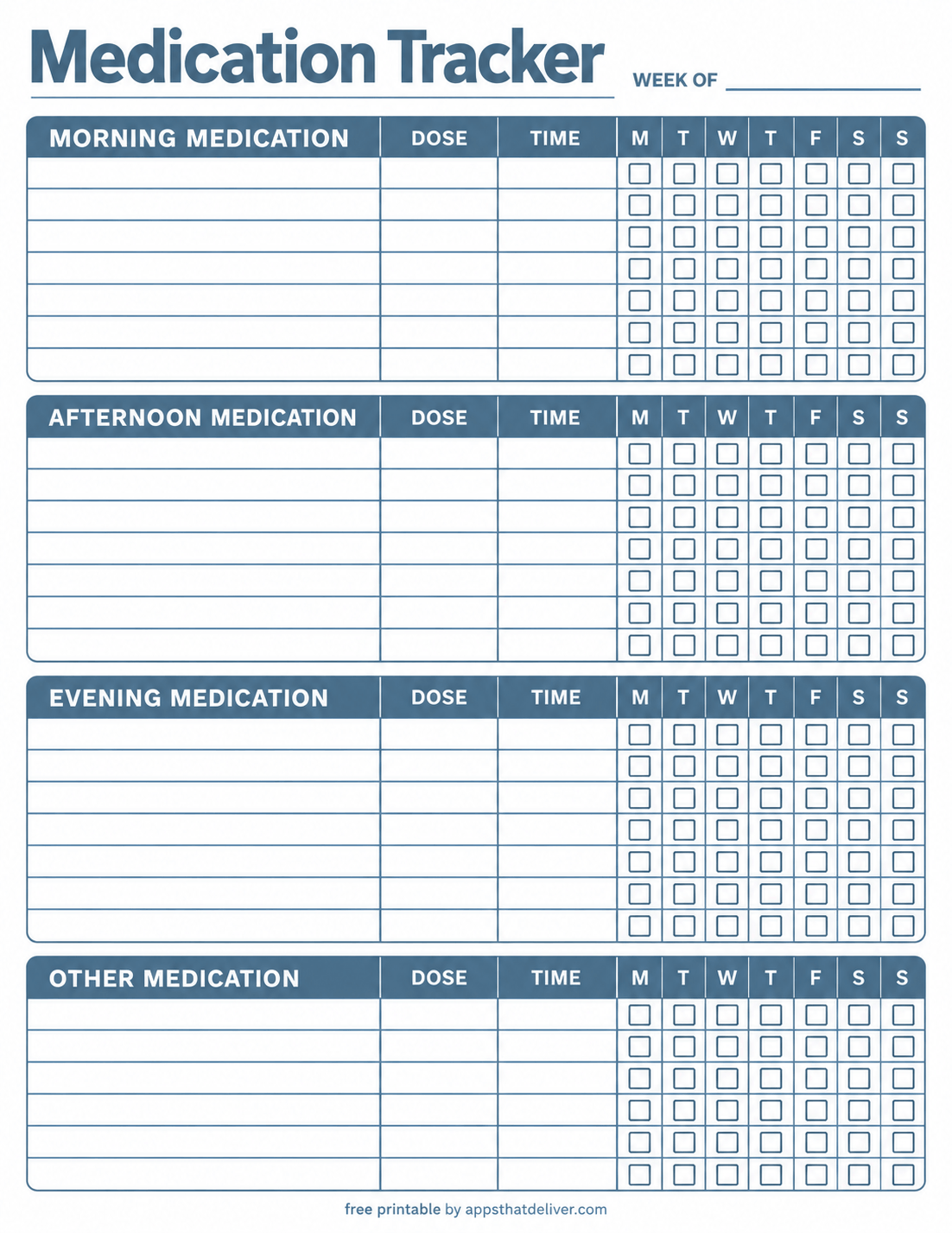
5. Weekly Medication Chart with Dose and Time Columns
If you prefer a simple, structured worksheet, this weekly medication chart printable provides a straightforward way to organize several medications.
The design includes four separate tables labeled Morning Medication, Afternoon Medication, Evening Medication, and Other Medication.
Each table has columns for medication, dose, and time, followed by seven daily tracking columns.
A Week Of field at the top lets you identify the tracking period. The black-and-white grid layout keeps the focus on clear writing spaces and checkboxes without unnecessary decoration.
This is a practical option when you want to organize medications by time of day while also recording the prescribed dose and scheduled time for each one.
The additional Other Medication section is useful for medicines that do not fit neatly into the morning, afternoon, or evening categories.
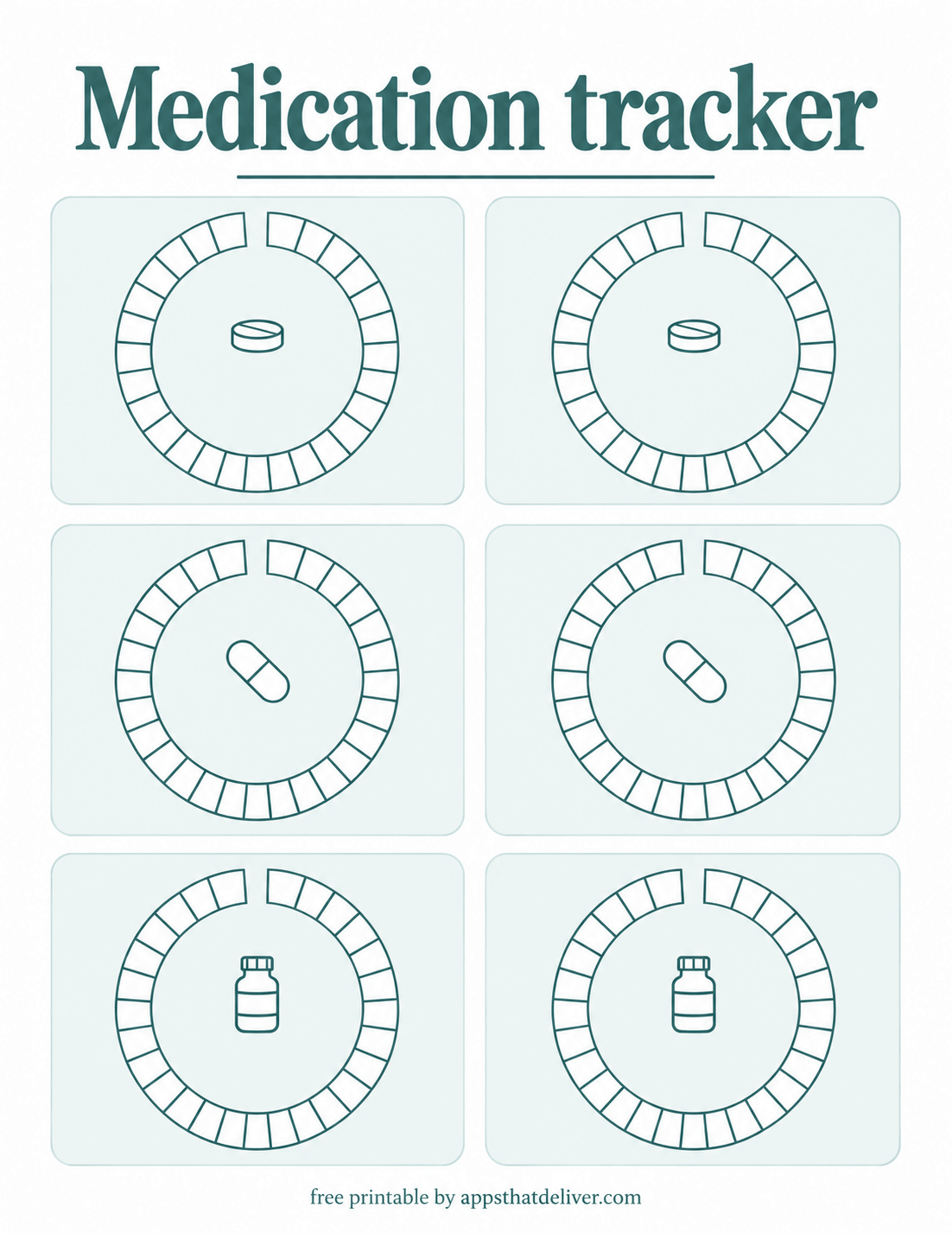
6. Circular Medication Tracker with Six Visual Tracking Wheels
This unique circular medication tracker printable replaces traditional checkboxes with six round tracking diagrams.
Each circle features small sections arranged around its outer edge, with a medication-related illustration in the center.
The six wheels are arranged in two columns and three rows, creating a balanced and uncluttered layout.
You can assign a purpose to each wheel and color or mark individual segments as you record medication activity. For example, you might use separate wheels for different medicines or tracking periods, provided you keep a clear written key for what each wheel represents.
This design is ideal for someone who enjoys visual progress tracking. Because the circles are not individually labeled with dates, medication names, or doses, it is best used alongside a more detailed medication record.
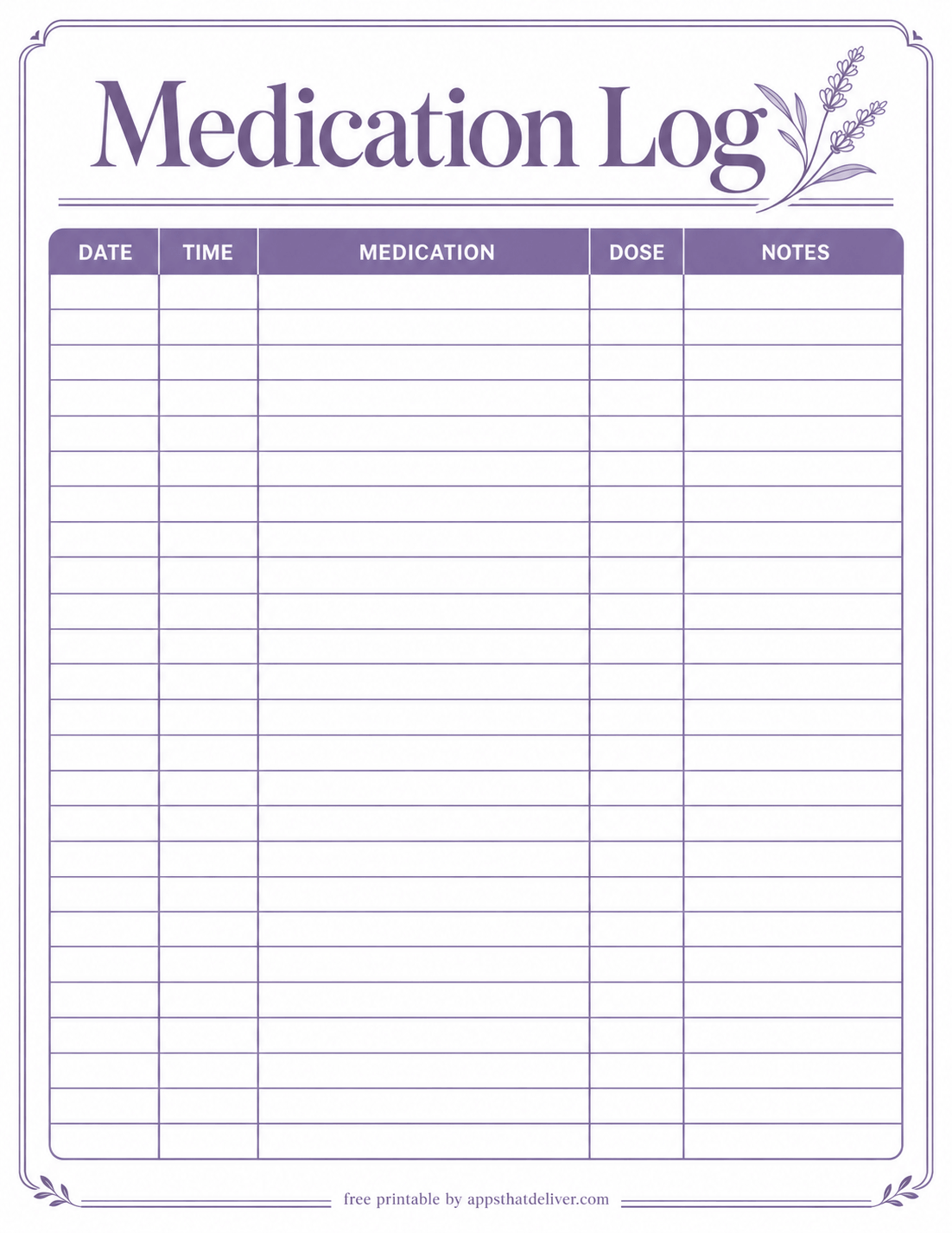
7. Printable Medication Log with Date, Time, Dose, and Notes
This minimalist medication log printable is designed for recording individual medication entries in a simple table.
The worksheet features five clearly labeled columns: Date, Time, Medication, Dose, and Notes.
Multiple blank rows run down the page, providing plenty of space for recording medications as they are taken.
Unlike a weekly medication checklist, this design is not limited to a particular week or month. You can continue adding entries in chronological order and start a new page whenever the current one is full.
The notes column can be used for relevant observations, questions, or other information you want to discuss with a healthcare professional.
This is an excellent choice when you need a straightforward written medication history rather than a prearranged weekly schedule.
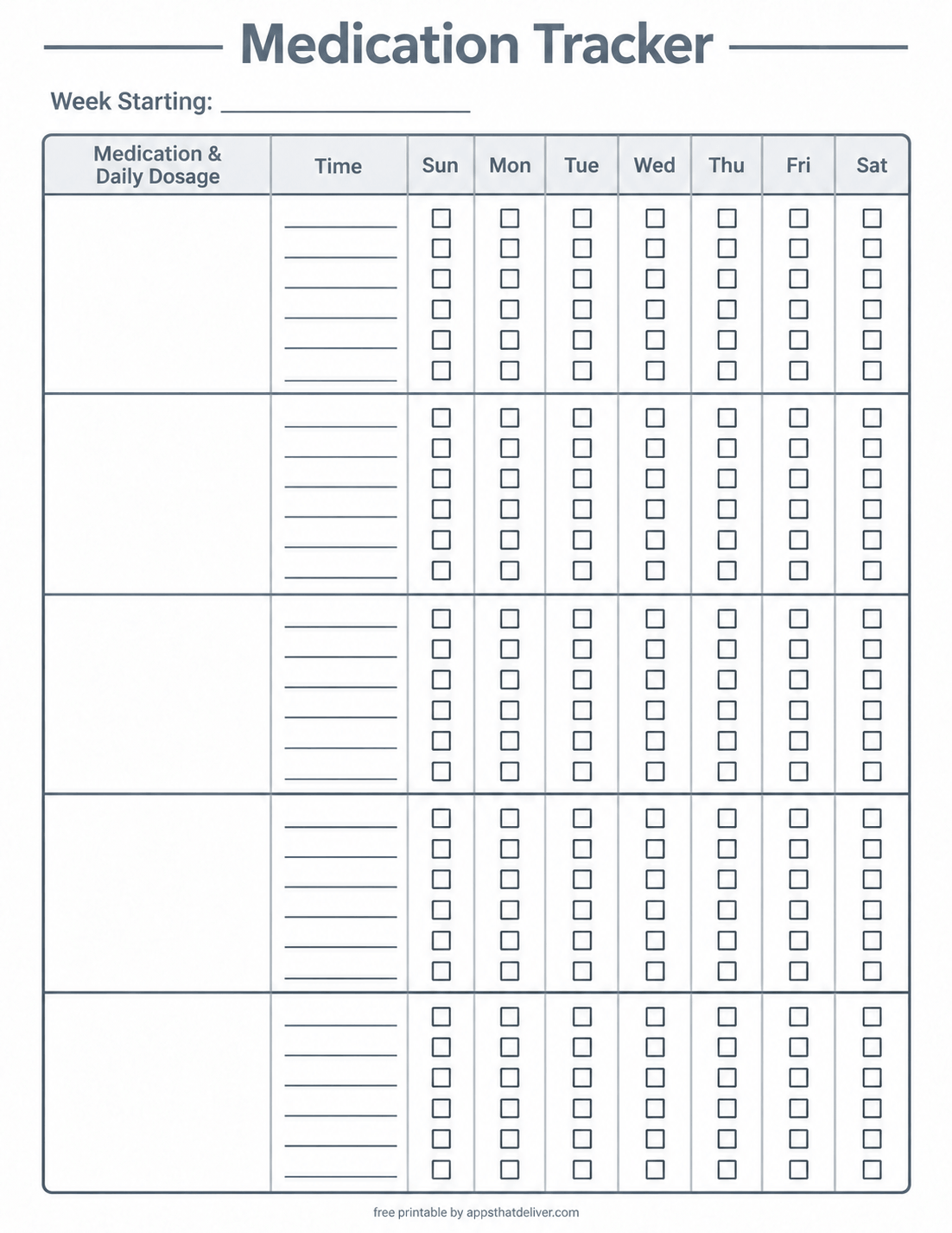
8. Weekly Medication Tracker with Multiple Daily Dosage Checkboxes
This detailed weekly medication tracking sheet provides space for recording several medication entries throughout each day.
At the top, there is a Week Starting field followed by a large table with columns for Medication & Daily Dosage, Time, and the seven days from Sunday through Saturday.
The main chart is divided into five horizontal medication sections. Each section provides several writing lines for scheduled times and corresponding checkboxes for every day of the week.
This arrangement is especially helpful when one medication needs to be recorded at multiple scheduled times during the day.
The clean black-and-white layout is easy to reproduce and keeps medication details, scheduled times, and daily tracking marks aligned.
Choose this template if you prefer a comprehensive weekly chart with multiple tracking opportunities for each medication.
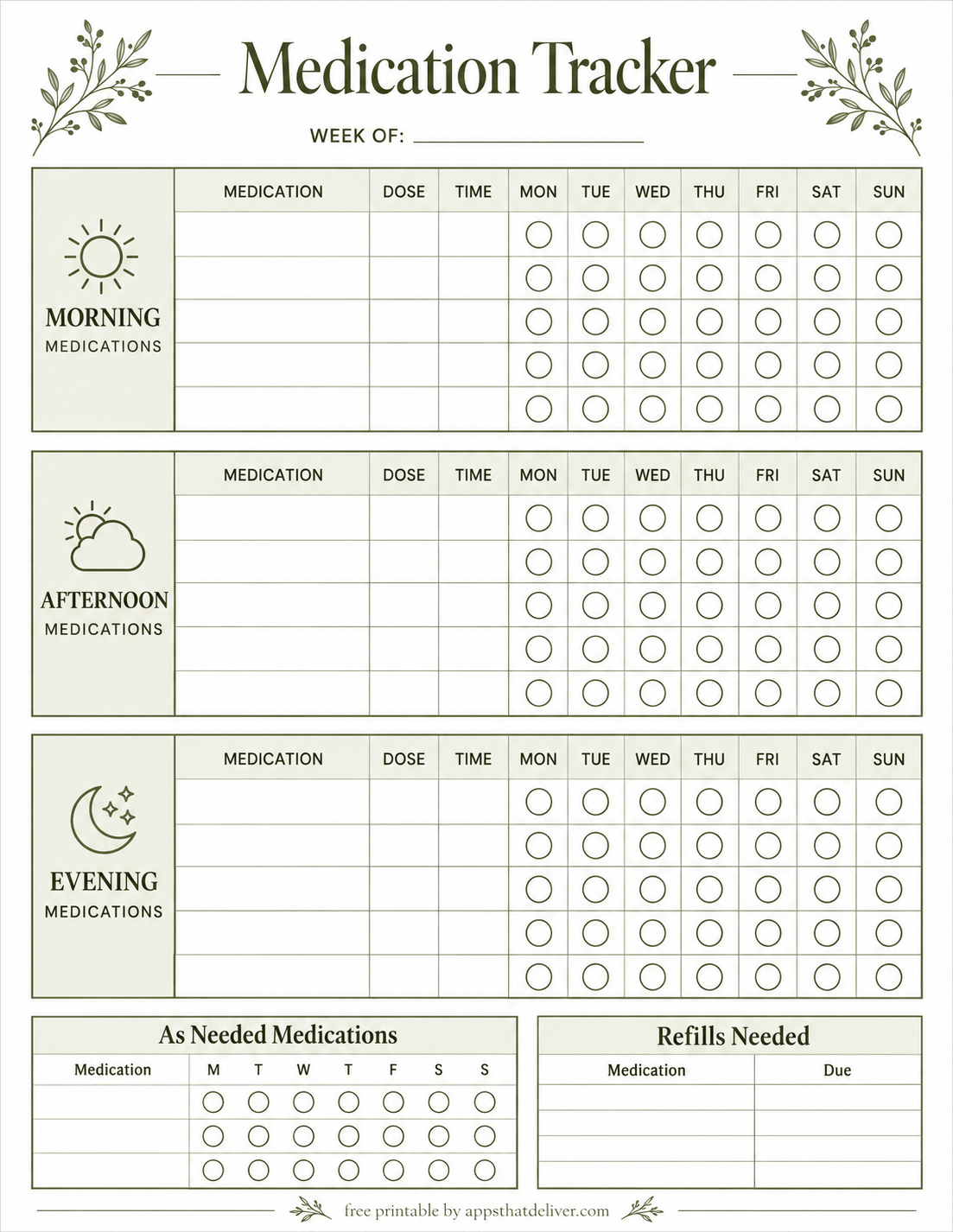
9. Floral Medication Tracker with Daily Schedule and Refill Reminders
This decorative weekly medication tracker printable combines a colorful floral design with several useful medication management sections.
The main worksheet includes three tables for Morning Medications, Afternoon Medications, and Evening Medications.
Each table contains columns for medication, dose, time, and the seven days of the week. The daily tracking spaces use empty circles that can be marked after recording a completed dose.
The morning section features a sun illustration, the afternoon section includes a weather-themed illustration, and the evening section uses a moon and stars. Soft pastel backgrounds distinguish the three medication schedules.
At the bottom, an As Needed Medications section provides additional tracking circles, while the Refills Needed section includes columns for medication and due information.
This is a lovely choice if you prefer a visually appealing medication chart that combines scheduled medication tracking with space for as-needed medicines and refill planning.
Which Medication Tracker Printable Should You Choose?
With nine different designs available, the best printable depends on your medication routine and the level of detail you want to record.
- For a simple monthly overview: Choose Tracker 1 for morning, afternoon, and evening pill symbols covering 31 days.
- For visual pill tracking: Tracker 2 offers numbered capsule illustrations, while Tracker 6 uses circular tracking wheels.
- For a weekly medication checklist: Tracker 3 combines daily checkboxes with refill tasks, questions, and notes.
- For separate morning, afternoon, and evening schedules: Trackers 4, 5, and 9 organize medications into distinct time-of-day sections.
- For a detailed medication history: Tracker 7 provides date, time, medication, dose, and notes columns.
- For multiple doses during the day: Tracker 8 provides several time entries and matching daily checkboxes within each medication section.
- For refill reminders and as-needed medications: Tracker 9 includes dedicated sections for both.
You can also use more than one printable. For example, a weekly medication chart can help organize scheduled medicines, while a separate medication log can provide a more detailed record of individual doses.
Daily vs. Weekly vs. Monthly Medication Trackers
Medication tracking worksheets generally serve different purposes depending on the time period they cover.
Daily Medication Logs
A daily medication log focuses on individual entries. You can record when a medicine was taken, the medication name, the dose, and any relevant notes.
This format is particularly useful when medication times vary or when you want a detailed chronological record.
Weekly Medication Trackers
A weekly medication tracker organizes information across seven days, usually with a row for each medication and a column for each weekday.
This format works well for recurring medication schedules because you can see the week’s recorded doses in one place.
Monthly Medication Trackers
A monthly medication tracker provides a broader view of medication activity across a calendar month.
These designs are useful for simple visual tracking, but they may not have enough space to record medication names, exact doses, or several scheduled times. If you need those details, combine the monthly tracker with a more complete medication chart.
What Information Should You Record on a Medication Tracker?
The information you record depends on your medications and the layout you choose. A detailed medication tracking sheet may include several important details.
- Medication name: The name of the medicine being tracked.
- Prescribed dose: The dose listed in the instructions from your healthcare professional or pharmacist.
- Scheduled time: The time the medication is supposed to be taken.
- Date: The day associated with the medication entry.
- Actual time taken: When the medicine was taken, if your chosen template has room to record it.
- Completion mark: A checkbox, circle, or symbol used to confirm a recorded dose.
- Notes: Relevant observations or questions to discuss with a healthcare professional.
- Refill information: Any upcoming refill tasks or due dates.
Not every printable in this collection includes every field. Choose a template that gives you enough room to record the information needed for your particular medication routine.
Tips for Keeping an Accurate Medication Record
A medication tracker is most useful when the information is clear, accurate, and updated consistently.
1. Keep Your Medication Information Current
Before starting a new tracker, review your medication list against your current prescription labels or instructions. If a healthcare professional changes a medicine, dose, or schedule, update your tracking information accordingly.
2. Record Doses When They Are Confirmed
Try to update the tracker when you can confirm that a medication was taken, rather than filling in several checkboxes from memory at the end of the day.
If you are uncertain whether a dose was taken, do not guess or take an extra dose simply to fill a blank checkbox. Follow the medication’s instructions or ask a pharmacist or healthcare professional what to do.
3. Use Clear and Consistent Markings
Choose a simple marking method and use it consistently. For example, you might check a box after a confirmed dose and leave the box unmarked when the status is unknown.
If you need to distinguish skipped, delayed, or uncertain doses, use a separate written note rather than assuming that an empty checkbox communicates the reason.
4. Keep Your Tracker Easy to Find
Store your printed tracker in a consistent, accessible location. A clipboard, folder, or binder can help keep the worksheet from getting misplaced.
Because medication information is personal, consider keeping completed pages somewhere private, especially when the tracker includes names or health-related notes.
5. Review Refill Needs Regularly
If your chosen printable includes a refill section, use it to record prescriptions that may need renewal or collection.
For medications that must be taken continuously, plan refills according to your pharmacy’s instructions rather than waiting until the supply has run out.
How to Organize Your Printed Medication Tracking Sheets
If you use medication trackers regularly, a simple filing system can make your records easier to manage.
For weekly trackers, you can keep completed pages in date order inside a binder. Monthly trackers can be organized by month, while individual medication logs can be filed chronologically.
It may also help to keep your current medication list separate from older tracking pages so you can quickly identify the latest prescribed schedule.
When preparing for a medical appointment, review your records and identify any questions or observations you want to discuss. Bring the relevant pages if they would help explain your medication history.
Frequently Asked Questions
Yes. This collection includes nine free medication tracker designs intended for PDF download and printing.
There are nine unique designs, including monthly pill trackers, weekly medication charts, a detailed medication log, circular trackers, and a floral medication schedule.
Trackers 3, 4, 5, 8, and 9 have separate medication rows and weekday tracking areas. Tracker 8 also provides multiple scheduled time entries within each medication section.
Yes. Trackers 1, 4, 5, and 9 include separate morning, afternoon, and evening tracking sections. Tracker 5 also includes an Other Medication section.
Yes. Trackers 1 and 2 provide numbered tracking spaces for days 1 through 31. The weekly designs can also be printed repeatedly to cover additional weeks.
Tracker 7 includes a dedicated Notes column for each medication entry. Tracker 3 also provides a Notes & Exceptions section and a separate area for questions.
Yes. Tracker 3 includes a Refills & Follow-Ups section, and Tracker 9 includes a Refills Needed table with medication and due columns.
Yes. You can use the blank tracking layouts to help maintain a written medication record for a family member. Confirm medication details and actual doses carefully, and follow instructions from the person’s healthcare professional.
Do not assume that an empty checkbox means the dose was missed, and do not take an additional dose based on a guess. Check the medication’s instructions or contact a pharmacist or healthcare professional for guidance.
Yes. You can print additional copies of your preferred template for each new week, month, or tracking period.
Final Thoughts
Keeping an accurate medication record doesn’t have to involve a complicated tracking system. Sometimes, a simple printed worksheet can make it easier to organize medicine information and maintain a consistent written record.
This collection includes 9 free medication tracker printables, ranging from simple 31-day pill trackers to detailed weekly medication schedules and daily logs.
Choose the design that fits your routine, download the corresponding PDF, and fill in the medication information you need to track.
Remember to follow your prescribed medication instructions and consult your healthcare professional whenever you have questions about doses, timing, or changes to your treatment.
Happy organizing!