

Most weeks don’t fall apart because of one big thing going wrong. They fall apart in small pieces — a forgotten errand, a chore nobody remembers assigning, a goal that quietly slides to “next week” for the third week in a row.
A weekly planner printable won’t fix a chaotic schedule on its own, but it gives you one place to put everything down before it gets lost in your head, your notes app, and four different sticky notes.
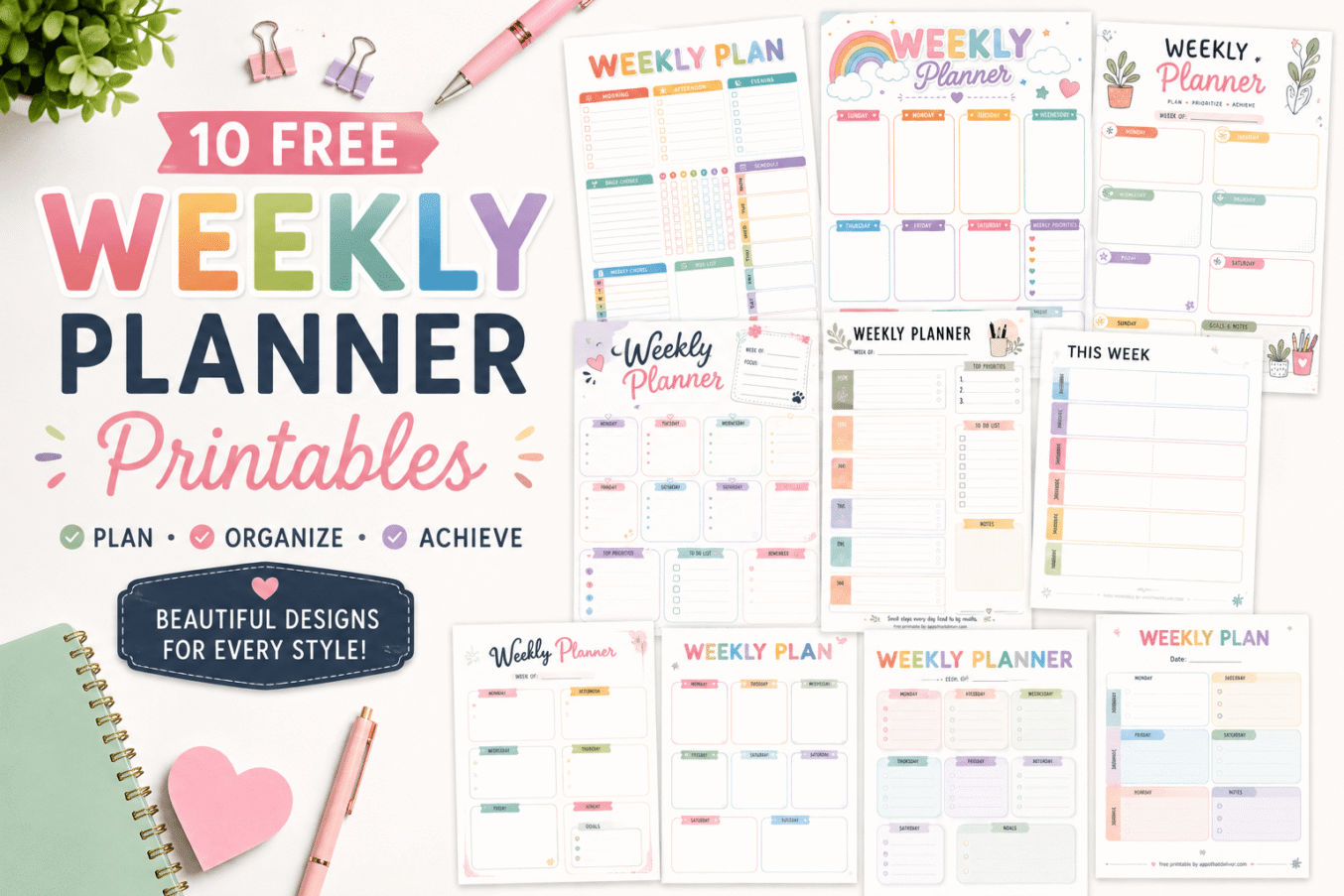
I put together this collection of 10 free weekly planner printables because not everyone plans the same way. Some people want a simple grid with seven boxes and nothing else. Others want a full system with priorities, a to-do list, chores, and a notes section all on one page.
So instead of giving you one planner, I made ten — in a range of layouts and styles, from clean and minimal to colorful and decorative — so you can pick the one that actually matches how you think.
They’re all free to download and print.
Trending Printables (links open in a new tab)
While you’re here, check out a few other free printables from the site:
- 10 Free Consequence Chart Printables for Kids & Teens
- 8 Free Brain Dump Printables & Worksheets (PDF)
- 7 Free Healthy Eating Tracker Printables for Kids
- 10 Cute Budget Planner Printables for Kids (Free PDF)
- 13 Free Printable Chore Chart PDFs
What Is a Weekly Planner Printable?
A weekly planner printable is a single-page PDF, sized to print on standard letter paper (8.5 x 11 inches), that lays out all seven days of the week in one place so you can plan, track, and review at a glance.
Depending on the layout, a weekly planner might just be seven blank boxes for you to fill in however you like, or it might be broken down further into sections for priorities, a to-do list, goals, chores, or notes.
Unlike a digital calendar, a printable planner sits somewhere you’ll actually see it — taped to a wall, clipped to a fridge, or sitting open on a desk — instead of buried behind a lock screen you have to actively open to check.
Some people fill one out at the start of every week and let it guide them. Others prefer to use it more loosely, jotting things down as the week goes and crossing them off as they’re done. Either way works — the printable is just the container.
Why Use a Printable Weekly Planner?
Planning apps are great, but they’re not always the right tool. A printable weekly planner has a few advantages that a phone or software calendar doesn’t.
- Gives you a visual overview of the whole week in one glance
- Keeps you off your phone while you’re planning
- Makes it easier to see what’s realistic and what’s overloaded
- Helps separate priorities from everyday to-dos
- Gives kids, teens, and adults a shared, simple format to plan with
- Doesn’t rely on notifications you can ignore or swipe away
- Can be pinned up somewhere visible for the whole household or team
- Gives you a physical record you can look back on later
None of this means digital planning is wrong — plenty of people use both. But there’s something about physically writing “laundry” or “finish report” in a box that makes it feel more real than typing it into an app.
What’s Included in This Collection?
There are 10 free weekly planner printables in this collection — each one a letter-size PDF you can download and print right away — and each has a slightly different layout and purpose:
- Morning, Afternoon & Evening Weekly Plan
- Rainbow Weekly Planner
- Botanical Weekly Planner
- Focus Card Weekly Planner
- Leaf & Flower Icon Weekly Planner
- “This Week” Minimalist Planner
- Washi Tape Weekly Planner
- Ribbon Banner Weekly Plan
- Sunshine Weekly Planner
- Colorful Block Weekly Plan
Some of these are dense, all-in-one systems with room for chores, goals, and notes. Others are deliberately simple, with nothing but a blank box for each day. Scroll down to see all ten and pick whichever fits how you actually plan.
10 Free Weekly Planner Printables
1. Morning, Afternoon & Evening Weekly Plan
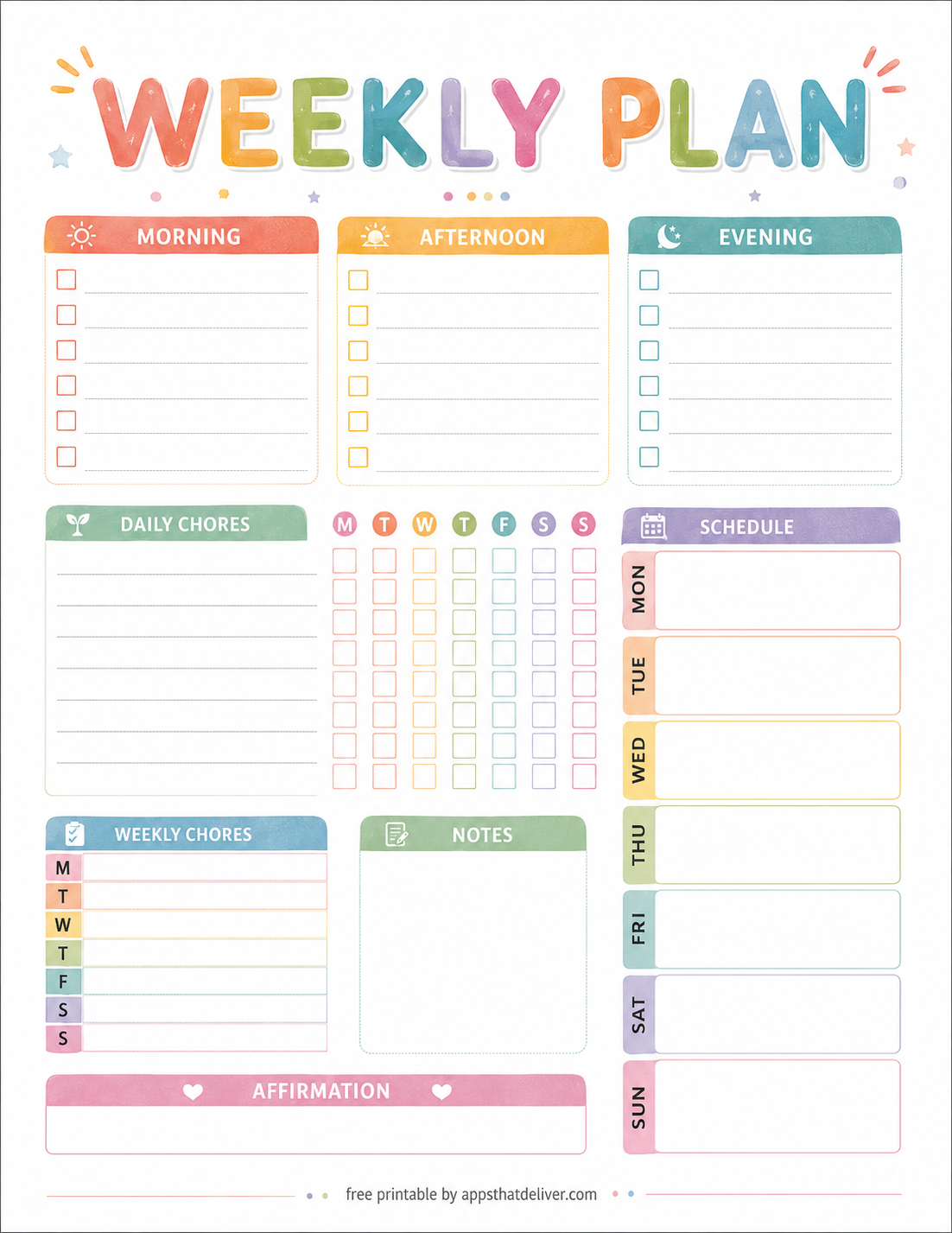
This is the most complete planner in the collection, and it’s the one to reach for if you want a single page that covers everything instead of juggling several sheets.
The top splits your day into Morning, Afternoon, and Evening checklists, so you’re not cramming a whole day’s tasks into one block. Below that is a Daily Chores tracker with a checkbox grid running Monday through Sunday, a full Mon–Sun Schedule column, a separate Weekly Chores list, a Notes box, and an Affirmation banner along the bottom.
Because it combines a daily routine tracker, a chore chart, and a weekly schedule in one layout, it works well as a shared family planner stuck to the fridge, or as a one-page command center for someone managing a lot of moving parts.
Good for: families, daily routines, chore tracking, and anyone who wants one page instead of five
2. Rainbow Weekly Planner
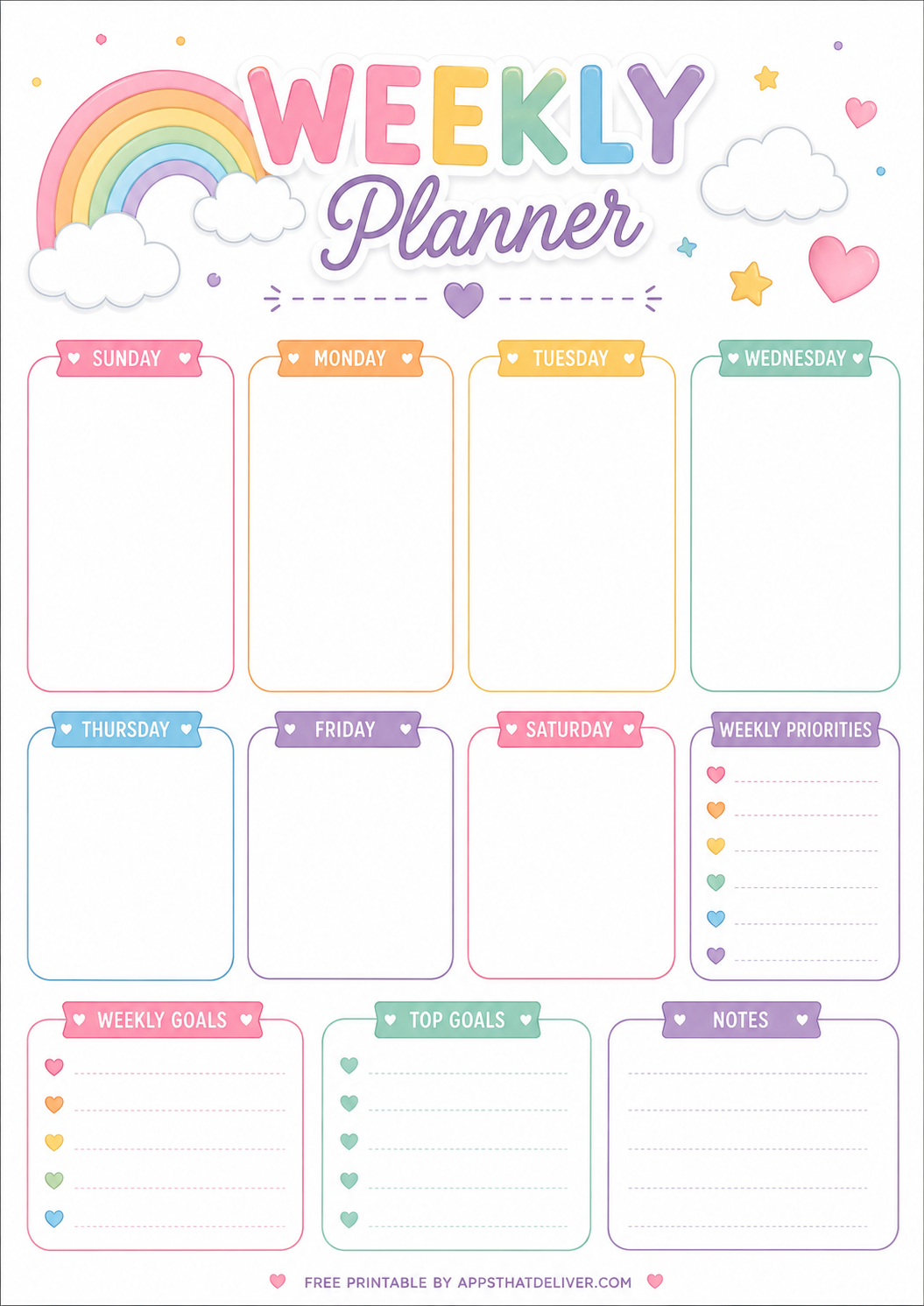
This planner leads with a rainbow, clouds, and hearts across the top, and it’s the most playful design in the set without losing any real planning function.
All seven days get their own labeled box — Sunday through Saturday — arranged in a simple grid with plenty of blank space to write in. Below the days, there’s a dedicated Weekly Priorities section with six lines, plus separate boxes for Weekly Goals, Top Goals, and Notes.
Splitting priorities, goals, and to-dos into their own sections is what makes this one useful beyond just looking nice — it forces you to actually decide what matters most for the week instead of treating every task the same.
Good for: kids, teens, goal-setting, and anyone who wants a planner that feels a little more fun to fill out
3. Botanical Weekly Planner
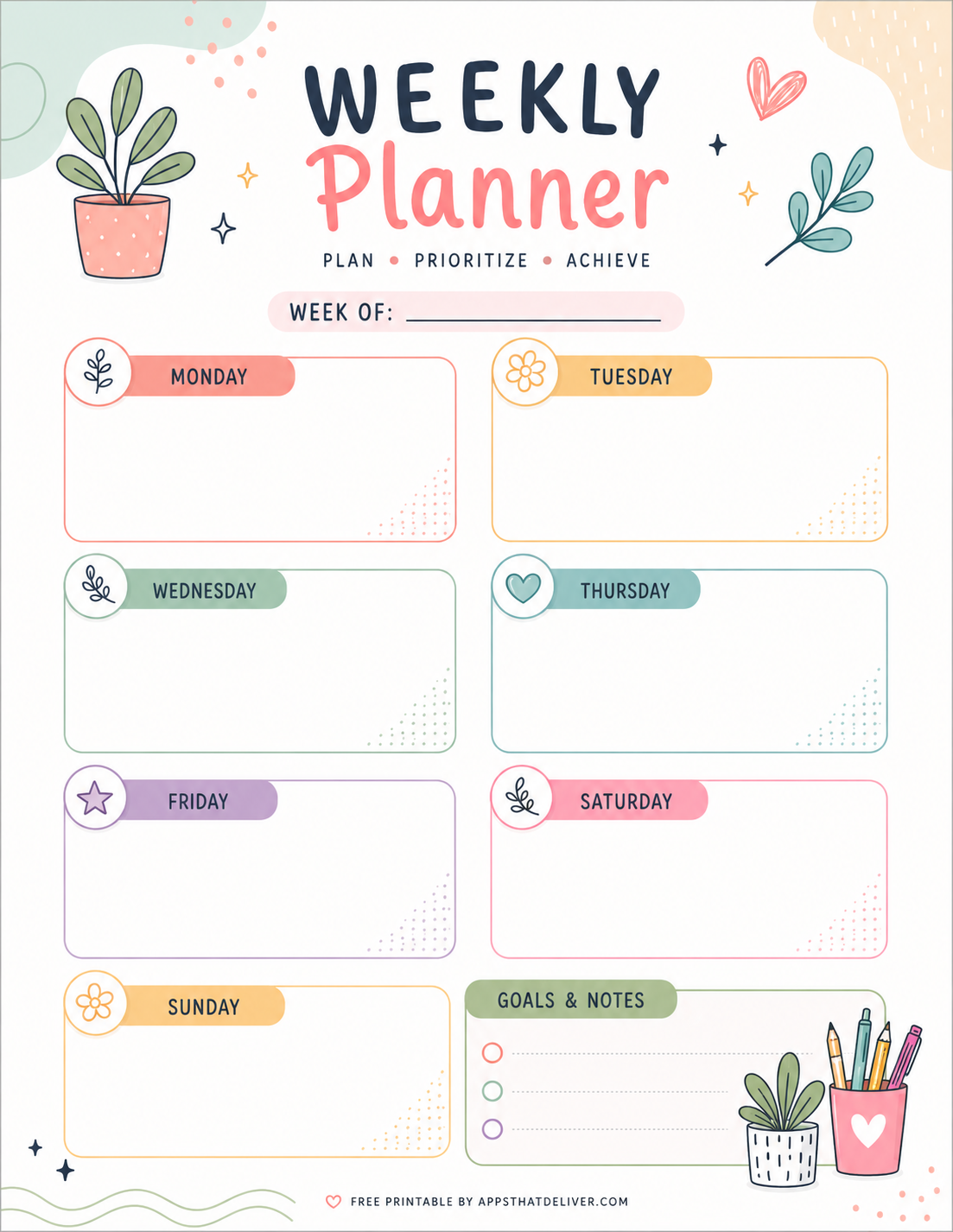
With a potted plant, soft sage and blush colors, and a “Plan • Prioritize • Achieve” tagline under the title, this one leans into a calmer, more grown-up aesthetic than a typical kids’ planner.
There’s a “Week Of” line at the top to date each page, followed by Monday through Sunday laid out in a two-column grid, each day marked with a small botanical icon — a leaf, a flower, a star, or a heart. A combined Goals & Notes section at the bottom rounds it out.
Because each day gets its own generously sized box rather than a tiny sliver, it works well if you tend to write more than a couple of words per day, or if you like a bit of open space to sketch out a rough schedule rather than a strict list.
Good for: a calm, minimal aesthetic, journaling-style planning, and anyone who likes a bit of open space
How to Pick the Right Weekly Planner for You
With ten different layouts to choose from, it helps to think about how you actually plan before picking one, rather than just going with whichever looks the prettiest.
If you tend to write long notes for each day — appointments, meal ideas, reminders — you’ll want a layout with big, open boxes rather than a page packed with small sections. If you’re the type who plans in short bursts of two or three words per task, a more structured layout with priorities, a to-do list, and a notes section separated out will probably serve you better.
It’s also worth thinking about who else might use the page. A planner going up on a family fridge benefits from clear day labels and a chores section everyone can glance at. A planner that’s just for you can be as minimal or as detailed as you want, since you’re the only one who has to make sense of it.
There’s no rule that says you have to stick with one style forever, either. A lot of people rotate between a few different printables depending on how busy a particular week looks.
4. Focus Card Weekly Planner
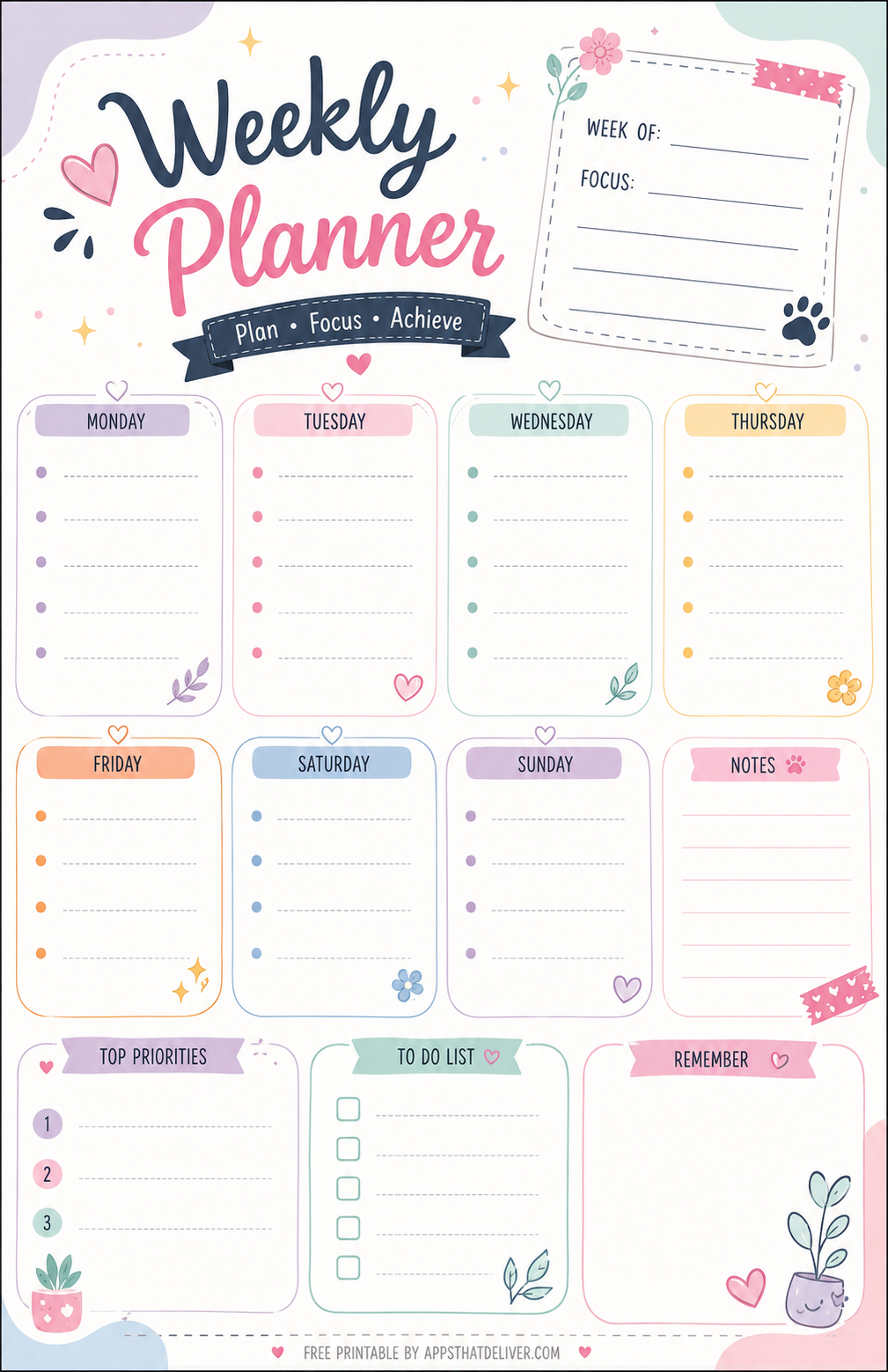
This layout stands out because of the little “Week Of / Focus” note card in the top corner, styled like a sticky note held down with washi tape and a small paw print. It’s a nice touch if you like to name one main focus for the week before diving into the daily details.
Monday through Sunday are laid out in a compact grid with bulleted lines for each day, followed by a Notes box. Below that sits a dedicated Top Priorities list numbered one through three, a To-Do List with checkboxes, and a “Remember” box for anything you don’t want to forget.
Separating your top three priorities from your general to-do list is a small detail that makes a real difference — it stops your most important tasks from getting buried under smaller errands.
Good for: setting a weekly focus, prioritizing top tasks, and pet lovers who like the small paw print detail
5. Leaf & Flower Icon Weekly Planner
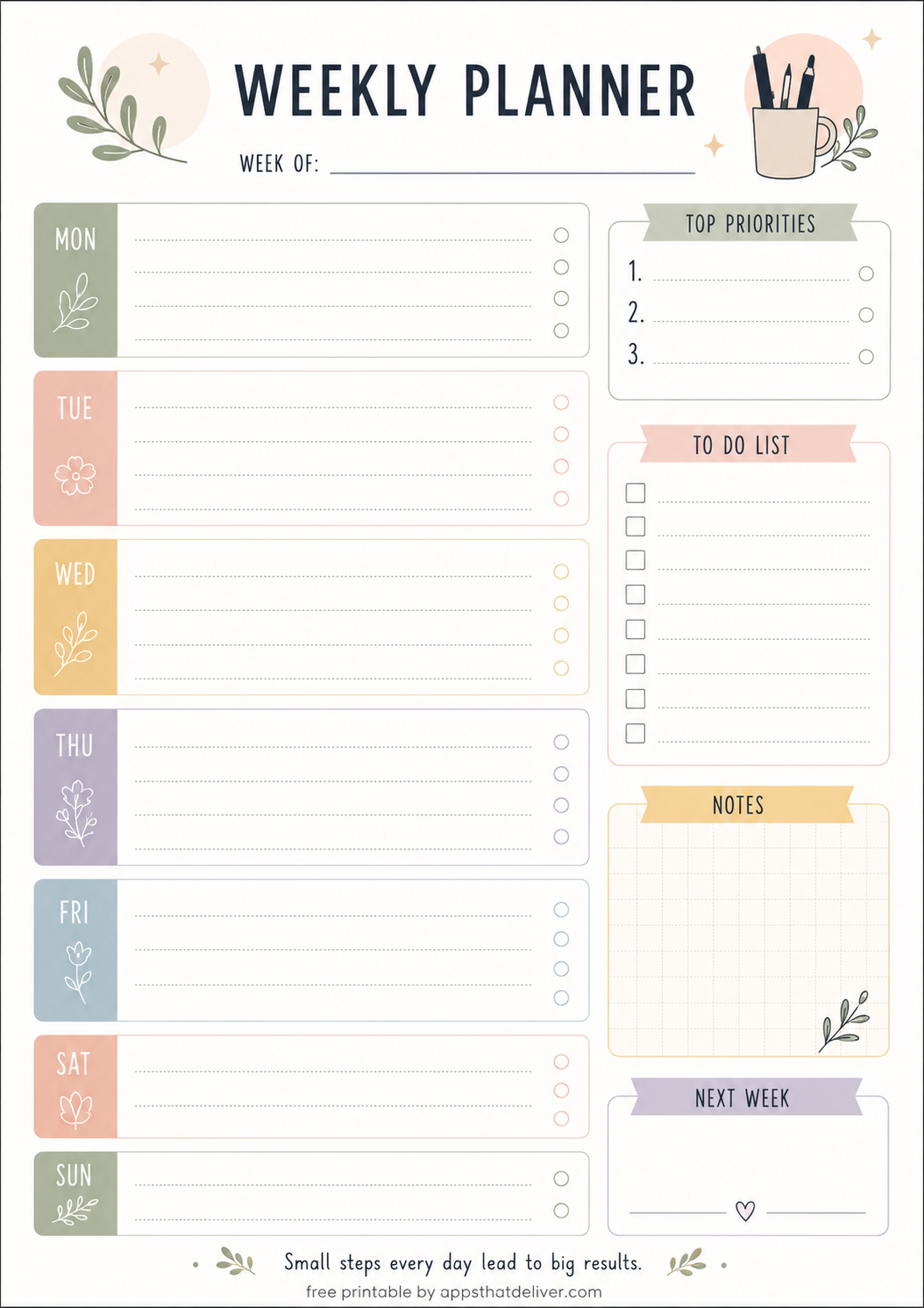
This is the most side-panel-heavy planner in the collection, and it’s a good pick if your week involves more than just daily tasks — things you also want to track separately, like priorities and an ongoing to-do list.
Monday through Sunday run down the left side in colored blocks, each labeled with a small botanical icon and a handful of circle-checkbox lines. The right side is where this one earns its keep: a Top Priorities list, a longer To-Do List, a lined Notes section, and a small Next Week box so you can jot down anything that needs to carry over.
That Next Week box is a small but genuinely useful feature — instead of losing a good idea or a task you didn’t get to, you have a built-in place to park it before you even start next week’s page.
Good for: people juggling several ongoing tasks, planning ahead, and anyone who likes a clear priorities-plus-to-do split
6. “This Week” Minimalist Planner
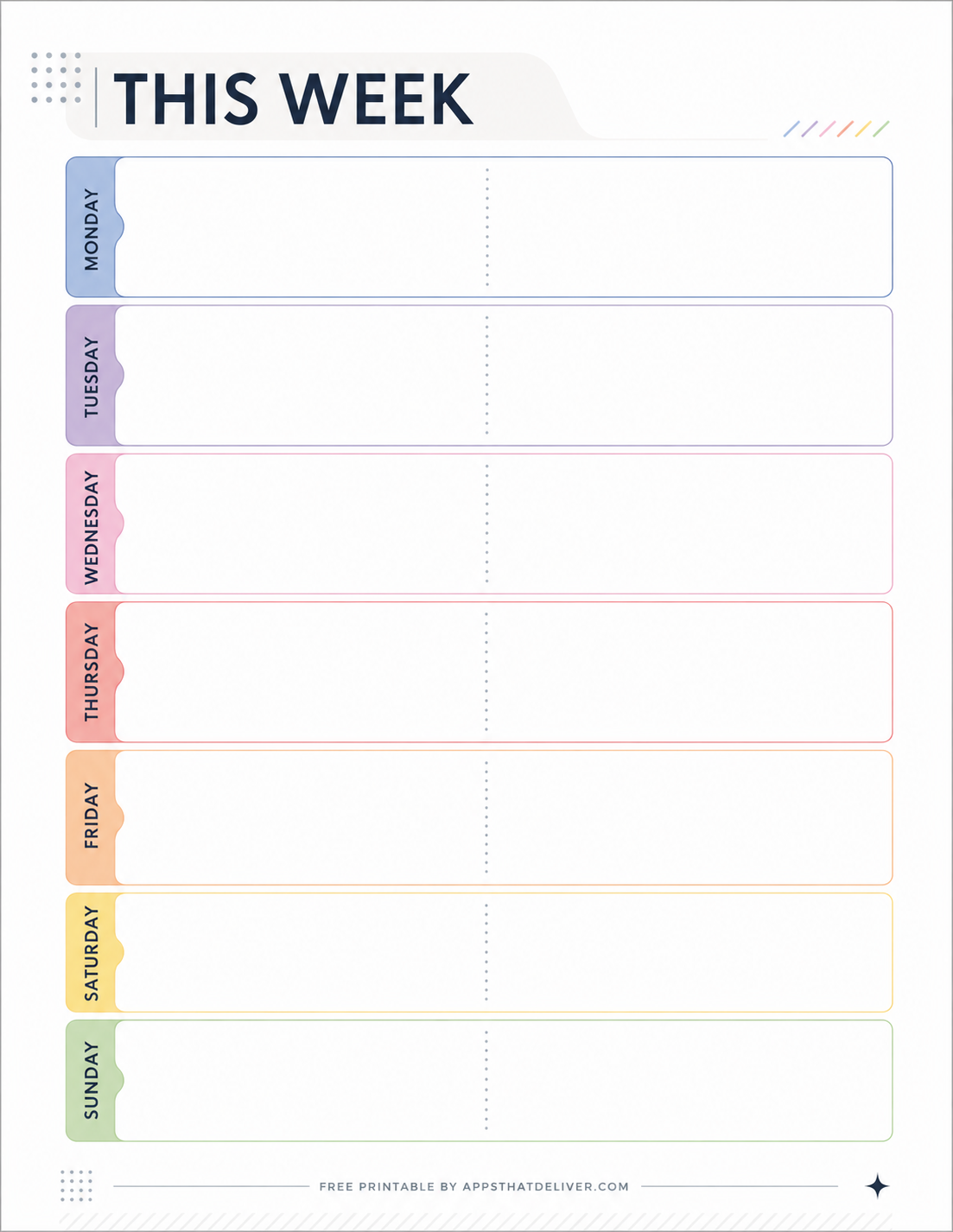
If most of the printables in this list feel a little too busy, this is the one to reach for. It strips everything down to seven large boxes, one for each day, with a bold “THIS WEEK” header and a small dotted vertical line running down the middle of each box.
That dotted line is subtle but useful — it gives you a natural way to split each day into two halves, whether that’s morning and afternoon, work and personal, or just “must do” and “nice to do,” without the page telling you exactly how to use it.
There are no extra sections for goals, notes, or chores here, and that’s the point. It’s meant for people who already know how they want to plan and just need the space to do it, without a template dictating the categories.
Good for: minimalists, people who plan their own way, and anyone who finds busy templates distracting
Printable vs. Digital Planners: Which Should You Use?
It’s a fair question, especially since most of us already carry a calendar app everywhere we go. But printable and digital planners tend to solve different problems, and a lot of people end up using both.
A digital calendar is better at handling recurring events, reminders with notifications, and anything that needs to sync across multiple devices. A printable planner is better at giving you a single, distraction-free view of the week — one that doesn’t ping you with an email the second you open it.
There’s also a research-backed reason handwriting tends to stick better than typing: writing something down by hand takes slightly longer, and that extra bit of effort seems to help people remember it and actually follow through. A lot of people find they’re simply more likely to do the thing they wrote by hand on a page they can see, versus a task buried in the fortieth item of an app list.
If you’re not sure which approach fits you, try printing one of these planners and using it alongside your phone calendar for a couple of weeks. You’ll usually know pretty quickly which one you actually reach for.
7. Washi Tape Weekly Planner
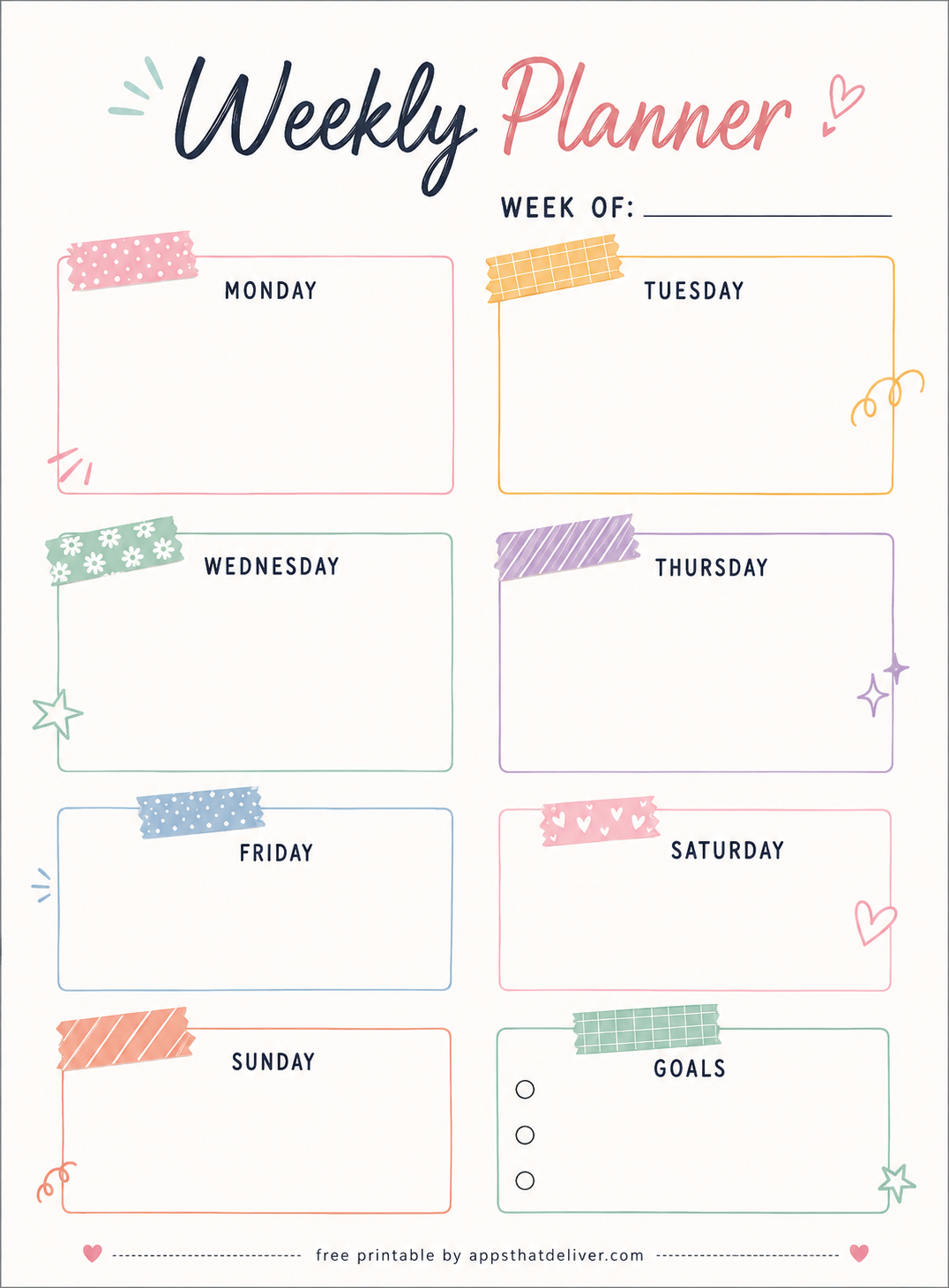
This planner is designed to look like a page in a scrapbook or bullet journal, with each day’s box “held down” by a different pattern of hand-drawn washi tape — polka dots, gingham, daisies, stripes, and hearts.
Monday through Sunday are arranged in a simple two-column grid, each box left open with no lines or bullet points inside, so you can write, doodle, or list things however you like. A Goals box with three circles sits alongside Sunday to close out the page.
Because the boxes are completely open, this one works especially well for people who like to combine a bit of journaling with their planning — adding small doodles, quotes, or notes alongside the actual tasks.
Good for: journaling-style planning, scrapbook lovers, and anyone who wants open space instead of lines
8. Ribbon Banner Weekly Plan
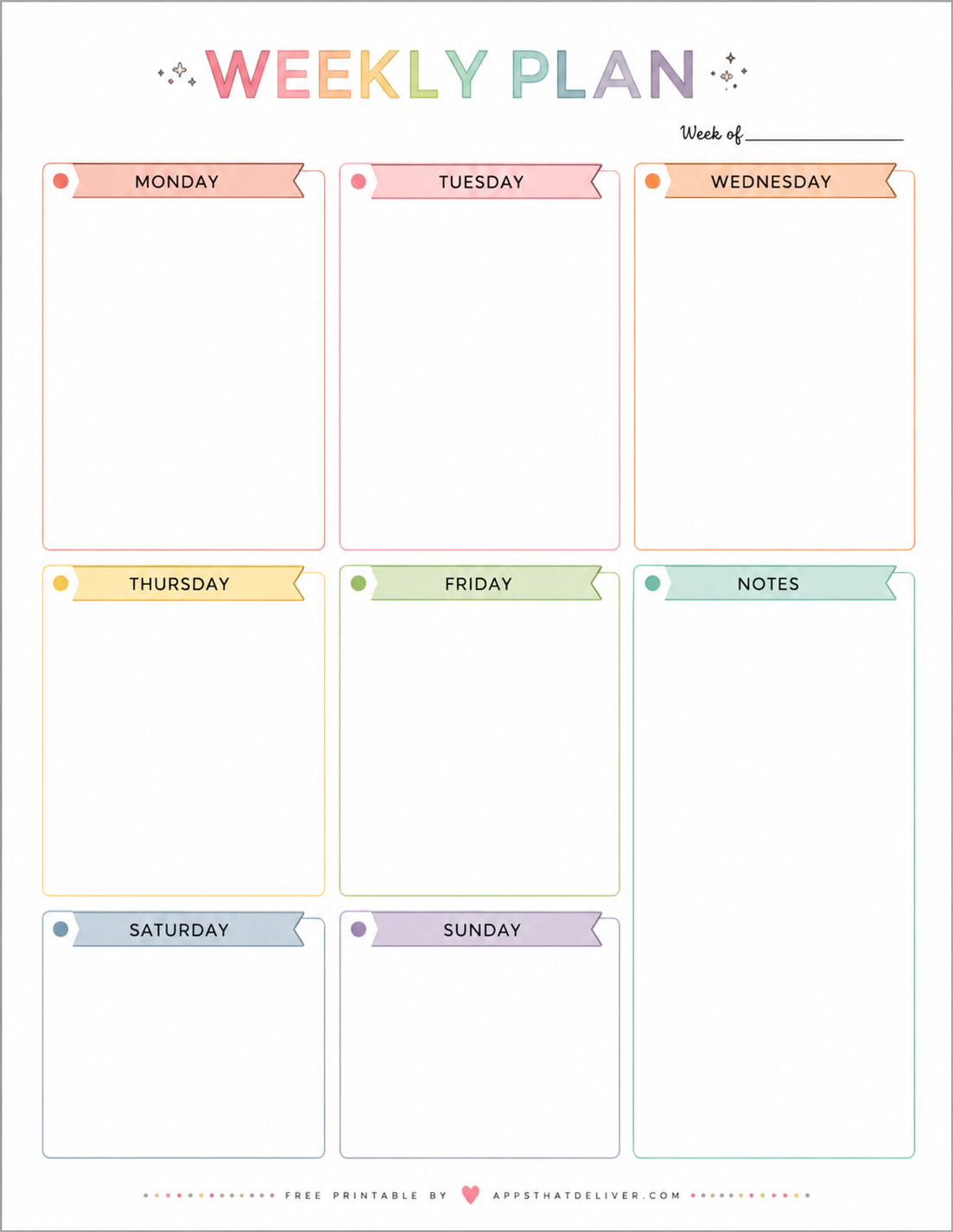
Each day on this planner gets its own colored flag-style banner header, which makes the page easy to scan even from across a room — useful if it’s going up somewhere shared, like a kitchen wall or a classroom.
Monday through Friday sit across the top two rows in large open boxes, with Saturday, Sunday, and a dedicated Notes box filling out the bottom row. Weekdays get more visual weight than the weekend, which fits how a lot of people actually plan — more structure on workdays, more flexibility once the weekend hits.
The larger Notes box is a nice addition here too, giving you somewhere to jot down anything that doesn’t belong to a single day — a shopping list, a reminder, or something you want to plan for the following week.
Good for: shared spaces, workweek-focused planning, and anyone who wants a page that’s easy to read at a glance
Tips for Actually Sticking to Your Weekly Plan
Printing a planner is the easy part. Actually using it every week is where most people fall off, so here are a few things that make it more likely to stick.
- Fill it out at the same time every week, like Sunday evening or first thing Monday morning.
- Keep it somewhere you’ll actually see it, not tucked away in a drawer or folder.
- Don’t overfill every box — leave a little room for things that come up during the week.
- Cross things off as you go instead of waiting until the end of the day.
- If a printable isn’t working for you after a couple of weeks, switch to a different layout rather than forcing it.
- Keep completed pages for a month or two if you want to spot patterns in how your weeks actually go.
The goal isn’t a perfectly filled-in page. It’s having somewhere to put things down so they’re not just floating around in your head all week.
9. Sunshine Weekly Planner
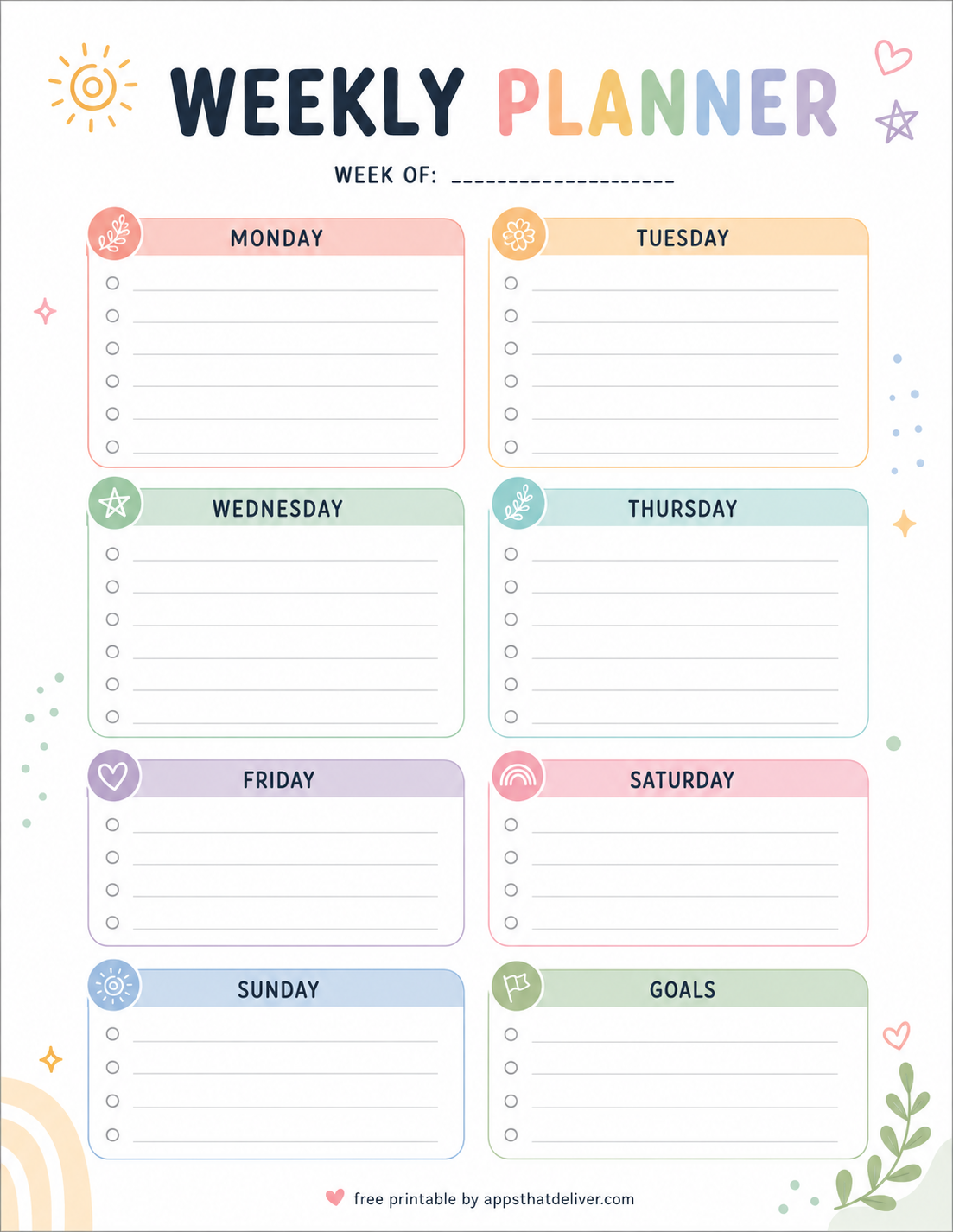
With a bright sun in the corner, a rainbow along the bottom, and a different colored icon marking each day — a leaf, a flower, a star, a heart, a rainbow, and a sun — this is the most cheerful planner in the collection.
Monday through Sunday are laid out in a two-column grid, and each day gets five circle-checkbox lines to fill in. An eighth box for Goals rounds out the bottom row, so you have somewhere to note the bigger picture alongside the day-to-day tasks.
The consistent five-line format for every day makes this one easy to fall into a rhythm with — you’re not stuck guessing how much to write for each day, since the layout naturally keeps things to a manageable list.
Good for: a bright, cheerful look, consistent daily task lists, and anyone who likes a bit of color on their planner
10. Colorful Block Weekly Plan
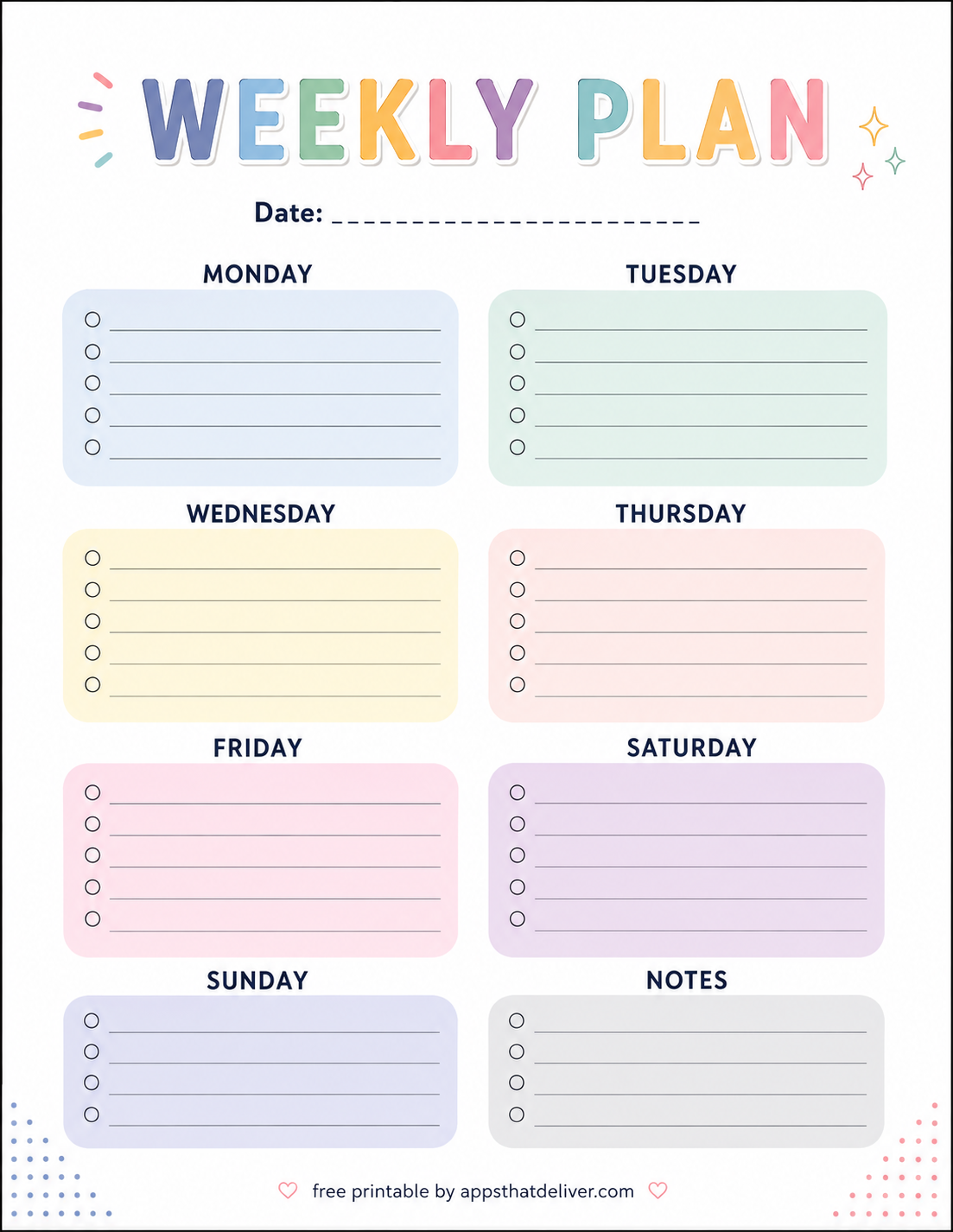
This final printable rounds out the collection with a clean, evenly balanced grid — Monday through Sunday plus a Notes box, each in its own soft pastel block with five circle-checkbox lines.
What makes this layout stand out is how evenly it treats every day, including the Notes section, which gets exactly the same amount of space as a regular day instead of being squeezed into a leftover corner.
It’s a solid all-around choice if you don’t need a lot of extra sections but still want more structure than a completely blank box — a good middle ground between the minimalist “This Week” planner and the busier, section-heavy layouts earlier in this list.
Good for: balanced daily planning, a dedicated notes section, and anyone who wants color without clutter
How to Use a Weekly Planner Printable
There’s no single correct way to fill one of these out, but a simple routine tends to work better than trying to plan the whole week in one rushed sitting.
- Pick your day. Choose one consistent day to sit down and plan the week ahead, whether that’s Sunday evening or Monday morning.
- Start with fixed commitments. Write down anything that already has a set time — appointments, work meetings, school events.
- Add your priorities. Before filling in every small task, decide on the two or three things that matter most this week.
- Fill in the rest. Add errands, chores, and smaller to-dos around your fixed commitments and priorities.
- Leave some room. Don’t pack every box completely full — unexpected things always come up during the week.
- Check in daily. Glance at the page each morning and cross things off as you go instead of only at the end of the day.
- Review at the end of the week. Notice what didn’t get done and decide whether it needs to move to next week or drop off entirely.
It doesn’t need to be perfect every week. Even a partially filled-in page is more useful than trying to keep the whole week in your head.
How to Print These Weekly Planners
All ten of these are letter-size PDF files (8.5 x 11 inches). Download the version you want, save it to your device, and print it at home or through a local print shop.
For the best results, print on standard letter-size paper at 100% scale (“actual size,” not “fit to page”) so the spacing and boxes line up the way they’re designed to. If you’re outside the US and only have A4 paper on hand, most printers can scale a letter-size PDF down to fit an A4 sheet automatically. If you’d like to reuse the same planner every week instead of printing a fresh copy, slide it into a clear sheet protector and fill it in with a dry-erase marker.
You can also print a few different styles and try each one for a week or two before deciding which layout fits you best.
Frequently Asked Questions
Yes. All 10 weekly planner printables in this collection are free PDF downloads. You can download and print as many as you like.
A weekly planner printable is a single printable page that lays out all seven days of the week, giving you a place to write down tasks, appointments, priorities, and notes at a glance.
Yes. These weekly planner printables work well for household planning, school schedules, personal goals, and general work tasks. A few also include chore tracking and priority sections that are useful for shared family or classroom use.
No. These are letter-size PDF files (8.5 x 11 inches) designed to print on a standard home or office printer using regular letter paper. A color printer will show the pastel designs best, but they will also print fine in black and white.
Yes. You can print a fresh copy each week, or slide one printable into a clear sheet protector and fill it in with a dry-erase marker so you can wipe it clean and reuse it.
A weekly planner shows all seven days on one page, which makes it easier to see the whole week at a glance and balance tasks across days. A daily planner usually gives one page to a single day with more room for hour-by-hour detail.
The ‘This Week’ Minimalist Planner or the Colorful Block Weekly Plan are good starting points, since both are simple, easy to fill in, and don’t require you to learn a whole system before you can start using them.
These are provided as printable PDFs meant to be filled in by hand after printing. If you’d like to write on them digitally, you can open the PDF in a note-taking or annotation app that supports handwriting on PDFs and use it on a tablet instead of printing it.
Think about how much detail you usually write for each day and whether you want extra sections like priorities, chores, or notes. Open, minimal layouts suit people who write a lot per day, while structured layouts with separate sections suit people who prefer short, organized lists.
Yes. The Rainbow Weekly Planner and Sunshine Weekly Planner are especially well suited to kids and teens, with playful colors and simple sections for goals and priorities. The other, more minimal designs work well for teens and adults who prefer a plainer look.
Final Thoughts
You don’t need a complicated system to get more organized. Most of the time, you just need one page where everything lives, instead of scattered across your head, your phone, and a handful of sticky notes.
That’s really all these printables are — a place to put the week down on paper so you can see it clearly, decide what actually matters, and move through it with a little less scrambling.
Whether you want a full command center like the Morning, Afternoon & Evening planner, something playful like the Rainbow Weekly Planner, or a completely blank canvas like the “This Week” Minimalist Planner, there’s a layout in this collection built for how you actually plan.
You don’t have to commit to one forever. Print a few, try them out for a week or two each, and keep whichever one you find yourself actually reaching for.
And since all 10 are free, there’s nothing stopping you from testing them all.
Pick your favorite weekly planner, print it today, and start giving your week a little more shape.