

Nursing school throws a new disease at you every week, and it’s easy for the details to blur together — which labs actually confirm it, which symptoms show up first, which interventions come before which. A blank page of notes doesn’t fix that. A structured template does.
These templates won’t study for you, but they force the same questions onto the page every time: what causes this, how does the body respond, what do you see, what do you do about it. Fill one out per disease and you’ve built yourself a study guide you can flip through the night before an exam.
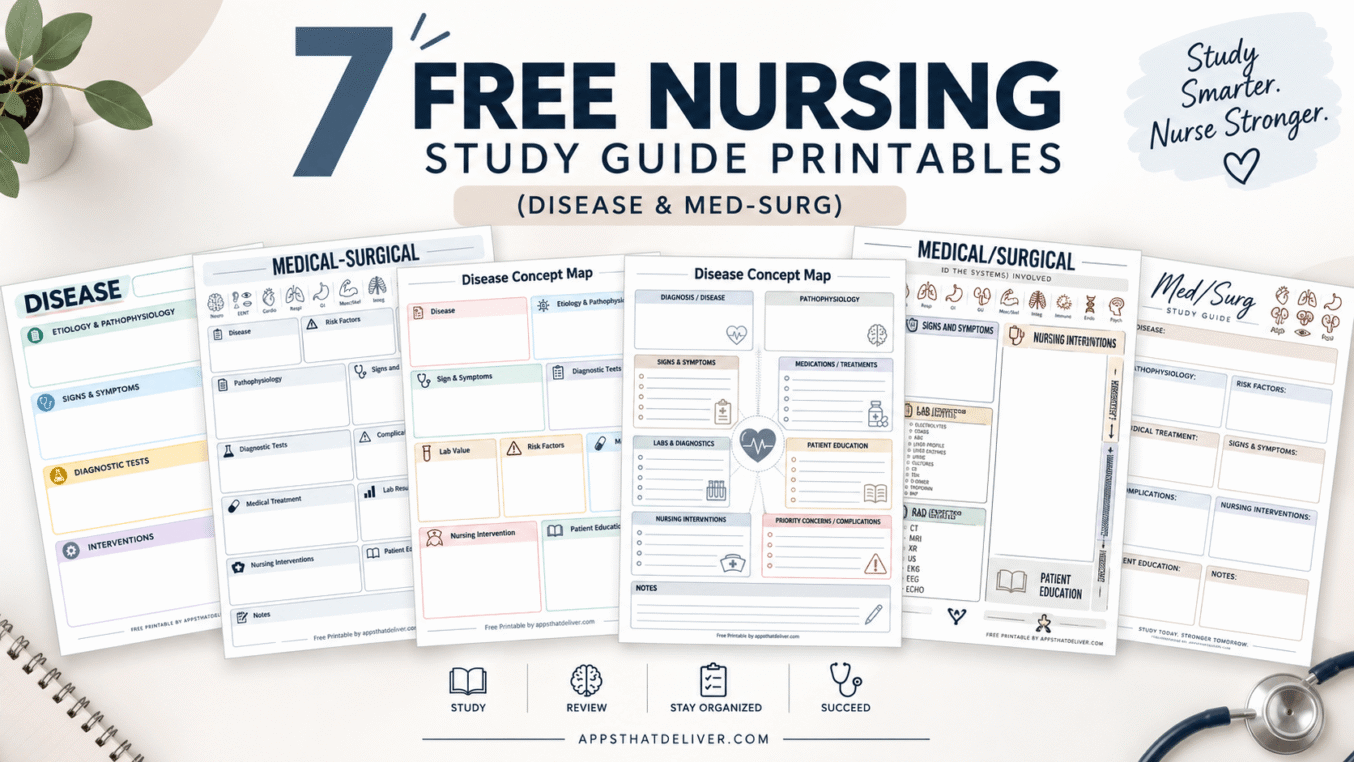
I put together 7 free disease process and med-surg templates because everyone organizes information a little differently. Some students want a simple, color-coded checklist. Others want a full concept map that shows how everything connects, or a flowchart with labs and interventions already sketched in.
So instead of one template, there are seven — from a clean single-disease page to a full concept map with pre-filled labs and body systems — pick whichever matches how you actually study.
They’re all free to download and print.
Trending Printables (links open in a new tab)
While you’re here, check out a few other free printables from the site:
- 10 Free Consequence Chart Printables for Kids & Teens
- 8 Free Brain Dump Printables & Worksheets (PDF)
- 7 Free Healthy Eating Tracker Printables for Kids
- 10 Cute Budget Planner Printables for Kids (Free PDF)
- 13 Free Printable Chore Chart PDFs
What Is a Disease Process Template?
A disease process template — also called a nursing concept map or med-surg study guide — is a single-page printable that breaks down everything you need to know about one condition: what causes it, how it progresses in the body, what it looks like in a patient, and how it’s diagnosed and treated.
Instead of scattered notes across a notebook or a stack of lecture slides, everything for one disease lives on one page, organized the same way every time — so once you’ve filled out a few, you can compare them side by side and start noticing the patterns med-surg and pathophysiology exams love to test.
Some templates lay this out as a simple list of labeled boxes. Others go further with a true concept map, showing how the disease connects out to symptoms, labs, and interventions, or a flowchart that walks through nursing priorities step by step.
Whichever version you use, filling one out is a form of active recall — the exact opposite of highlighting a textbook page and hoping it sticks.
Why Use a Printable Disease Process Template?
Digital flashcard apps and study platforms have their place, but a printed template solves a slightly different problem — it forces structure onto information that’s naturally messy and interconnected.
- Forces you to organize each disease the same way every time
- Makes similar diseases easier to compare side by side before an exam
- Separates signs and symptoms from complications so you don’t confuse the two
- Keeps labs, diagnostics, and interventions in their own dedicated space
- Works as active recall instead of passive reading or highlighting
- Builds into a personal study guide you can flip through before clinicals or exams
- Gives study groups a shared format to fill out together
- Doesn’t require any app or software — just print and write
None of this means you have to give up your digital tools. A lot of nursing students use both — flashcard apps for quick daily review, and a printed template for actually working through a new disease for the first time.
What’s Included in This Collection?
There are 7 free disease process and med-surg study guide printables in this collection — each one a letter-size PDF you can download and print right away — and each has a slightly different layout and level of detail:
- Colorful Disease Process Template
- Medical-Surgical Study Guide with Body Systems
- Disease Concept Map with Color-Coded Sections
- Hub-and-Spoke Disease Concept Map
- Medical-Surgical Flowchart with Pre-Filled Labs & Radiology
- Minimalist Two-Column Disease Process Template
- Med/Surg Study Guide with Organ Icons
Some of these pack in body systems, pre-filled labs, and nursing interventions by acuity level. Others keep things simple with a clean, color-coded grid. Scroll down to see all seven and pick whichever fits how you actually study.
7 Free Nursing Study Guide Printables
1. Colorful Disease Process Template
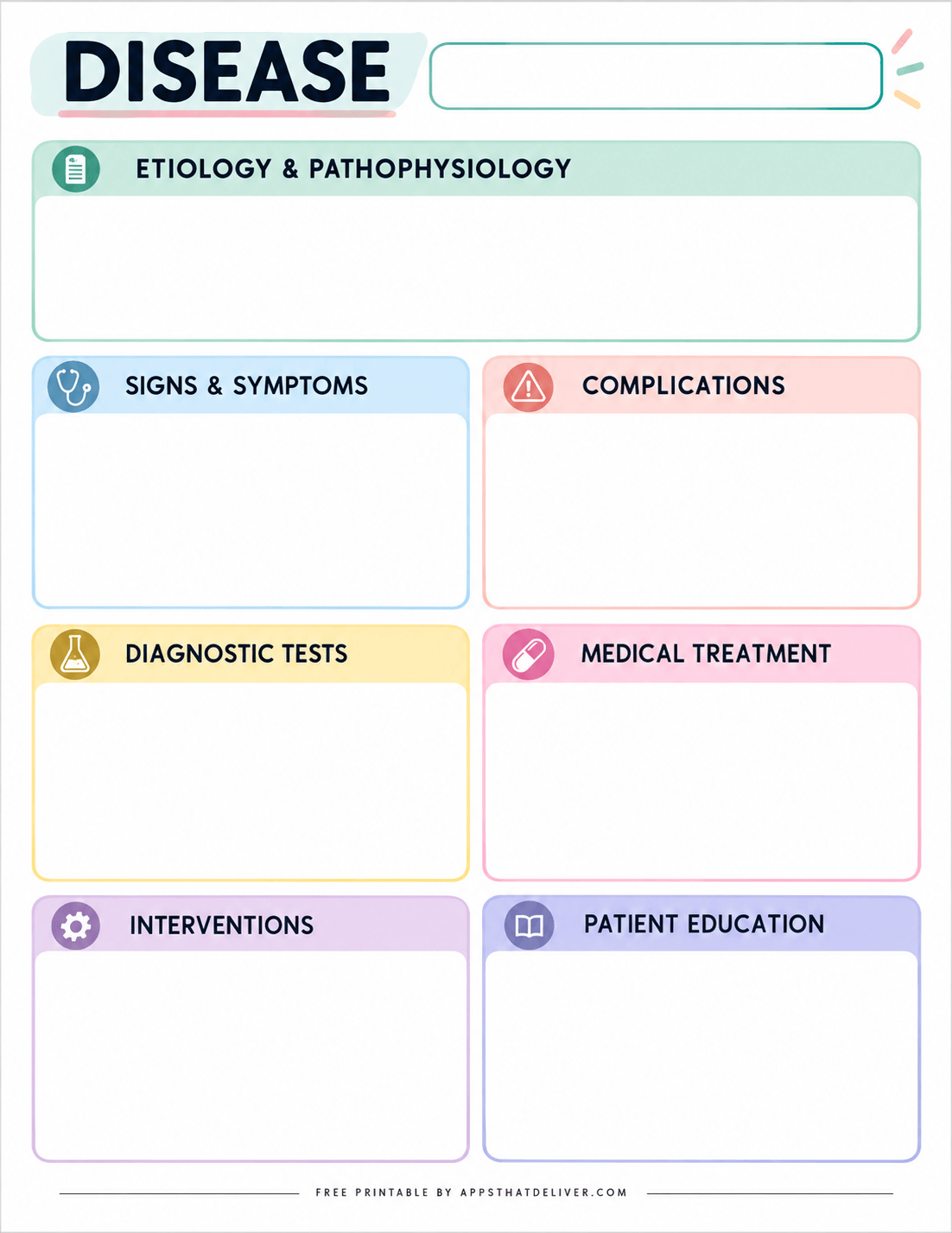
This is the classic, single-disease template in the set, built around six clearly labeled, color-coded sections: Etiology & Pathophysiology up top, then Signs & Symptoms and Complications side by side, Diagnostic Tests and Medical Treatment side by side, and Interventions and Patient Education closing out the page. A blank title box at the top lets you write in the disease name so the page is ready to use for anything you’re studying that week.
Each section header gets its own color and icon circle, which makes the page easy to scan once you’ve filled in several and are flipping through them before an exam.
Good for: a quick, all-purpose disease template you can reuse for any condition, and a colorful layout that’s easy to scan at a glance
2. Medical-Surgical Study Guide with Body Systems
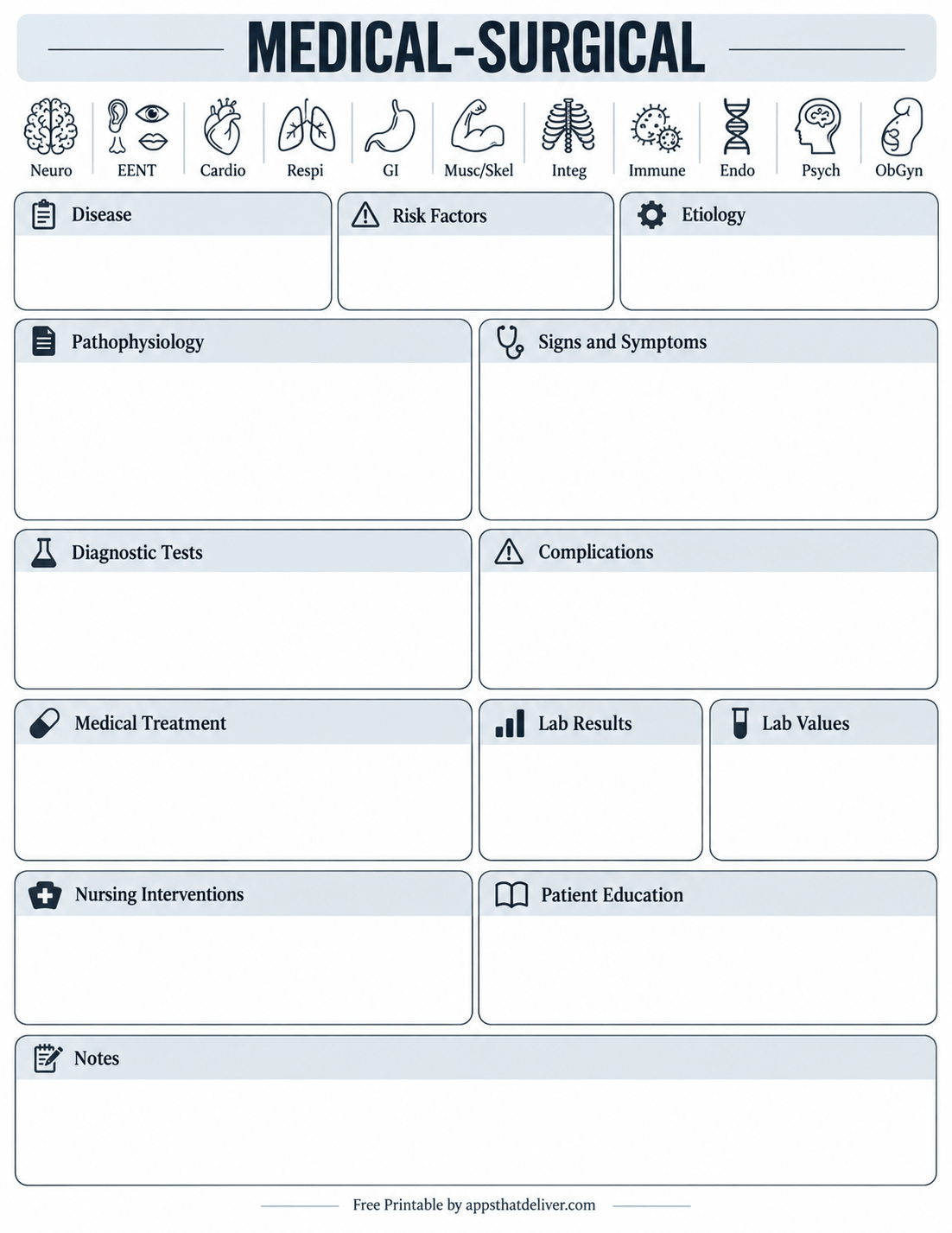
This is the most complete template in the collection, and it’s built to double as a body-systems reference as much as a disease-specific study guide. A row of icons across the top — Neuro, EENT, Cardio, Respi, GI, Musc/Skel, Integ, Immune, Endo, Psych, and ObGyn — lets you mark which system the disease belongs to before you even start filling in the boxes below.
From there, the page walks through Disease, Risk Factors, and Etiology, then Pathophysiology and Signs and Symptoms, Diagnostic Tests and Complications, Medical Treatment alongside separate Lab Results and Lab Values boxes, and Nursing Interventions and Patient Education. A full-width Notes section runs along the bottom for anything that doesn’t fit elsewhere.
Because it separates lab results from lab values and gives risk factors and etiology their own boxes, this one holds more detail per page than most of the others — a good match for a condition with a lot of moving parts.
Good for: a single, detailed reference page per disease, and tagging which body system a condition falls under
3. Disease Concept Map with Color-Coded Sections
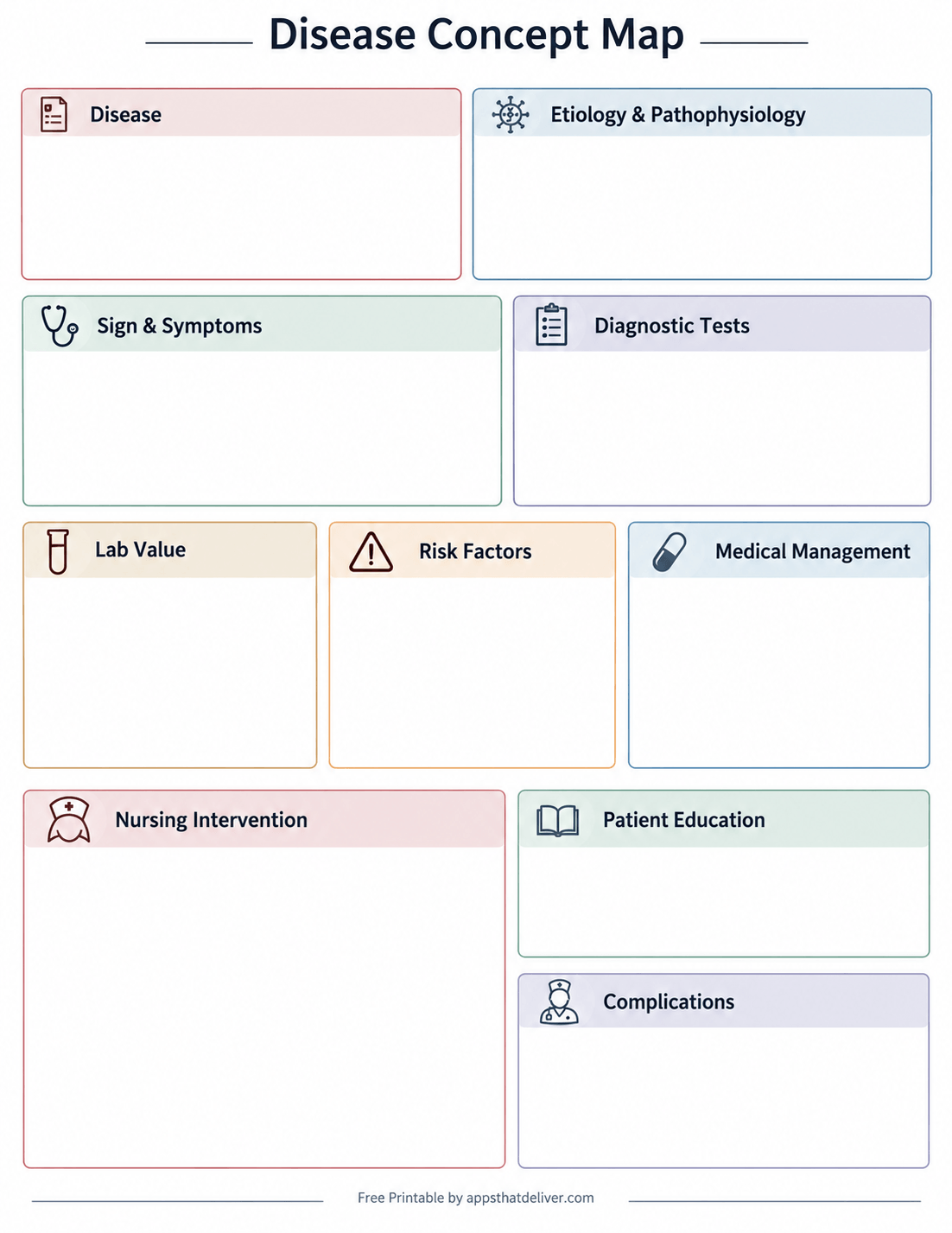
This concept map keeps things clean and grid-based rather than free-form, with ten sections each boxed off in its own colored border: Disease, Etiology & Pathophysiology, Signs & Symptoms, Diagnostic Tests, Lab Value, Risk Factors, Medical Management, Nursing Intervention, Patient Education, and Complications.
Every section carries a small icon in its header — a stethoscope, a test tube, a warning triangle — which makes the page easy to navigate even before you’ve filled anything in. Because every box is the same open, lined shape, you can write as much or as little as a section needs without the layout fighting you.
It’s a solid middle ground between a simple checklist template and a full connected concept map — organized like a concept map, but quicker to fill in like a study guide.
Good for: a color-coded, easy-to-navigate layout, and covering ten categories without the page feeling cramped
How to Pick the Right Template for Your Study Style
With seven layouts to choose from, it helps to think about how you actually study before picking one, rather than just going with whichever looks the nicest.
If you learn best by seeing how ideas connect, a true concept map — like the hub-and-spoke design further down — will do more for you than a grid of separate boxes, even if it takes a little longer to fill in. If you’re mainly trying to build a quick reference you can flip through fast before an exam, a simpler, color-coded checklist template will get filled out faster and reviewed more often.
It’s also worth thinking about how much detail a particular disease needs. A straightforward condition might fit comfortably on the classic single-page template, while something with a lot of overlapping systems, labs, and interventions might need the fuller Medical-Surgical layout or the flowchart with pre-filled labs.
There’s no reason to pick just one, either. A lot of nursing students keep two or three different templates in rotation, depending on how complex the disease of the week turns out to be.
4. Hub-and-Spoke Disease Concept Map
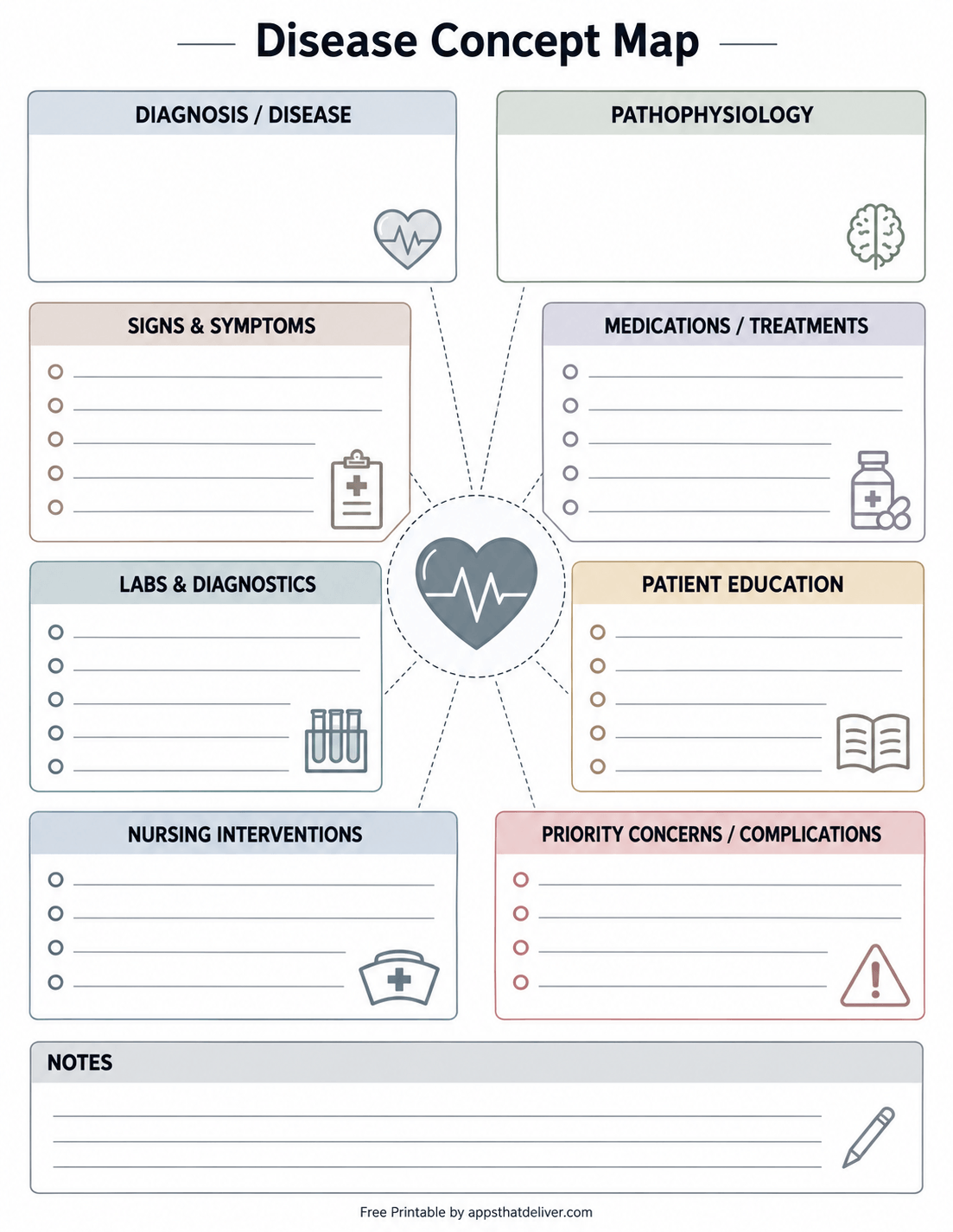
This is the only true hub-and-spoke concept map in the collection, with a central heart-pulse icon in the middle of the page and eight boxes radiating out from it, connected by dashed lines: Diagnosis/Disease, Pathophysiology, Signs & Symptoms, Medications/Treatments, Labs & Diagnostics, Patient Education, Nursing Interventions, and Priority Concerns/Complications.
Rather than open paragraph space, most sections use a short lined checklist with circle bullets, which nudges you toward writing concise, exam-ready points instead of long sentences. A Notes section runs along the bottom for anything extra.
Because everything visibly connects back to the center, this layout does the best job in the set of actually showing how a disease’s parts relate to each other — which is the whole point of a concept map, as opposed to just a categorized list.
Good for: visual learners who want to see how a disease connects to its symptoms, labs, and treatments, and short, checklist-style notes instead of paragraphs
5. Medical-Surgical Flowchart with Pre-Filled Labs & Radiology
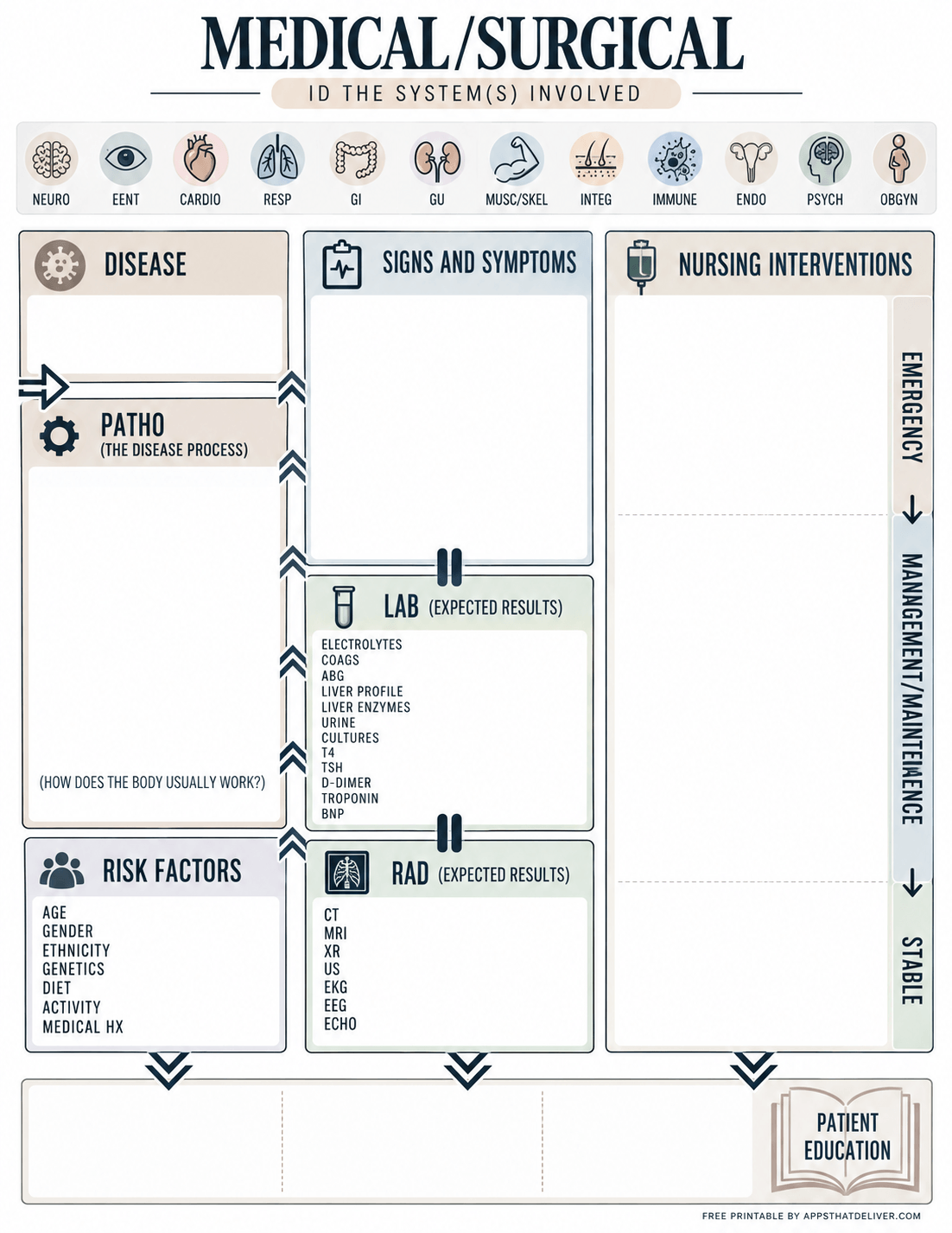
This is the most advanced template in the collection, built as a flowchart with arrows guiding you from one section to the next rather than a simple grid. It starts with the same body-systems icon row as the other Medical-Surgical template, then walks Disease into Patho (“the disease process,” with a prompt asking how the body usually works), across to Signs and Symptoms, Lab, and Rad.
The Lab and Rad boxes come with their categories already printed in for you — electrolytes, coags, ABG, liver profile, liver enzymes, urine, cultures, T4, TSH, D-dimer, troponin, and BNP for labs; CT, MRI, XR, US, EKG, EEG, and ECHO for radiology — so you only have to fill in the expected results instead of remembering which tests to list. A Risk Factors box does the same with age, gender, ethnicity, genetics, diet, activity, and medical history already listed, and a Nursing Interventions column is split into Emergency, Management/Maintenance, and Stable phases with arrows showing how care escalates or de-escalates.
If you’ve ever blanked on which labs to even check for a given disease, having them pre-printed here does a lot of the remembering for you.
Good for: a detailed flowchart with pre-filled lab and radiology categories, and organizing nursing interventions by acuity level (emergency, management, stable)
Concept Maps vs. Traditional Study Guides — Which Should You Use?
Both formats are trying to solve the same problem — turning a wall of textbook and lecture content into something you can actually study from — but they go about it differently.
A traditional study guide, like the classic Disease template or the minimalist two-column layout further down, organizes information into labeled categories. It’s fast to fill in and easy to scan, which makes it a good fit for building out a lot of diseases quickly.
A concept map goes a step further and tries to show how those categories connect — how a risk factor leads to a pathophysiological change, which leads to a symptom, which points to a lab result, which drives an intervention. That connection is exactly what a lot of exam-style questions are testing, since they rarely ask you to just recall a fact in isolation.
If you only have time to build one type of study tool, a concept map arguably teaches you more per page. But a stack of quick traditional study guides across many diseases can be just as valuable when it’s time for a broad review before finals.
6. Minimalist Two-Column Disease Process Template
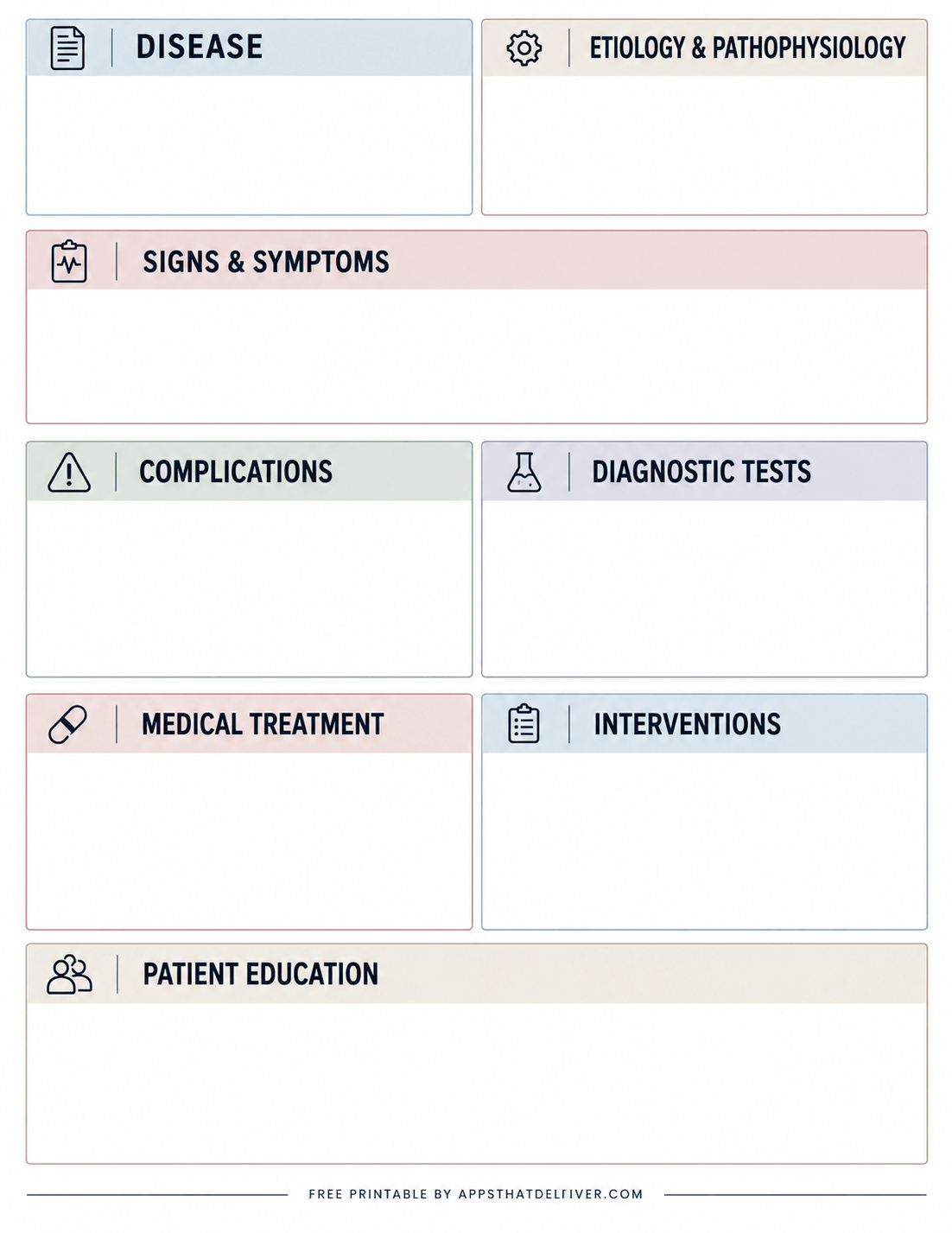
Where several of the other templates lean on color and icons, this one strips things back to a clean two-column grid with a simple vertical-bar icon next to each header. Disease and Etiology & Pathophysiology sit side by side at the top, Signs & Symptoms takes a full-width box of its own, then Complications and Diagnostic Tests pair up, followed by Medical Treatment and Interventions, with Patient Education closing the page in another full-width box.
The muted, low-contrast color scheme and lack of icons keep the focus on the content rather than the design, which makes this a good option if you print in black and white or just prefer a plainer page to write on.
Good for: a minimalist look, printing in black and white without losing readability, and a straightforward two-column layout
7. Med/Surg Study Guide with Organ Icons
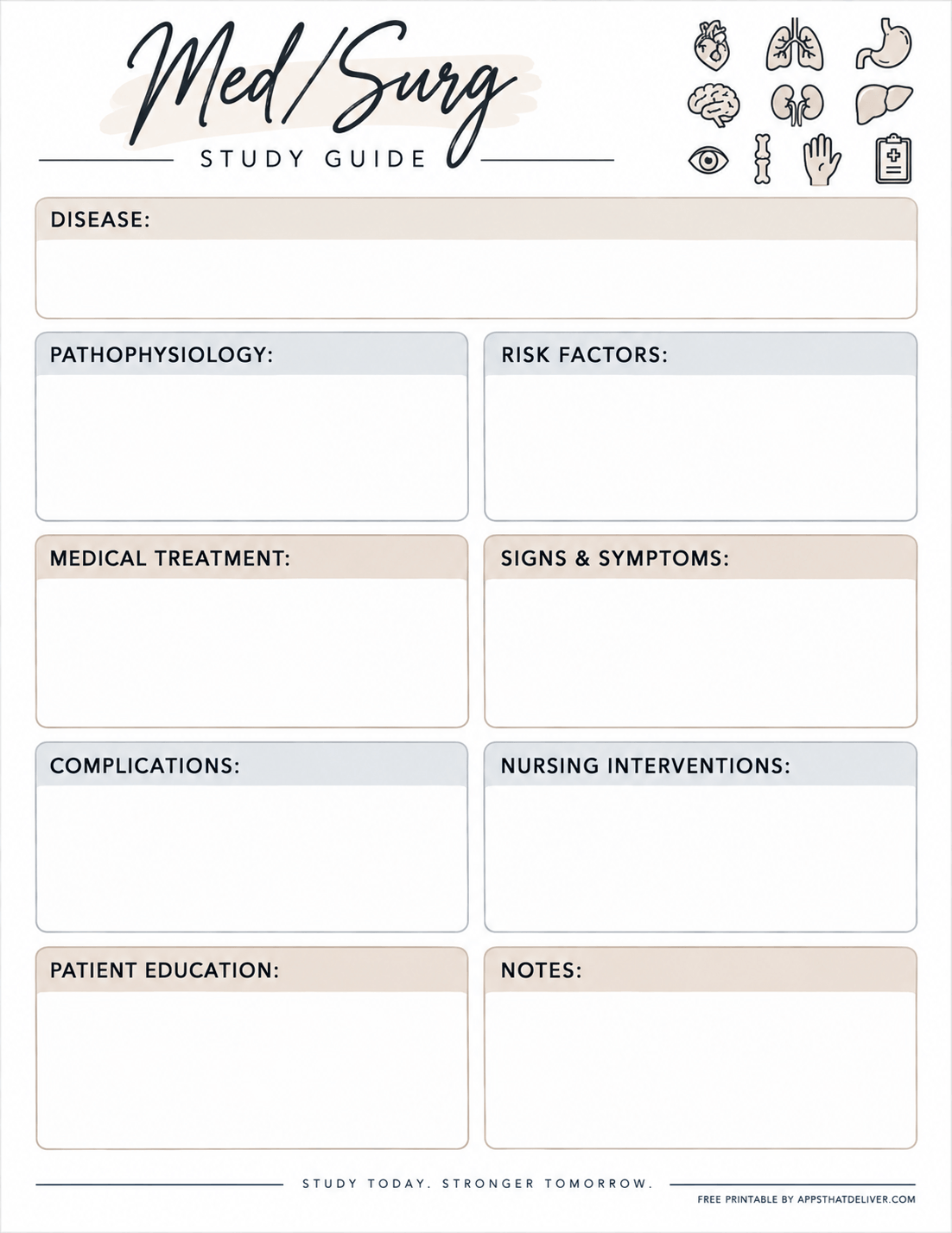
This is the most polished, academic-looking template in the set, with an elegant script title, a small grid of organ icons — heart, lungs, stomach, brain, kidneys, liver, eye, bone, hand, and a clipboard — in the top corner, and a “Study Today. Stronger Tomorrow.” tagline along the bottom.
The layout itself is straightforward: a full-width Disease box up top, then Pathophysiology and Risk Factors, Medical Treatment and Signs & Symptoms, Complications and Nursing Interventions, and finally Patient Education alongside a dedicated Notes box.
Because it looks a little more finished than a typical worksheet, this is a nice one to print for a study binder you’re planning to keep and reference throughout the semester, not just cram from the night before a test.
Good for: a polished, binder-ready look, and keeping a longer-term study reference rather than a one-time cram sheet
How to Fill Out a Disease Process Template
The order you fill in the boxes matters almost as much as the boxes themselves. Working through a template in the same sequence every time helps the information click into place rather than sitting there as disconnected facts.
- Start with the diagnosis. Write the disease name first so every other box builds around it.
- Fill in etiology and pathophysiology next. Establish what causes it and how it changes the body before moving on to symptoms.
- List signs and symptoms in your own words. Avoid copying textbook phrasing word for word — recall works better than recognition.
- Add diagnostic tests and expected results. Note what actually confirms the diagnosis, not just what tends to get ordered.
- Cover complications separately from symptoms. Keep what the disease itself causes distinct from what happens if it’s poorly managed.
- Fill in medical treatment and nursing interventions. Separate what the provider orders from what you, as the nurse, actually do.
- Finish with patient education. If you can explain it simply enough to teach a patient, you’ve usually learned it well enough for the exam.
It doesn’t need to be filled in perfectly the first time. Going back and adding detail after a lecture or clinical shift is part of how these templates are meant to be used.
How to Print These Nursing Study Guides
All seven of these are letter-size PDF files (8.5 x 11 inches). Download the version you want, save it to your device, and print it at home, at the library, or through a campus print center.
For the best results, print on standard letter-size paper at 100% scale (“actual size,” not “fit to page”) so the boxes and borders line up the way they’re designed to. If you’re outside the US and only have A4 paper on hand, most printers can scale a letter-size PDF down to fit an A4 sheet automatically. If you want to reuse a template across multiple study sessions before committing your final answers, slide it into a clear sheet protector and fill it in with a dry-erase marker first.
You can also print a few different styles and try each one on a couple of diseases before deciding which layout actually helps you retain the material best.
Frequently Asked Questions
Yes. All 7 disease process and med-surg study guide printables in this collection are free PDF downloads. You can download and print as many as you like.
A disease process template is a single printable page that organizes everything you need to know about one condition — etiology, pathophysiology, signs and symptoms, diagnostics, treatment, and nursing interventions — into labeled sections.
A traditional study guide organizes information into separate labeled categories. A concept map goes further, visually connecting those categories to show how a risk factor, symptom, lab result, and intervention relate to each other.
No. These are letter-size PDF files (8.5 x 11 inches) designed to print on a standard home, library, or campus printer using regular letter paper. They print clearly in black and white as well as color.
Yes. Print a fresh copy for each new condition you study, or slide one into a clear sheet protector and fill it in with a dry-erase marker if you want to practice before writing your final answers.
The Hub-and-Spoke Disease Concept Map is built specifically to show how a disease’s parts connect to each other, which tends to work well for visual learners who want to see relationships rather than a flat list of categories.
Yes. Because each template covers the same core categories every time, filling one out per disease builds a personal reference you can review across multiple courses and exams, not just a single assignment.
These are provided as printable PDFs meant to be filled in by hand after printing. If you’d like to write on them digitally, you can open the PDF in a note-taking or annotation app that supports handwriting on PDFs and use it on a tablet instead of printing it.
Think about whether you learn better from connected concept maps or quick categorized checklists, and how much detail the disease you’re studying actually needs. Simpler conditions suit the shorter templates, while complex ones benefit from the fuller layouts with pre-filled labs and body systems.
Yes. Filling one out for a patient’s diagnosis before a clinical shift is a quick way to review the disease process, expected labs, and nursing priorities you’ll need to know that day.
Final Thoughts
You don’t need a complicated study system to get through med-surg. Most of the time, you just need one consistent page per disease — the cause, the presentation, the labs, the treatment, the nursing priorities — instead of scattered notes across a notebook, a textbook, and last semester’s slides.
That’s really all these templates are — a place to put a disease down on paper in a way that forces you to actually understand it, not just recognize it when you see it on an exam.
Whether you want a quick, colorful checklist like the classic Disease template, a full connected concept map like the hub-and-spoke design, or a detailed flowchart with labs already sketched in, there’s a layout in this collection built for how you actually study.
You don’t have to commit to one forever, either. Print a few, try each on a different disease, and keep whichever one you find yourself reaching for again before the next exam.
And since all 7 are free, there’s nothing stopping you from testing them all.
Pick your favorite disease process template, print it today, and start turning this week’s lecture into something you’ll actually remember.