
Helping children understand that their choices have consequences doesn’t always have to turn into a big argument.
Sometimes, having something simple and visual in front of them can make the connection much easier to understand.
That’s where a consequence chart can be useful.
A good consequence chart gives children a clear way to see the relationship between an action and what happens afterward.
Depending on the child’s age and the situation, that might mean identifying a behavior, thinking about why it matters, recording a consequence, choosing a repair step, or deciding what they can do differently next time.
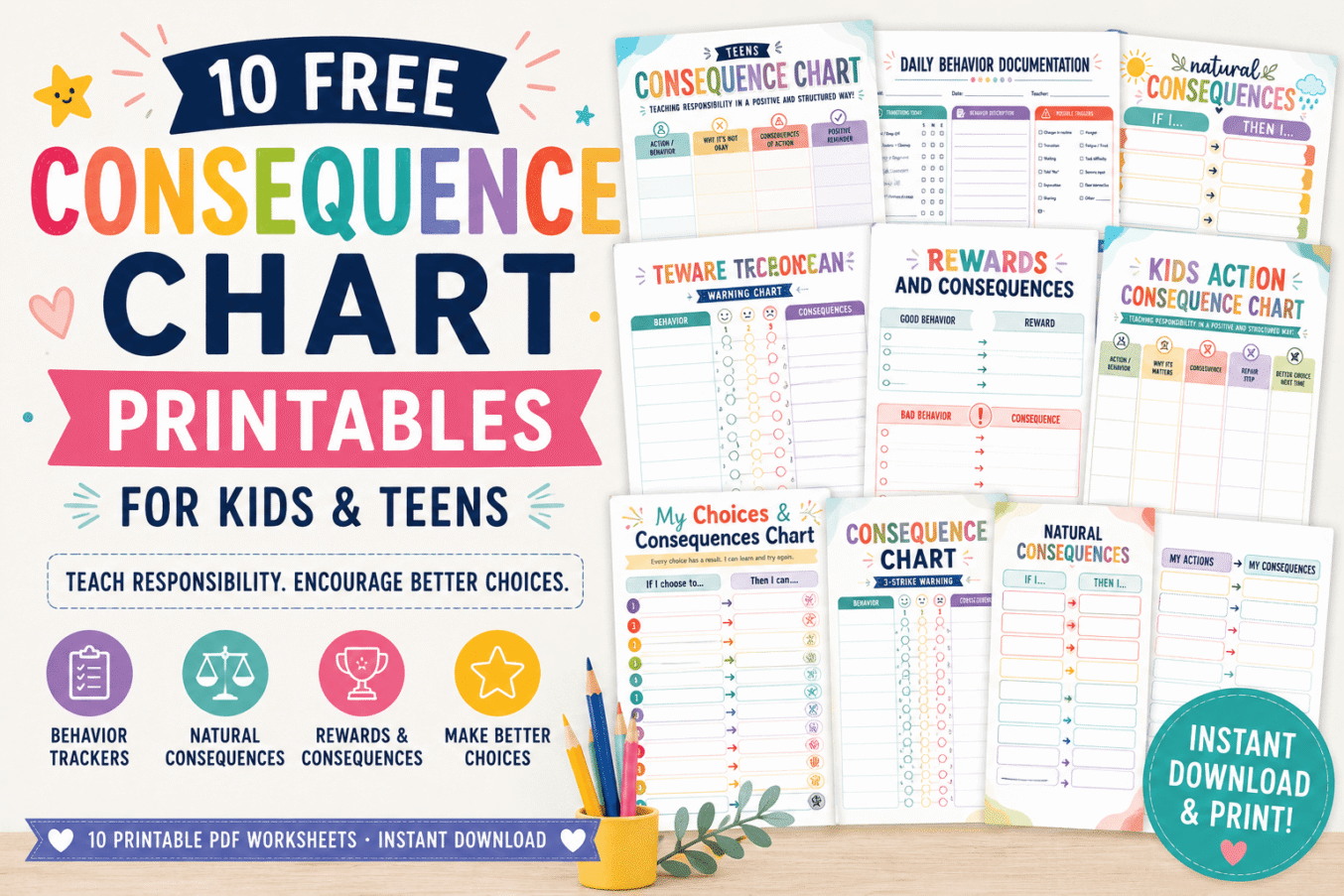
I put together these 10 free consequence chart printables for parents, teachers, caregivers, and anyone who wants a simple visual tool for talking about behavior and responsibility.
There are several different styles included, so you don’t have to use the same chart for every child or every situation.
Some are designed for younger kids, some work especially well for older children and teens, and others are useful for teachers who want to document behavior throughout the day.
They’re all free to download and print.
What Is a Consequence Chart?
A consequence chart is a printable tool that helps children connect their actions with what happens as a result.
Depending on the chart, you might record a behavior, identify why the behavior wasn’t appropriate, describe a consequence, choose a repair step, or write down a better choice for next time.
Some consequence charts are also designed to track behavior over time. Instead of focusing on one specific incident, a behavior tracker can help parents or teachers notice patterns, identify triggers, and see which strategies seem to work best.
The important thing is that the chart should be a tool for communication and learning rather than simply a list of punishments.
When children can see what happened, why it mattered, what happened next, and what they can do differently, it gives them a more concrete way to think about responsibility.
Why Use a Consequence Chart?
Children don’t always make the connection between an action and its result immediately. A consequence chart can slow the process down and give everyone a chance to look at what happened more clearly.
- Help children understand cause and effect
- Make expectations more visible and concrete
- Encourage children to think about their choices
- Provide a place to record behaviors and patterns
- Encourage responsibility and problem solving
- Help children identify better choices for next time
- Give parents and teachers a consistent visual tool
- Make it easier to discuss behavior calmly after an incident
- Help identify possible triggers behind challenging behavior
- Encourage repair, reflection, and moving forward
A chart doesn’t have to be complicated. Sometimes the simplest format is the most useful because a child can understand it quickly and actually use it.
What’s Included in This Collection?
There are 10 free consequence and behavior printables in this collection. Each one has a slightly different purpose:
- Teens Consequence Chart
- Daily Behavior Documentation Printable
- Natural Consequences Chart
- Behavior Tracker Warning Chart
- Rewards and Consequences Chart
- Kids Action Consequence Chart
- My Choices & Consequences Chart
- 3-Strike Consequence Warning Chart
- Natural Consequences If/Then Chart
- My Actions & My Consequences Chart
Some of these printables are better suited to younger children, while others are designed with teens, teachers, or more detailed behavior tracking in mind.
Choose whichever format fits your situation best.
10 Free Consequence Chart Printables
1. Teens Consequence Chart
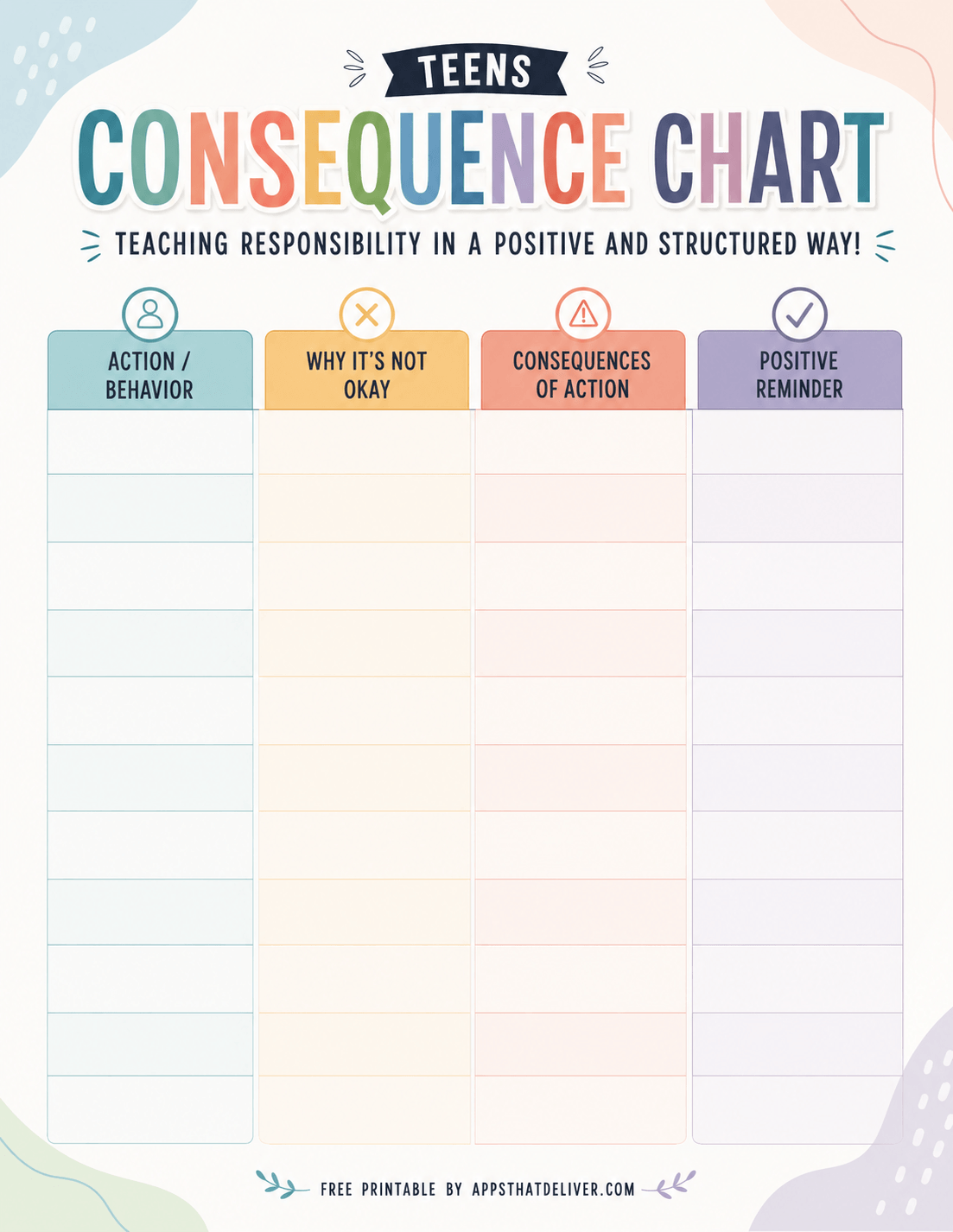
This consequence chart is designed specifically with teens in mind. The layout provides a structured way to look at an action or behavior, why it isn’t okay, the consequence of the action, and a positive reminder.
That makes it different from a simple behavior chart that only records whether something was good or bad. Instead, it creates an opportunity to explain the reasoning behind the consequence and finish with a constructive reminder.
There is plenty of writing space, making this useful for situations where a quick checkmark isn’t enough and you want to have a more detailed conversation about what happened.
It can be used at home, in educational settings, or anywhere you want an older child to think more carefully about responsibility and decision-making.
Good for: teens, responsibility, behavior discussions, consequences, reflection and positive reminders
2. Daily Behavior Documentation Printable
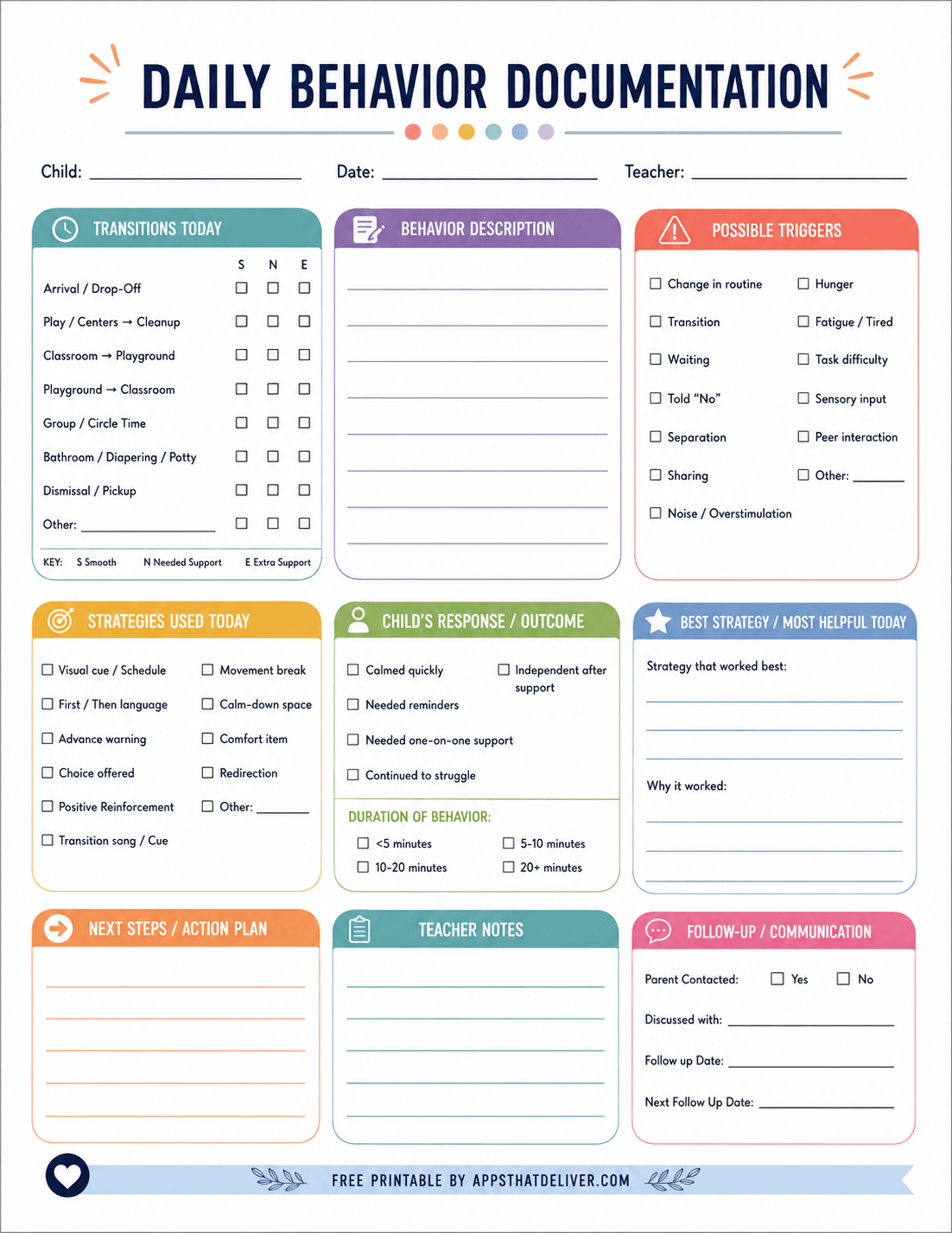
This printable is designed for teachers, classroom staff, and caregivers who need a more detailed way to document behavior throughout the day.
The form includes space for the child’s name, date, and teacher, followed by a detailed section for tracking transitions such as arrival, cleanup, classroom changes, group time, bathroom routines, and dismissal.
It also includes a behavior description area and a list of possible triggers, including changes in routine, transitions, waiting, being told no, separation, sharing, noise, hunger, fatigue, task difficulty, sensory input, and peer interaction.
There’s also room to document strategies used, the child’s response or outcome, the duration of the behavior, the most helpful strategy, next steps, teacher notes, and follow-up communication.
This makes it much more than a simple behavior chart. It can help create a fuller picture of what happened before, during, and after a behavior.
Good for: teachers, classroom documentation, behavior tracking, identifying triggers and recording strategies
3. Natural Consequences Chart
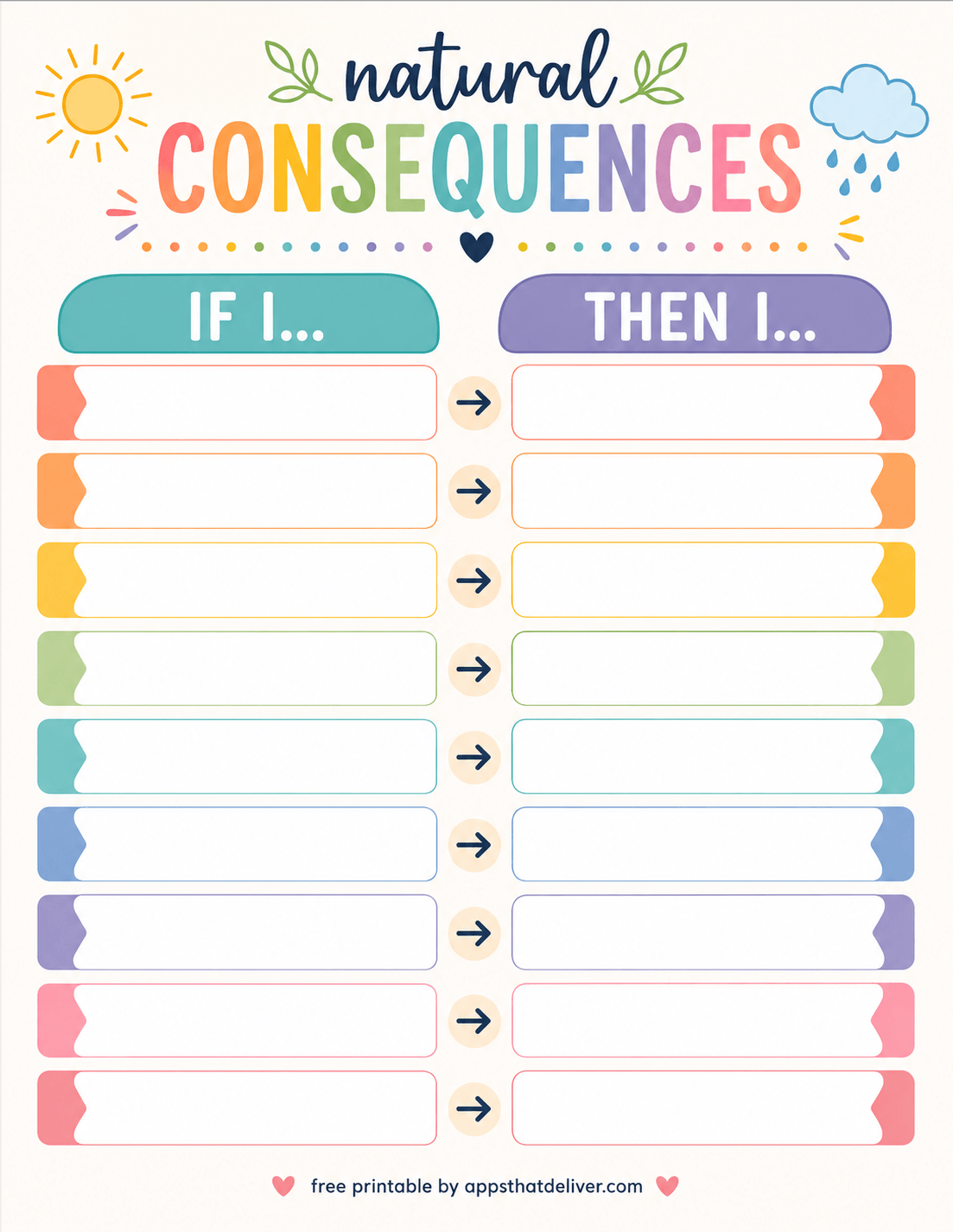
Natural consequences can be easier for children to understand when they are presented as a simple connection between an action and what happens next.
This printable uses an easy “If I…” and “Then I…” format. Children can write down an action or choice on one side and the resulting consequence on the other.
The colorful layout gives you multiple rows to work through, making it useful for teaching cause and effect without requiring a complicated behavior management system.
For example, a child might write about forgetting an important item, leaving a responsibility unfinished, or making a choice that creates an expected result. The point is to help them recognize the connection between what they choose and what happens afterward.
Good for: teaching cause and effect, natural consequences, responsibility and decision-making
4. Behavior Tracker Warning Chart
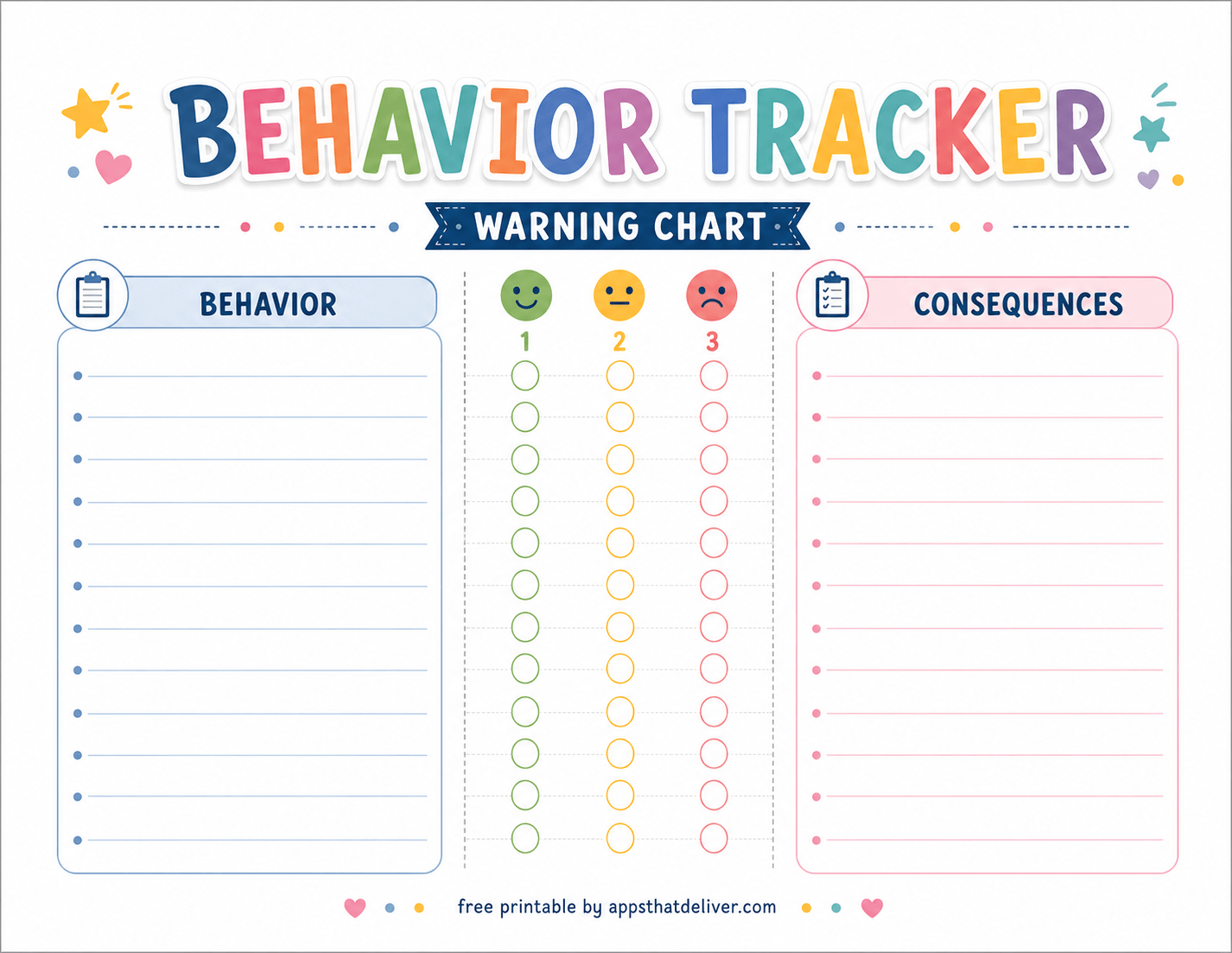
This behavior tracker combines a behavior description area with a simple three-level warning system.
The center of the chart provides three choices labeled 1, 2, and 3, represented visually by different facial expressions. This gives you a quick way to record where a behavior falls on the chart.
On the left, there is room to write down the behavior. On the right, there is space to record the corresponding consequence or follow-up.
Because the chart is simple and visual, it can be particularly useful when children need a quick reminder of expectations without requiring a long written explanation every time.
It can also be used as a record of repeated behaviors so parents or teachers can look back and identify patterns.
Good for: behavior tracking, visual reminders, warning systems, classroom routines and repeated behaviors
5. Rewards and Consequences Chart
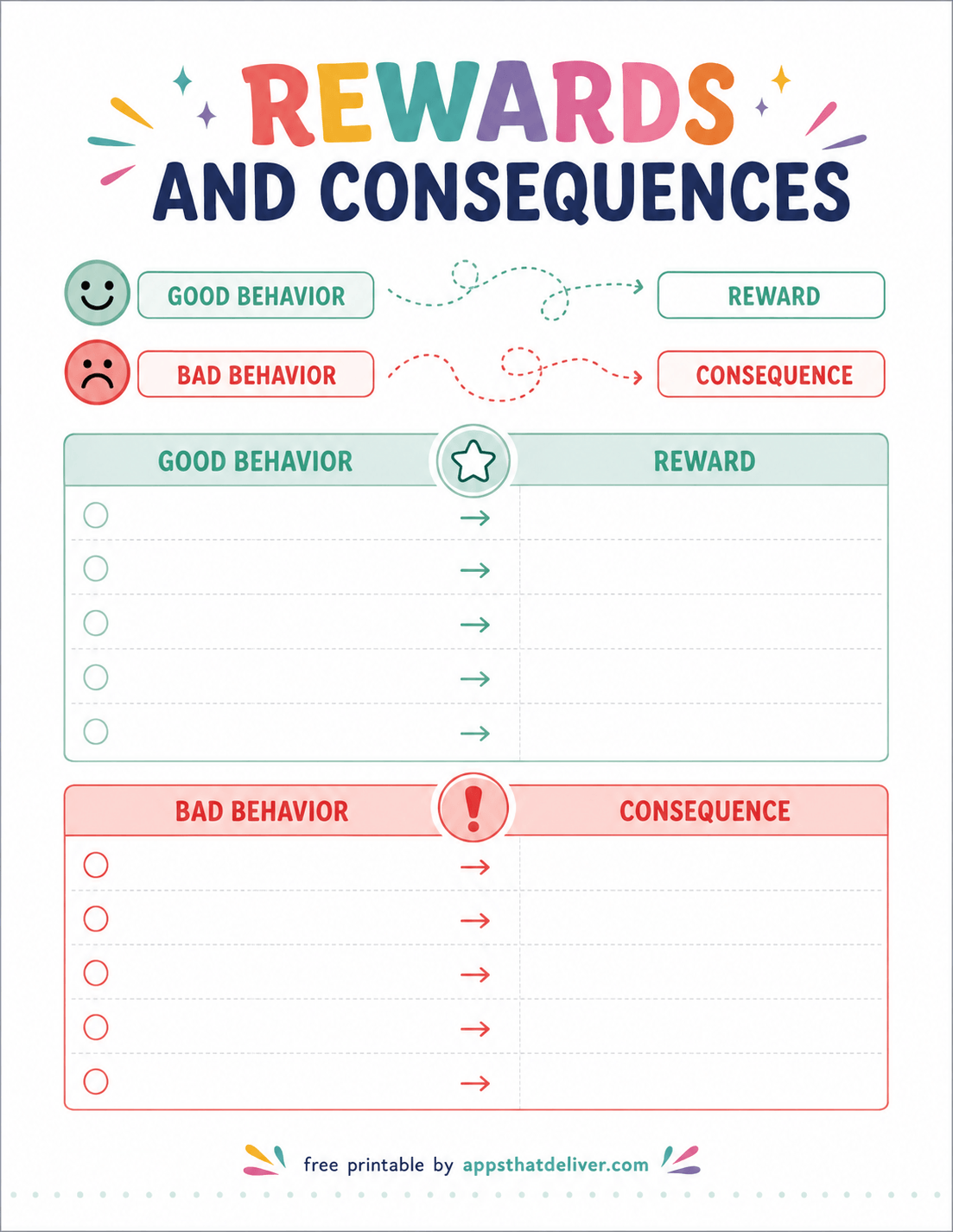
This printable takes a balanced approach by including space for both good behavior and rewards as well as bad behavior and consequences.
The top section lets you connect positive behaviors with an appropriate reward. The lower section provides space to connect a behavior with a consequence.
Having both sections on the same printable can make it easier to keep the focus from becoming entirely negative. Children can see that positive choices are worth noticing too.
Each section includes several rows, so you can create your own examples based on the child’s age, responsibilities, household expectations, or classroom routines.
Good for: reward systems, behavior expectations, positive reinforcement and consequence planning
6. Kids Action Consequence Chart
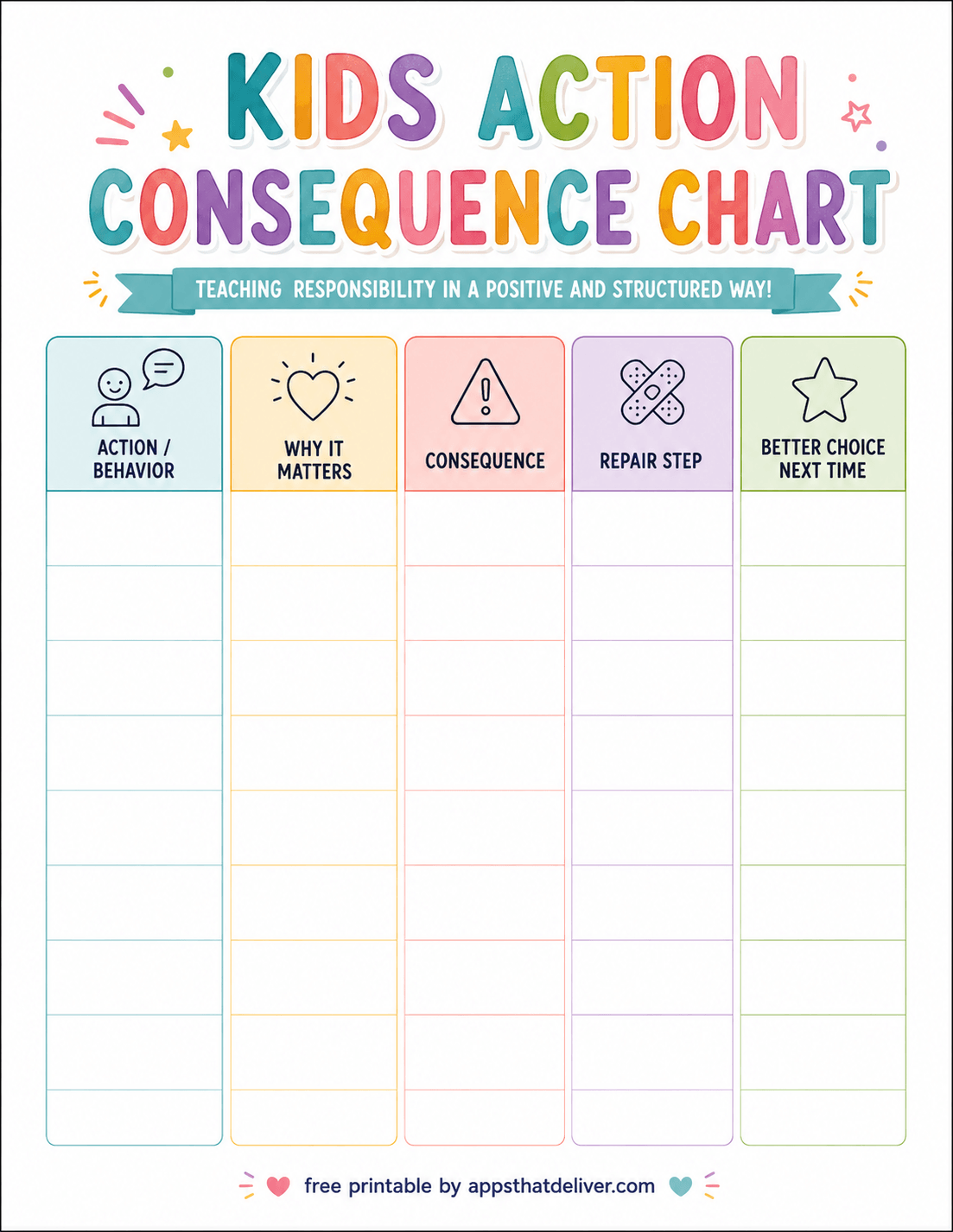
This printable is designed to help kids look beyond simply labeling something as good or bad.
The five columns focus on Action / Behavior, Why It Matters, Consequence, Repair Step, and Better Choice Next Time.
That structure gives children several different questions to think about. What did I do? Why does it matter? What happened as a result? Is there something I can do to repair the situation? What could I choose next time?
This can be especially helpful when you want a consequence chart to encourage reflection rather than simply recording an incident.
The repair step is particularly useful because it gives children a place to think about how they can make things right after a mistake.
Good for: younger children, reflection, responsibility, repair steps and learning from mistakes
7. My Choices & Consequences Chart
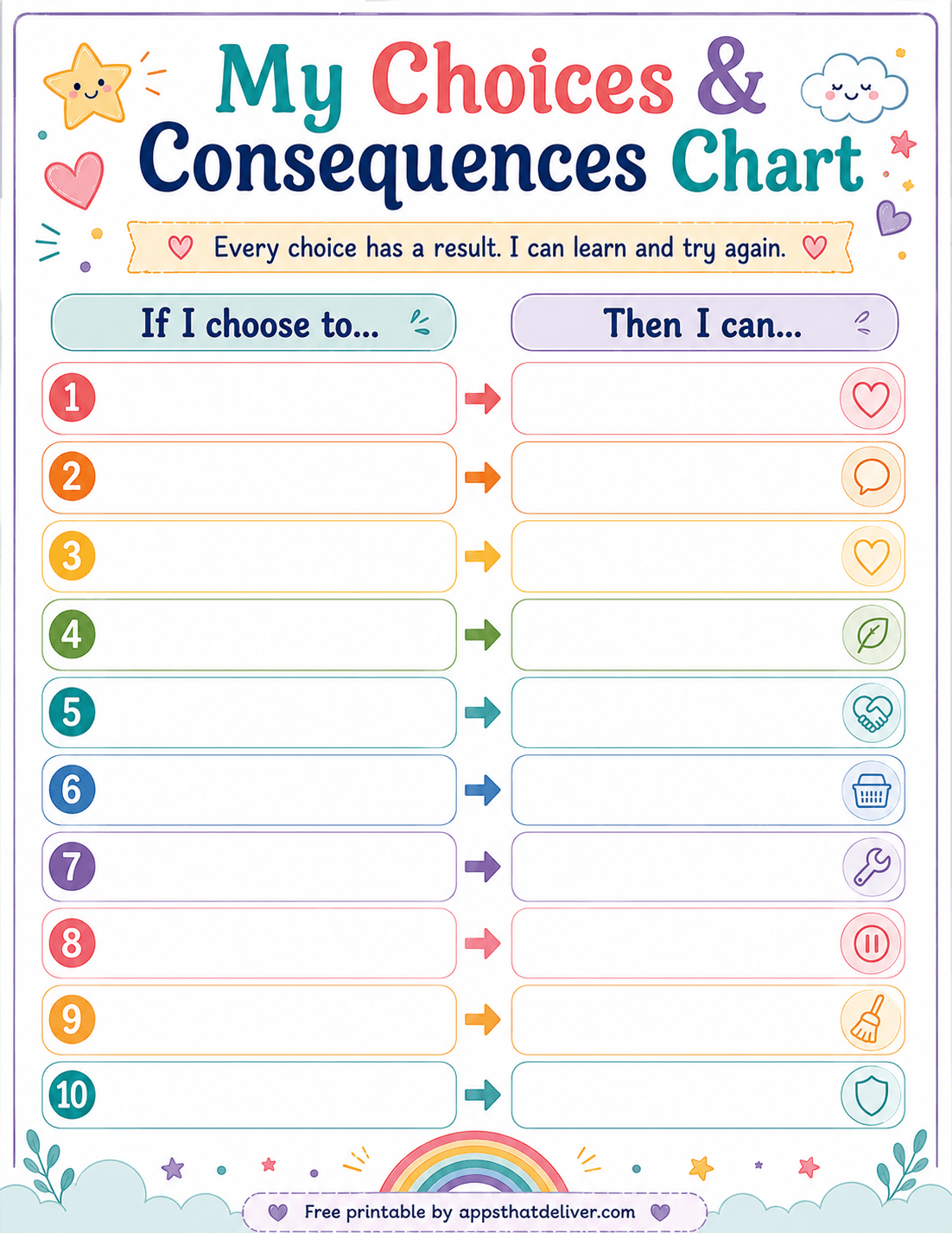
This printable puts the focus directly on the connection between a child’s choices and what happens afterward.
Each row begins with “If I choose to…” and leads to “Then I can…”. There are 10 numbered rows, giving you plenty of room to create examples, expectations, or personal goals.
The format is intentionally simple. Instead of simply telling a child what consequence they will receive, it encourages them to think about the result of a choice.
You can use the chart for everyday situations, household responsibilities, classroom expectations, sibling interactions, or other choices that a child may need to think through.
Good for: teaching choices and consequences, responsibility, decision-making and everyday behavior
8. 3-Strike Consequence Warning Chart
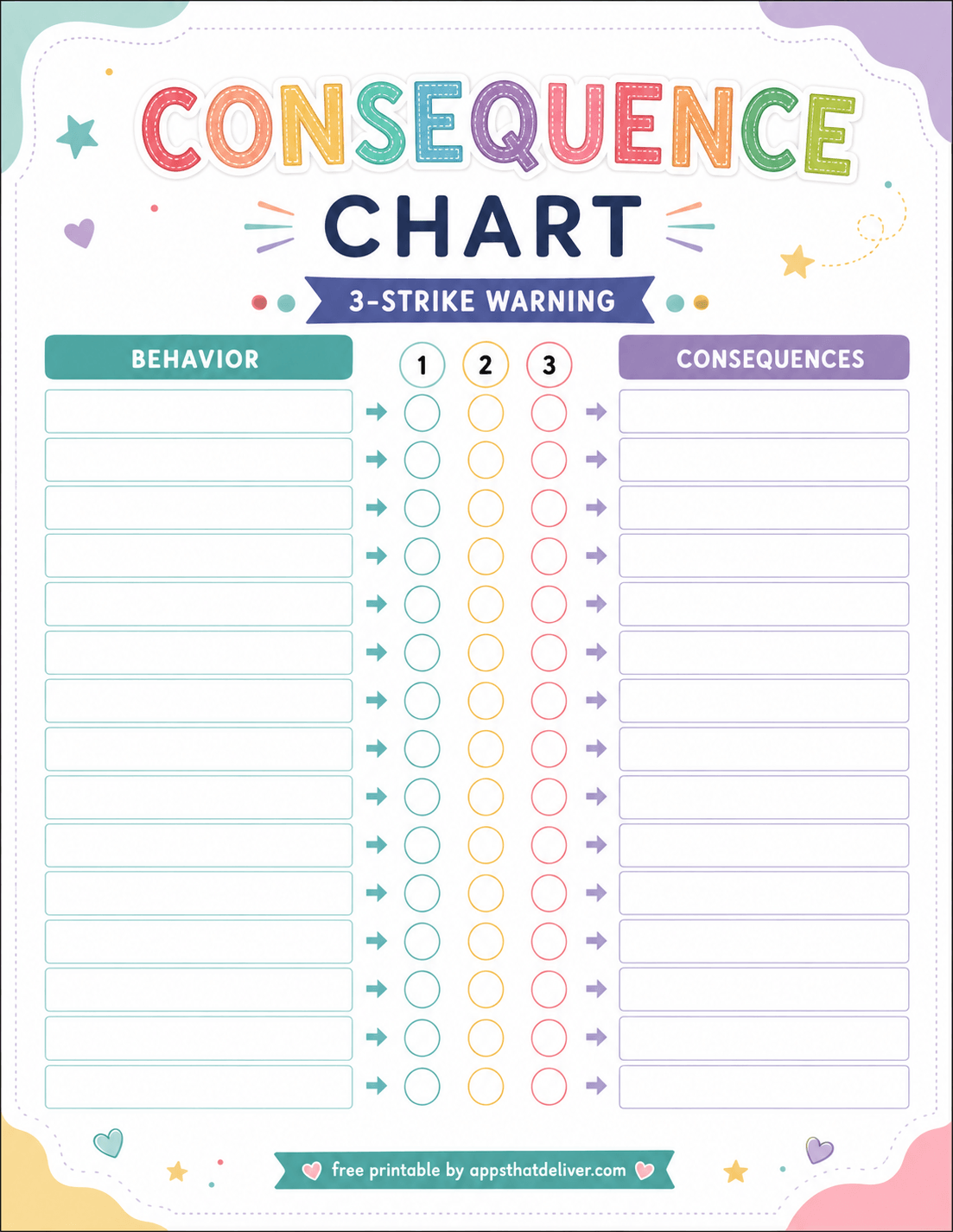
This printable uses a simple 3-strike warning format for recording behavior and consequences.
Each row gives you space to write down a behavior, mark whether it received a first, second, or third warning, and record the corresponding consequence.
The visual structure makes it easy to see how a repeated behavior is being recorded over time. It can be useful when children benefit from having expectations and warnings presented in a clear, consistent format.
As with any behavior chart, the exact rules and consequences can be customized to suit your household, classroom, or situation.
Good for: warning charts, behavior tracking, classroom expectations, repeated behaviors and visual reminders
9. Natural Consequences If/Then Chart
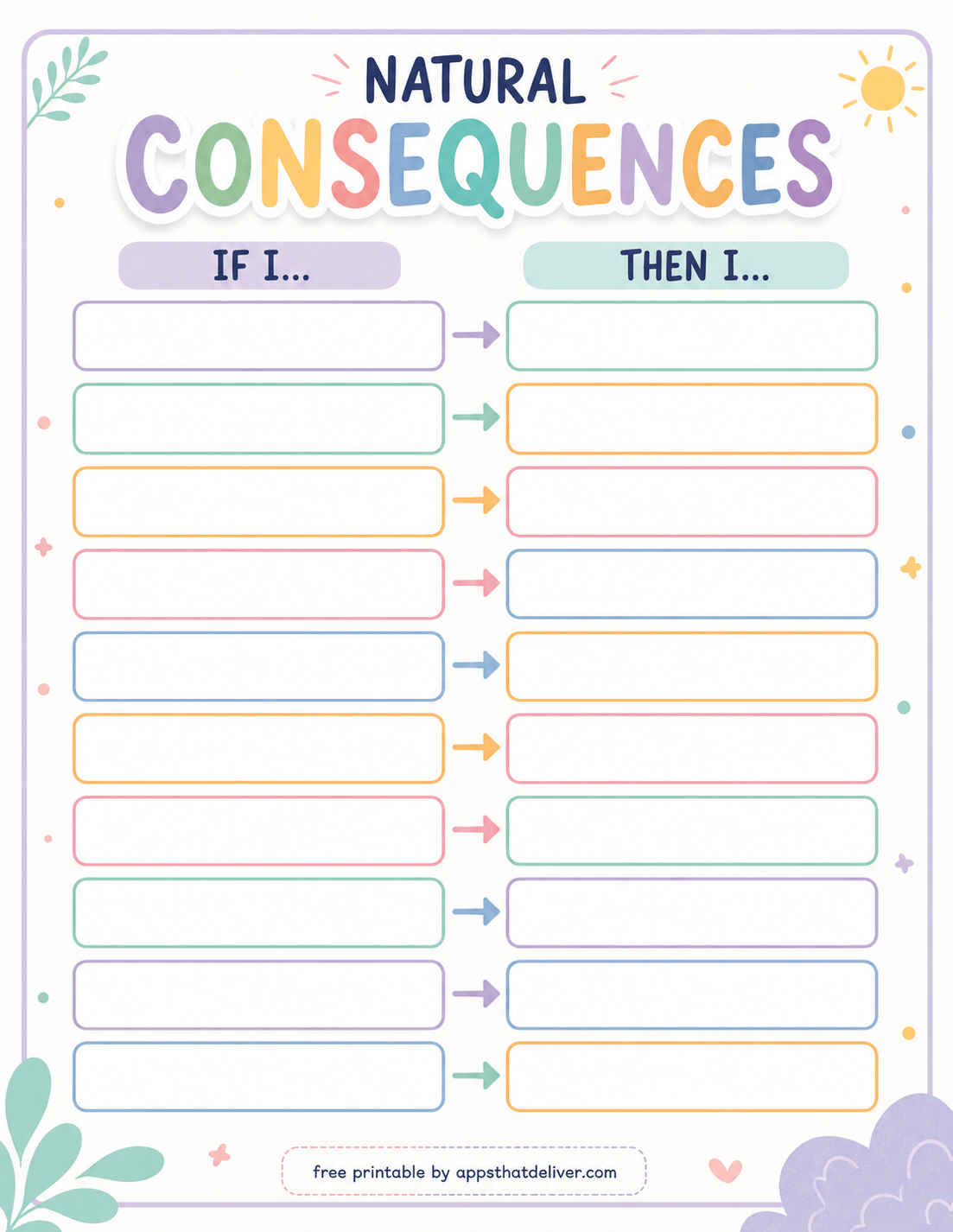
This natural consequences printable gives children another simple way to explore the connection between an action and its result.
The chart is divided into two columns labeled “If I…” and “Then I…”, with multiple colorful rows for different situations.
It’s a useful format for children who respond well to short, straightforward cause-and-effect statements.
You can use it to discuss everyday responsibilities, choices, routines, and situations where an action naturally leads to a particular result.
Because there are multiple rows, you can fill out several examples together or use the printable repeatedly as new situations come up.
Good for: natural consequences, cause and effect, routines, responsibility and decision-making
10. My Actions & My Consequences Chart
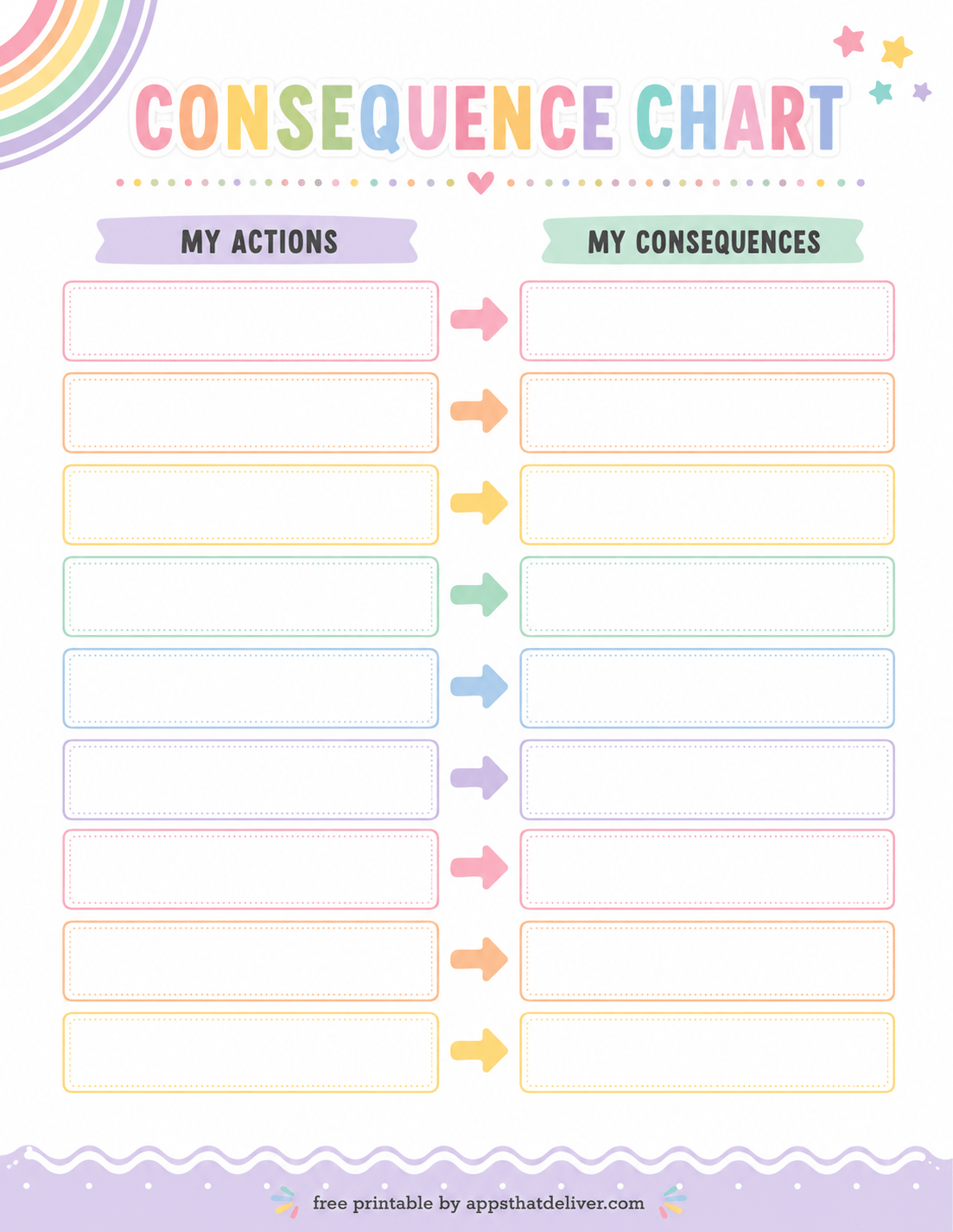
This final consequence chart keeps things very straightforward with two main sections: My Actions and My Consequences.
The two-column layout makes the connection between an action and its result easy to see. Each row provides space for a behavior or choice on the left and the resulting consequence on the right.
This can be useful for children who don’t need a lot of extra instructions and simply benefit from seeing the relationship between what they do and what happens afterward.
It can also be used as a discussion worksheet. After an incident, you can work through one row together and talk about what happened, what the result was, and what might be done differently next time.
Good for: simple behavior reflection, cause and effect, responsibility and consequences
How to Use a Consequence Chart
There’s no single right way to use a consequence chart. The best approach depends on the child’s age, the situation, and what you’re hoping the chart will accomplish.
The goal should be to make the connection between behavior and consequences easier to understand, not to turn the worksheet into another source of conflict.
- Choose the right chart. Pick a printable that matches the child’s age and the situation you’re dealing with.
- Explain the purpose. Let the child know that the chart is there to help understand choices and what happens as a result.
- Describe the behavior clearly. Avoid vague statements when a specific description is possible.
- Talk about why it matters. Help the child understand how their action affected the situation, another person, or a responsibility.
- Identify the consequence. Record what happened as a result of the action.
- Think about repair. When appropriate, consider whether there is something the child can do to repair the situation.
- Discuss the next choice. Ask what they could try differently if the same situation happens again.
The chart doesn’t need to be completed perfectly every time. Sometimes one short conversation and one completed row is enough.
Natural Consequences vs. Punishments
The terms natural consequences and punishments are sometimes used interchangeably, but they aren’t necessarily the same thing.
A natural consequence is something that happens as a direct result of a choice without someone having to create an additional consequence.
For example, if someone forgets an item they needed, they may have to deal with the result of not having it. The consequence comes from the situation itself.
A consequence imposed by an adult is different because someone decides what will happen after a behavior.
These printables can be used to help children understand either kind of cause-and-effect relationship. The important part is explaining the connection clearly and keeping the conversation focused on learning, responsibility, and what happens next.
How to Choose the Right Consequence Chart
With 10 different printables, you may be wondering which one to start with.
Here’s a simple way to narrow it down.
- For teens: Start with the Teens Consequence Chart because it provides more space for explaining behavior, consequences, and positive reminders.
- For teachers: The Daily Behavior Documentation printable is useful when you need to record triggers, transitions, strategies, outcomes, and follow-up.
- For natural consequences: Choose one of the If/Then Natural Consequences charts.
- For younger kids: The Kids Action Consequence Chart provides simple sections for behavior, why it matters, consequences, repair, and better choices.
- For rewards and positive behavior: Try the Rewards and Consequences Chart.
- For warning systems: Use the Behavior Tracker Warning Chart or the 3-Strike Consequence Chart.
- For simple reflection: The My Actions & My Consequences chart is a straightforward two-column option.
- For choice-based discussions: Try the My Choices & Consequences Chart.
You can also print several versions and see which one your child or students respond to best.
Tips for Using Behavior and Consequence Charts
A printable works best when it becomes a useful part of a larger conversation rather than something that is pulled out only when everyone is already frustrated.
- Keep the language simple and specific.
- Explain expectations before a problem happens whenever possible.
- Use the chart consistently rather than changing the rules every time.
- Give children an opportunity to explain what happened.
- Focus on the behavior rather than labeling the child.
- Use positive reminders alongside discussions about consequences.
- When appropriate, include a repair step after a mistake.
- Look for patterns rather than judging a single incident in isolation.
- Keep completed charts if you need to look back for recurring patterns.
- Choose a different printable if the current format isn’t working well.
Most importantly, remember that the printable is just a tool. The conversation around it is often more important than the chart itself.
Why Visual Behavior Charts Can Be Helpful
Children often understand information differently when they can see it written down.
A visual behavior chart turns an abstract idea like “your choices have consequences” into something concrete. Instead of only hearing a verbal explanation, the child can see the action, the result, and sometimes the next step all in one place.
For younger children, the colors, icons, arrows, and simple sections can make the idea easier to follow. For older children and teens, a more detailed chart can provide space for reflection without making the conversation feel like a lecture.
Teachers may also find behavior documentation charts useful because they provide a consistent place to record information that might otherwise be forgotten by the end of a busy day.
Using Consequence Charts at Home
At home, a consequence chart can be used for many everyday situations.
You might use one to discuss household responsibilities, sibling conflicts, forgotten tasks, routines, respectful communication, screen-time expectations, or other behaviors that come up repeatedly.
It can be helpful to introduce the chart when everyone is calm rather than waiting until the middle of an argument.
For example, you can explain what each section means, discuss a few hypothetical examples, and let the child help decide what a positive choice might look like.
That way, the chart becomes familiar before you actually need it.
Using Behavior Charts in the Classroom
Teachers often need more than a simple good-behavior/bad-behavior chart.
Sometimes the important information is what happened immediately before a behavior, where it happened, what strategy was tried, and how the child responded afterward.
That’s why the Daily Behavior Documentation printable in this collection includes sections for transitions, possible triggers, strategies used, outcomes, duration, teacher notes, and communication.
For simpler classroom situations, the warning charts and action-and-consequence charts may be more appropriate.
The advantage of having several different formats is that you can choose the level of documentation that makes sense for the situation.
How to Print These Consequence Charts
All of these worksheets are designed to be used as printable PDFs. You can download the version you want, save it to your device, and print it at home or through a local print shop.
For the best results, use standard printer paper and make sure your printer is set to the appropriate paper size. If you want to reuse a chart, you can also place it inside a clear sheet protector and use a dry-erase marker.
You can print several copies if you want to track behavior over multiple days or use the same chart with more than one child.
Frequently Asked Questions
Yes. All 10 consequence, behavior, and responsibility printables in this collection are free PDF printables. You can download and print the charts you find useful.
A consequence chart is a visual worksheet that helps children understand the relationship between an action or behavior and what happens as a result. Depending on the chart, it may also include reflection, repair steps, rewards, warnings, or better choices for next time.
A natural consequences chart helps children think about the connection between a choice and the result that naturally follows. These printables often use an If/Then format to make cause and effect easier to understand.
Yes. These printable charts can be used at home for conversations about choices, responsibilities, routines, behavior, rewards, consequences, and better choices.
Yes. Several of the printables are suitable for classroom use, including the Daily Behavior Documentation printable, behavior tracker, warning charts, and action-and-consequence worksheets.
Yes. The collection includes a Teens Consequence Chart with sections for action or behavior, why it is not okay, consequences of the action, and a positive reminder.
A behavior chart often focuses on tracking or recording behavior, while a consequence chart focuses more directly on the relationship between an action and what happens afterward. Some printables combine both approaches.
Start with simple, specific examples. Help the child identify what happened, what choice was made, what happened as a result, and what could be done differently next time. A visual consequence chart can make this process easier to understand.
Yes. These charts are designed as printable PDF worksheets and can be printed at home on standard printer paper.
Not necessarily. A consequence chart can be used to help children understand cause and effect, reflect on behavior, identify repair steps, recognize positive choices, and plan what to do differently next time. The exact approach depends on how the chart is used.
Final Thoughts
Helping children understand consequences doesn’t have to mean turning every mistake into a major confrontation.
Sometimes, a simple worksheet gives everyone a chance to slow down, look at what happened, and think about what could happen next.
That’s what these consequence charts are designed to do.
Whether you’re looking for a free consequence chart for kids, a teen behavior chart, a natural consequences printable, a classroom behavior tracker, or a simple worksheet for discussing choices, there’s a printable in this collection that may fit what you’re looking for.
Choose the format that makes the most sense for your situation, print it out, and use it as a starting point for a conversation.
You don’t have to use every section, fill out every row, or create a complicated system. The goal is simply to make choices, actions, and consequences easier to understand.
And because all 10 printables are free, you can try different versions and see which one works best for your family, classroom, or child.
Pick your favorite consequence chart, print it today, and start turning everyday behavior conversations into opportunities for reflection and better choices.