

Keeping track of blood sugar readings can be challenging, especially when you need to remember several measurements throughout the day.
A blood sugar log printable gives you a simple place to record your glucose levels, check changes before and after meals, and keep important information organized.
Whether you monitor your blood sugar daily, follow a specific testing schedule, or want to bring a written record to your healthcare appointments, having a clear tracking sheet can make the process easier.
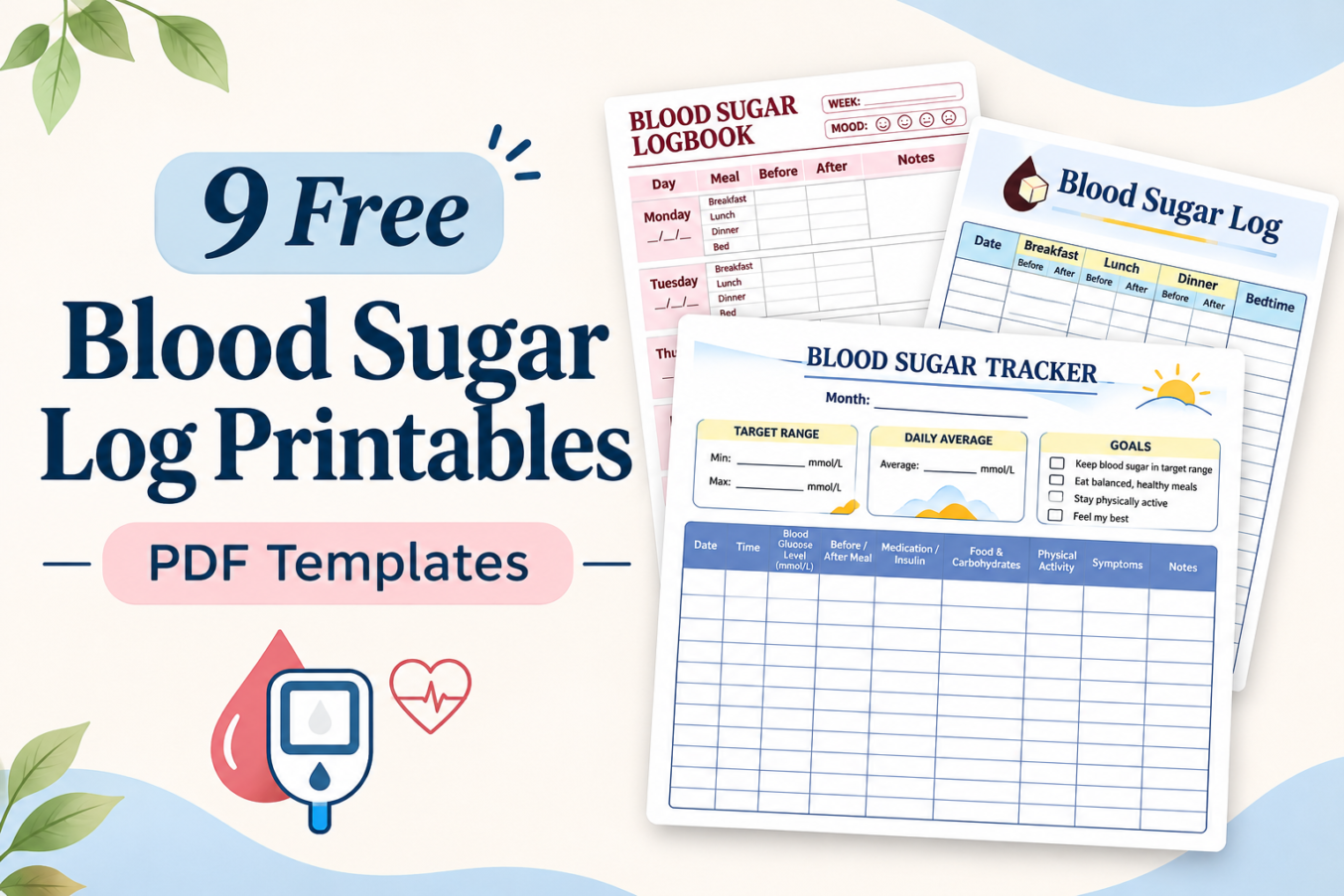
That’s why I’ve put together this collection of 9 free blood sugar log printables. You’ll find everything from simple monthly glucose charts to detailed weekly tracking sheets with spaces for insulin, carbohydrates, symptoms, and notes.
All nine designs have blank spaces for recording your information by hand, so you can choose the layout that best matches your monitoring routine.
Free Blood Sugar Log Printables
Everyone’s blood sugar monitoring routine is different. Some people record glucose levels before and after meals, while others need to track medication, physical activity, or additional health measurements.
These printable blood glucose logs offer several ways to organize that information.
- Weekly Blood Sugar Logbook with meals, dates, mood, and notes
- Simple Weekly Blood Sugar Log with before-and-after meal readings
- Blood Sugar Log with breakfast, lunch, dinner, and bedtime columns
- Monthly Blood Sugar Tracker with 31 numbered days
- Combined Blood Sugar and Blood Pressure Tracker
- Weekly Blood Sugar Log with fasting readings and weekly summary
- Detailed Blood Sugar Log with goals, symptoms, insulin, and carbohydrates
- Monthly Blood Sugar Log with insulin and carbohydrate tracking
- Simple Blood Sugar Tracker with two side-by-side recording tables
Each printable has a different layout, making it easy to choose between a straightforward glucose record and a more detailed monitoring worksheet.
Why Use a Printable Blood Sugar Log?
A printable blood sugar log helps you keep glucose measurements together instead of relying on memory or scattered notes.
It can also make it easier to review your readings over several days or weeks and discuss them with your healthcare professional.
- Keep readings organized. Record blood sugar measurements in a consistent place.
- Compare meal-related readings. Track glucose levels before and after breakfast, lunch, and dinner when those measurements are part of your care plan.
- Notice recurring patterns. Review whether readings tend to change at particular times of the day.
- Record additional information. Depending on the template, write down insulin, carbohydrates, physical activity, symptoms, or blood pressure.
- Prepare for appointments. Bring your completed log to help your healthcare professional understand your recorded measurements.
- Maintain a written history. Store completed pages in a binder or folder for future reference.
A tracking sheet does not replace medical advice or a glucose monitoring device. Its purpose is to help you document information and follow the monitoring schedule recommended by your healthcare team.
How to Use These Blood Sugar Tracking Sheets
Getting started is simple. Choose the printable that includes the information you need to record, then fill it out as you take your measurements.
- Choose your preferred design. Pick a weekly meal-based log, a monthly tracker, or a detailed worksheet depending on your monitoring routine.
- Download and print the PDF. Select the corresponding download button and print the worksheet.
- Fill in the date or week. Write the appropriate month, date, or week in the space provided.
- Record your glucose readings. Enter each measurement in the correct row or column.
- Include the measurement unit. Record whether your glucose values are in mg/dL or mmol/L when needed, and use the same unit consistently.
- Add relevant details. Use the available spaces to record meals, insulin, carbohydrates, symptoms, physical activity, or notes.
- Review your completed entries. Look for patterns and share your records with your healthcare professional when appropriate.
You don’t need to complete every available field. Use the sections that apply to your care plan, and follow your healthcare professional’s guidance about when to check your blood sugar.
9 Free Printable Blood Sugar Log Sheets (PDF Templates)
Below are all nine blood sugar log designs. Each offers a different way to record glucose measurements and related information.
Take a look at the layouts and choose the printable that works best for you.
1. Weekly Blood Sugar Logbook with Meals and Mood Tracker
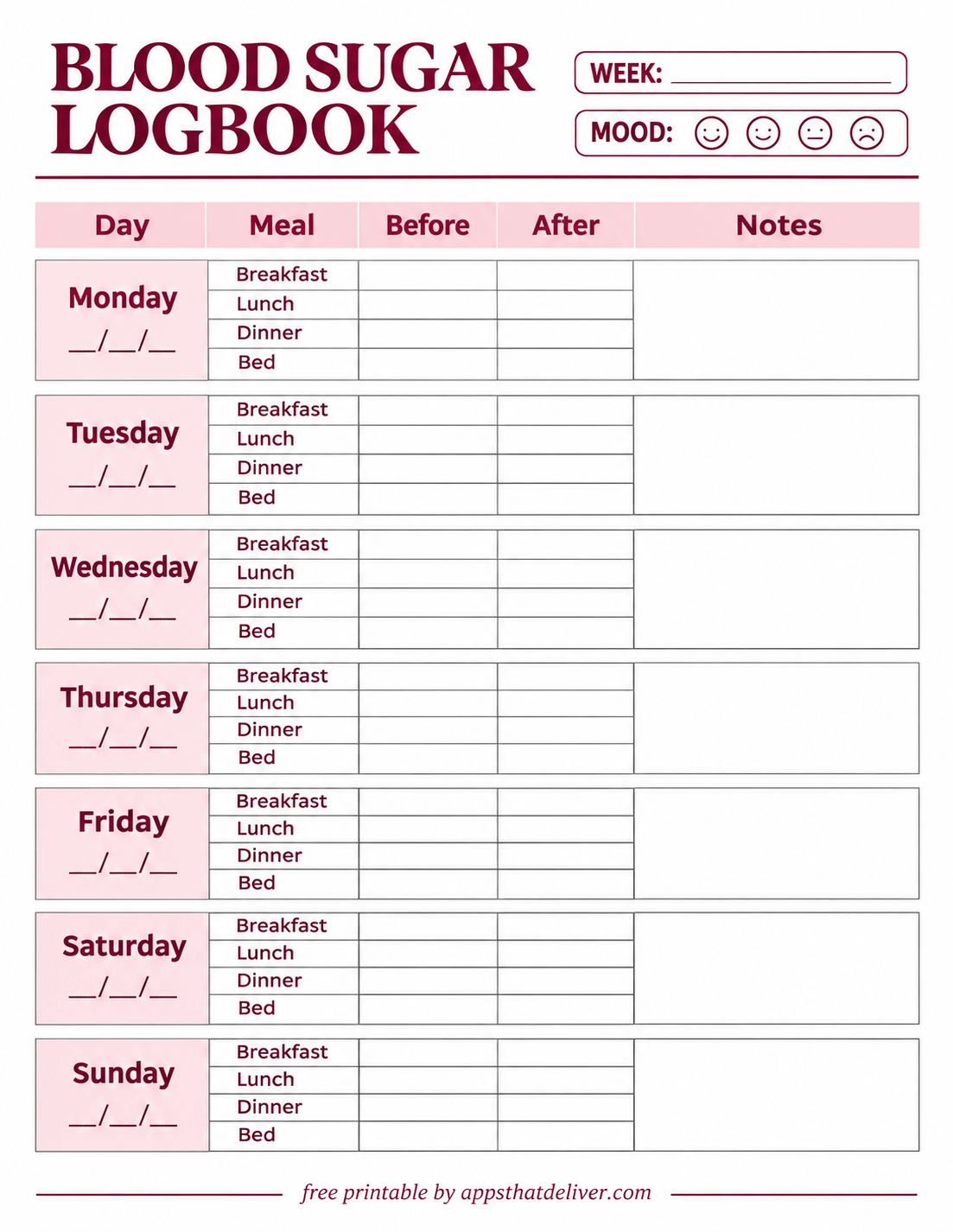
This Weekly Blood Sugar Logbook is a practical choice for anyone who wants to record meal-related glucose readings and daily notes in one organized worksheet.
The log is divided into seven sections, covering Monday through Sunday. Each day includes a blank date field and four recording rows: Breakfast, Lunch, Dinner, and Bed.
For each meal or bedtime entry, you can record blood sugar measurements in the Before and After columns. A spacious Notes column gives you room to write additional observations for the day.
At the top, you’ll find a blank Week field and four mood symbols that can be marked to reflect how you’re feeling.
The soft pink and burgundy color scheme makes the worksheet visually appealing while keeping the recording areas easy to follow.
Best for: Weekly meal-based glucose monitoring with daily notes and a simple mood check-in.
2. Simple Weekly Blood Sugar Log with Before and After Meal Readings
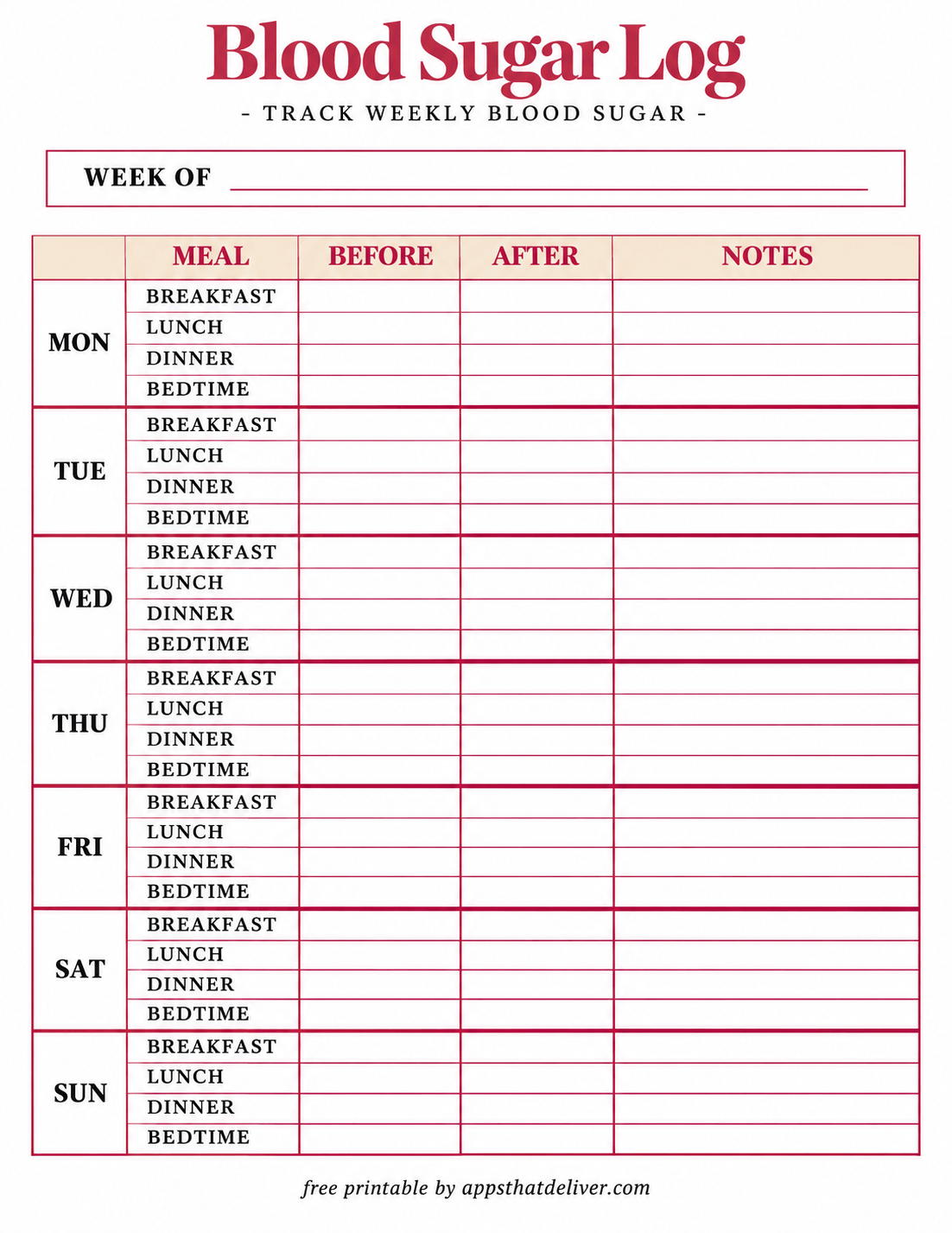
If you prefer a straightforward worksheet without additional tracking sections, this Weekly Blood Sugar Log is a useful option.
The printable includes a Week Of field at the top, followed by a large table covering Monday through Sunday.
Each day is divided into Breakfast, Lunch, Dinner, and Bedtime rows. The Before and After columns provide spaces for glucose measurements, while the Notes column allows you to record additional information.
Its simple red-and-white layout uses clear borders and bold headings to separate the days and meal entries.
Because everything is arranged in one continuous table, you can quickly scan your readings across the entire week.
Best for: A simple weekly blood sugar record focused on meals, bedtime, and notes.
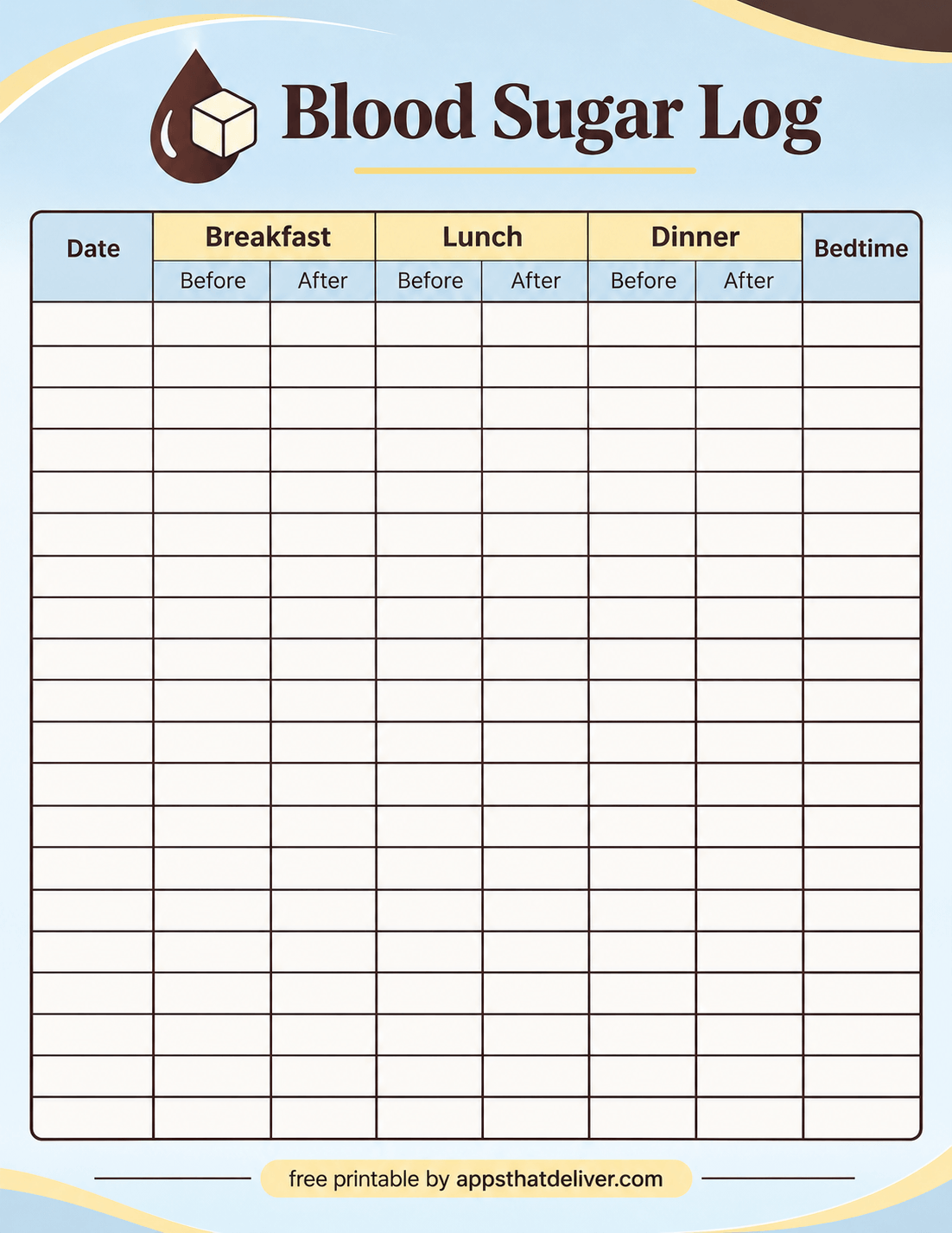
3. Blood Sugar Log with Breakfast, Lunch, Dinner, and Bedtime Columns
This colorful Blood Sugar Log printable uses a different layout from the weekly trackers above.
Instead of listing each meal on a separate row, the worksheet arranges Breakfast, Lunch, and Dinner across the top of the page.
Each meal has separate Before and After columns, making it easy to enter and compare glucose readings taken around mealtimes.
You’ll also find a Date column on the left and a Bedtime column on the right. The large table contains multiple blank rows, allowing you to record readings over a series of days.
The light blue and pale yellow design features a decorative blood drop and sugar cube illustration near the title.
This layout is particularly helpful when you want to view several daily glucose measurements side by side without using separate sections for every day of the week.
Best for: Comparing before-and-after meal readings across multiple dates.
4. Monthly Blood Sugar Tracker with 31-Day Recording Chart
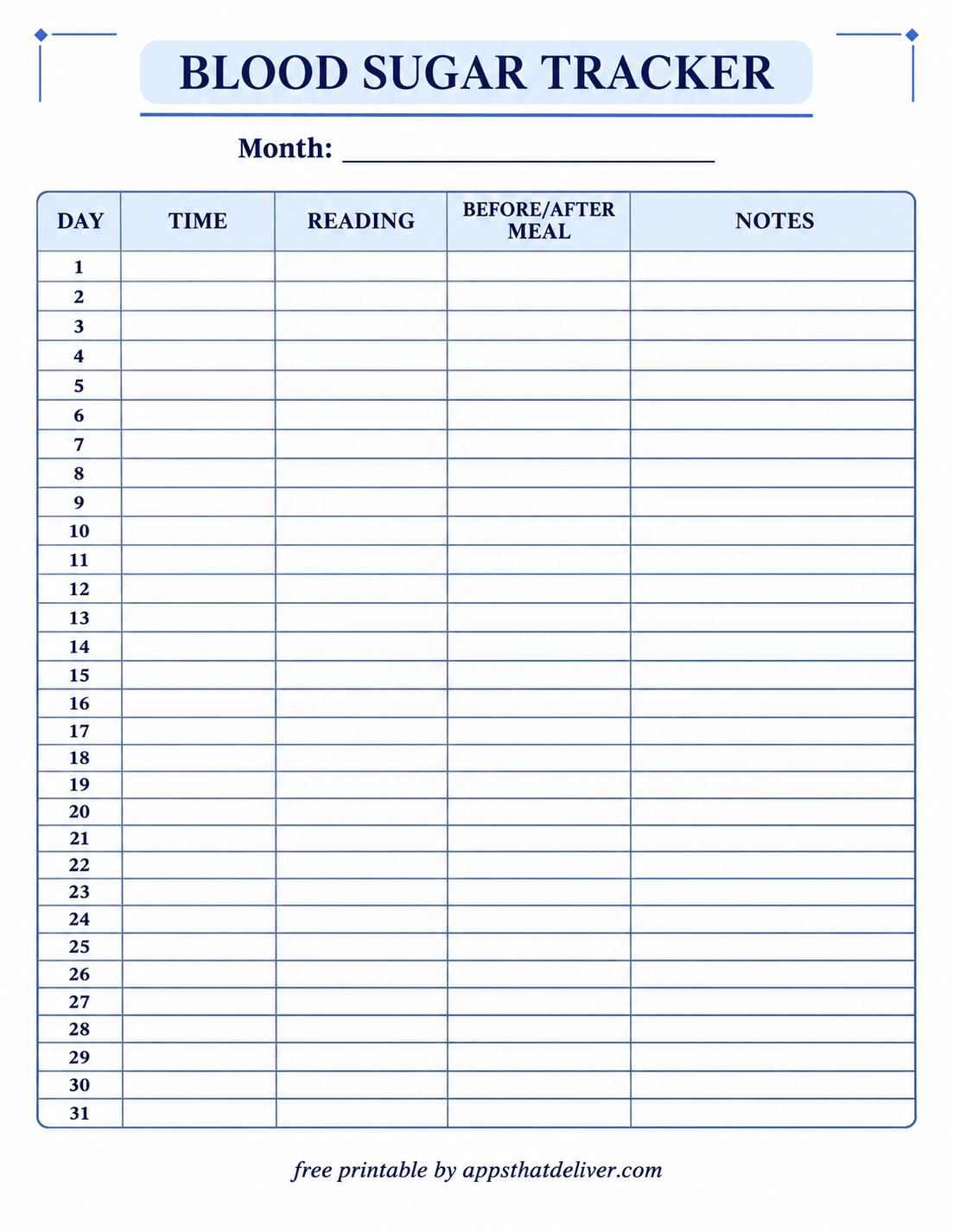
Looking for a monthly blood sugar log printable? This clean blue tracker provides a simple way to organize glucose measurements throughout an entire month.
The worksheet includes a Month field at the top and a table with numbered rows from 1 through 31.
Each row contains spaces for Day, Time, Reading, Before/After Meal, and Notes.
You can record the time of a glucose measurement, write down the reading, indicate whether it was taken before or after a meal, and include any relevant observations.
The numbered layout makes it especially convenient for keeping one dated entry per row. If you need to record several readings on the same day, you can use additional sheets or choose a more detailed template from this collection.
Its minimal blue-and-white color scheme and clearly divided columns help keep the information organized without unnecessary decoration.
Best for: Simple monthly blood sugar tracking with dates, times, and notes.
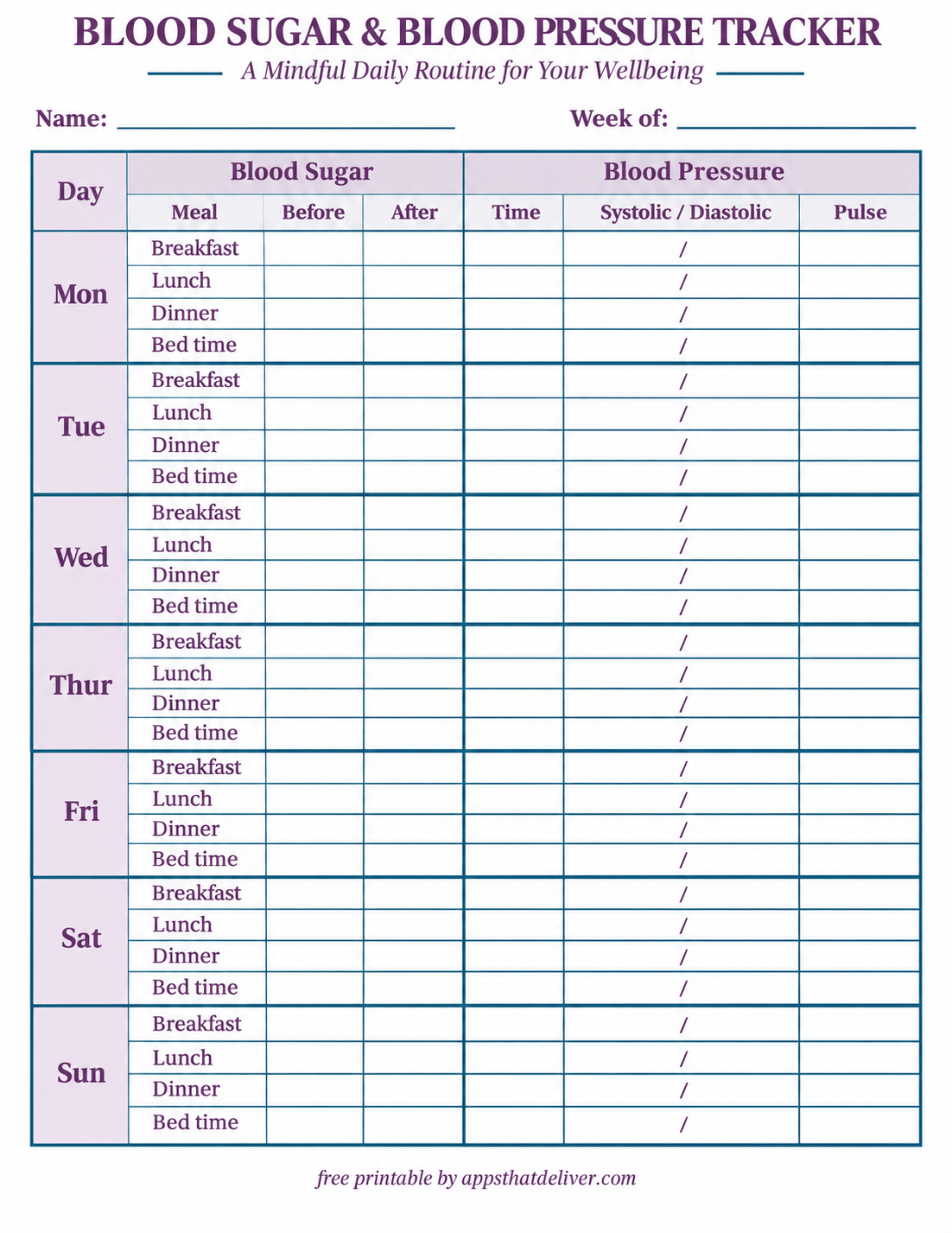
5. Blood Sugar and Blood Pressure Tracker Printable
This Blood Sugar and Blood Pressure Tracker combines two types of health measurements in one weekly worksheet.
It’s a convenient option for anyone who has been advised to monitor both blood glucose and blood pressure and wants to keep those records together.
At the top, the printable includes blank Name and Week Of fields, followed by a large table divided into Blood Sugar and Blood Pressure sections.
The blood sugar section includes Meal, Before, and After columns. Each day provides rows for Breakfast, Lunch, Dinner, and Bed time.
The blood pressure section includes Time, Systolic / Diastolic, and Pulse columns.
This arrangement lets you record glucose readings and blood pressure information alongside each other without needing two separate sheets.
The worksheet uses a soft lavender and blue color palette, with bold day labels and clearly separated weekly sections.
Best for: Keeping weekly blood sugar, blood pressure, and pulse records together.
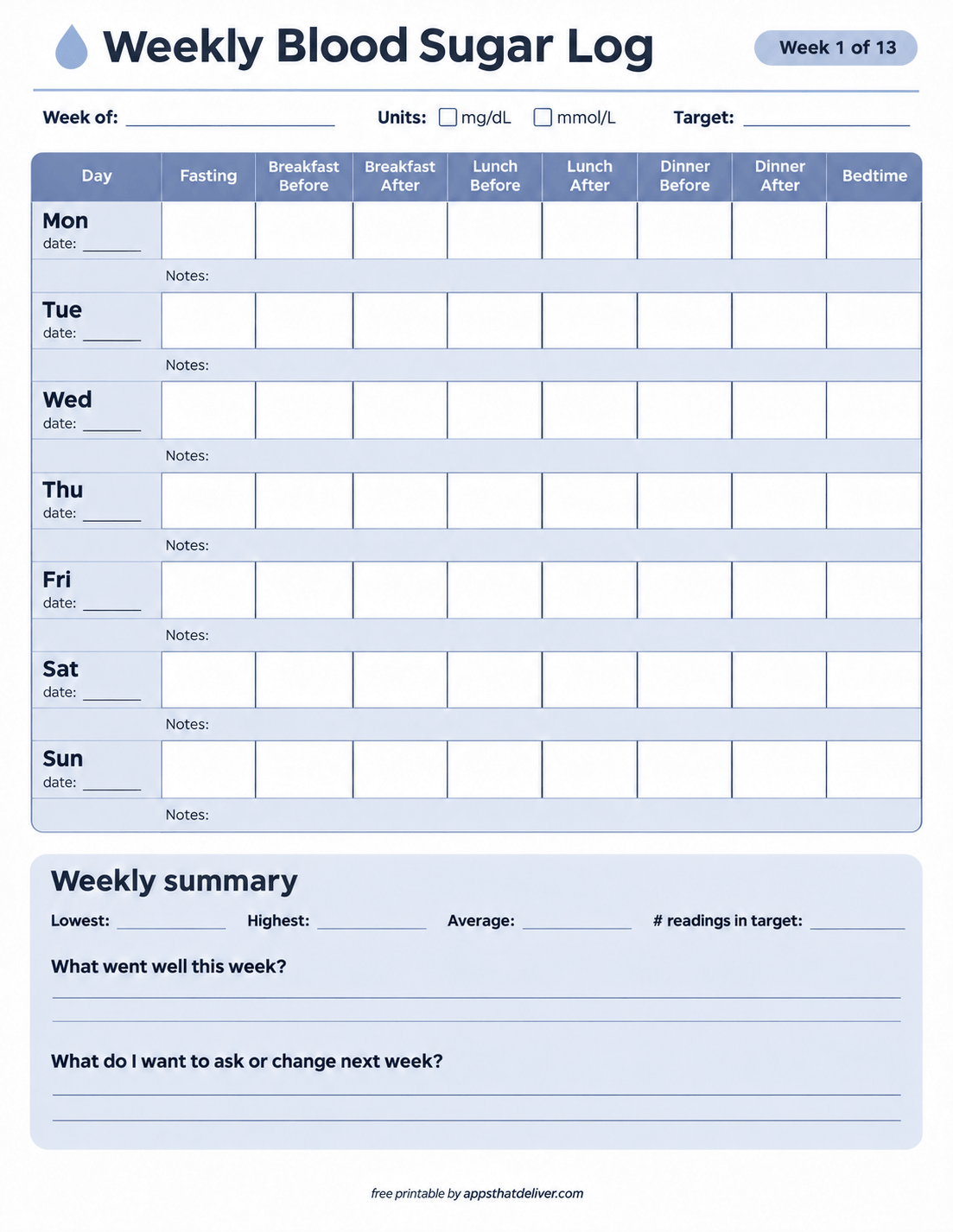
6. Weekly Blood Sugar Log with Fasting Readings and Summary
This detailed Weekly Blood Sugar Log is designed for people who want to record several daily glucose measurements and review their results at the end of the week.
The top section includes spaces for Week Of, Units, and Target. You can mark whether your measurements are recorded in mg/dL or mmol/L.
The main table covers Monday through Sunday, with separate columns for Fasting, Breakfast Before, Breakfast After, Lunch Before, Lunch After, Dinner Before, Dinner After, and Bedtime.
Each day also includes a blank date field and a dedicated Notes row for additional observations.
What makes this printable especially useful is the Weekly Summary section at the bottom.
Here, you can record your Lowest, Highest, and Average readings, along with the number of readings within your target range.
Two reflection prompts provide space to write what went well during the week and what you might want to ask or change next week.
The blue-and-white layout keeps the daily measurements organized while providing extra room for reviewing the week as a whole.
Best for: Detailed weekly glucose monitoring, fasting readings, and end-of-week review.
7. Detailed Blood Sugar Log with Insulin, Carbohydrates, and Symptoms
If you need a more comprehensive blood glucose monitoring log, this printable includes several additional tracking sections beyond basic glucose measurements.
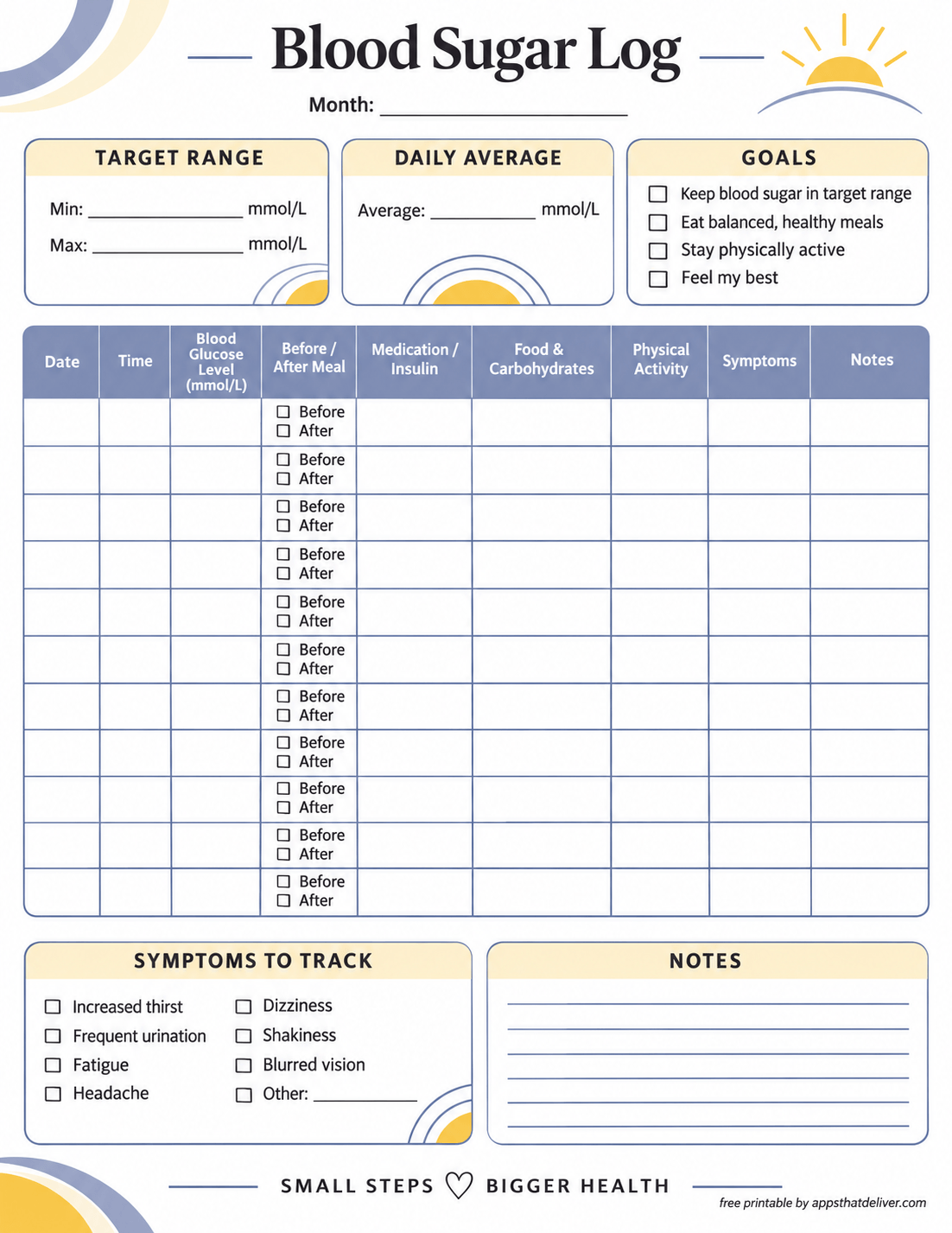
The top of the worksheet has a Month field, followed by three separate panels: Target Range, Daily Average, and Goals.
The Target Range section includes spaces for minimum and maximum glucose values in mmol/L, while the Daily Average panel provides a space for recording an average measurement.
The Goals panel includes checkboxes for keeping blood sugar within the target range, eating balanced meals, staying physically active, and feeling your best.
Below these sections is a detailed tracking table with columns for Date, Time, Blood Glucose Level (mmol/L), Before / After Meal, Medication / Insulin, Food & Carbohydrates, Physical Activity, Symptoms, and Notes.
The Before / After Meal column includes separate blank checkboxes, making it easy to identify the timing of each reading.
At the bottom, a Symptoms to Track section provides checkboxes for increased thirst, frequent urination, fatigue, headache, dizziness, shakiness, blurred vision, and other symptoms.
There’s also a separate Notes section with writing lines for recording additional information.
The soft blue and yellow design includes decorative sunshine and rainbow elements, giving the worksheet a cheerful appearance without sacrificing its practical layout.
Best for: Detailed glucose tracking that includes meals, insulin, carbohydrates, activity, symptoms, and personal goals.
8. Monthly Blood Sugar Log with Insulin and Carbohydrate Tracking
This Monthly Blood Sugar Log printable is a straightforward option for recording glucose readings alongside insulin and carbohydrate information.
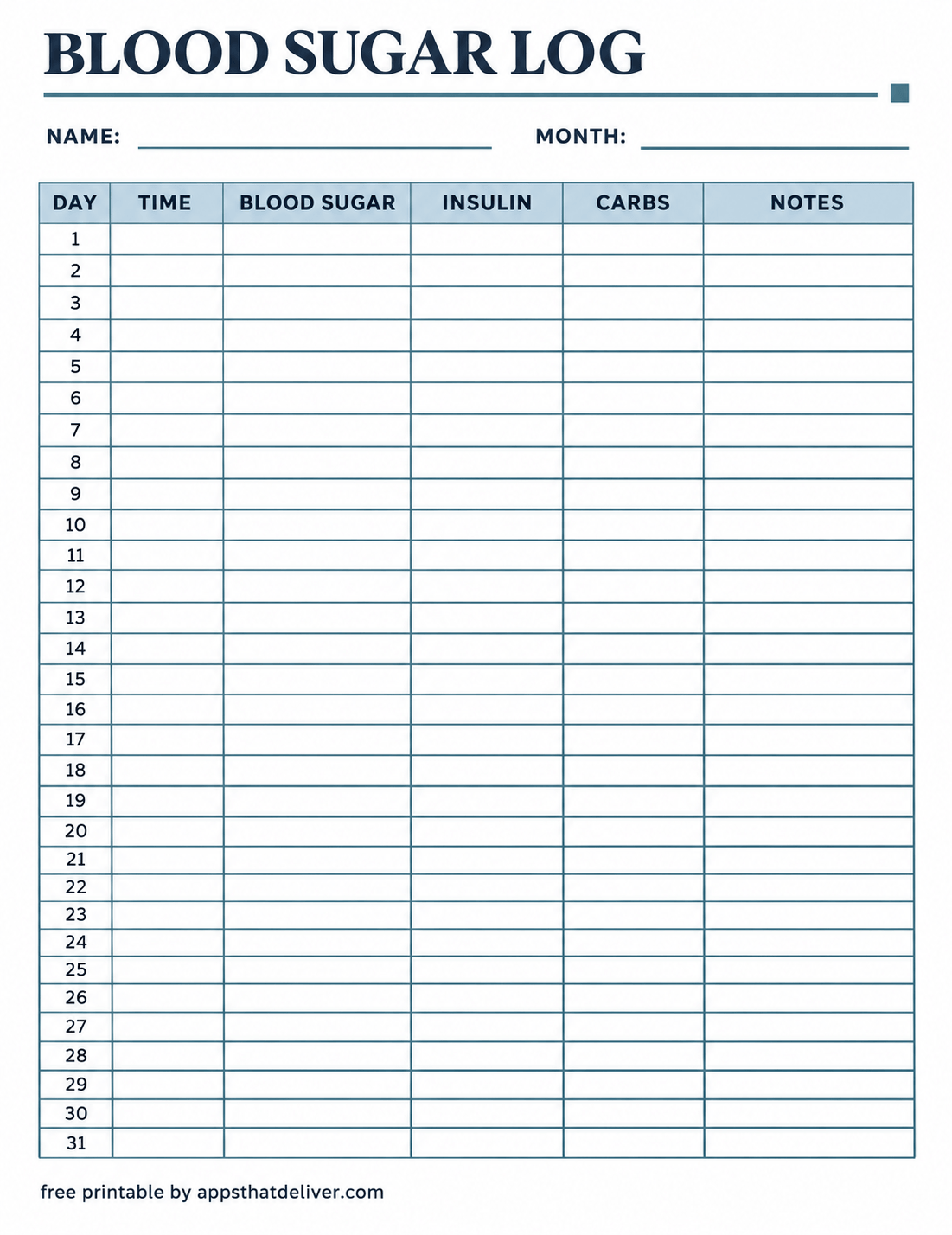
The worksheet features a bold title, blank Name and Month fields, and a large table with numbered rows from 1 through 31.
The table includes six columns: Day, Time, Blood Sugar, Insulin, Carbs, and Notes.
You can write the time of each measurement, record your blood sugar value, and enter any relevant insulin or carbohydrate information.
The Notes column provides additional space for observations that may be helpful when reviewing your records.
Its light blue and dark navy color scheme creates a clean, easy-to-read worksheet with minimal decoration.
Because the rows are numbered by day, this template is particularly suitable for a simple monthly overview. If you need to record multiple readings every day, consider using additional pages or choosing one of the weekly meal-based logs.
Best for: Monthly blood sugar records that also include insulin and carbohydrate tracking.
9. Simple Blood Sugar Tracker with Date, Time, Level, and Notes
This elegant Blood Sugar Tracker printable is designed for people who prefer a minimal, flexible recording sheet.
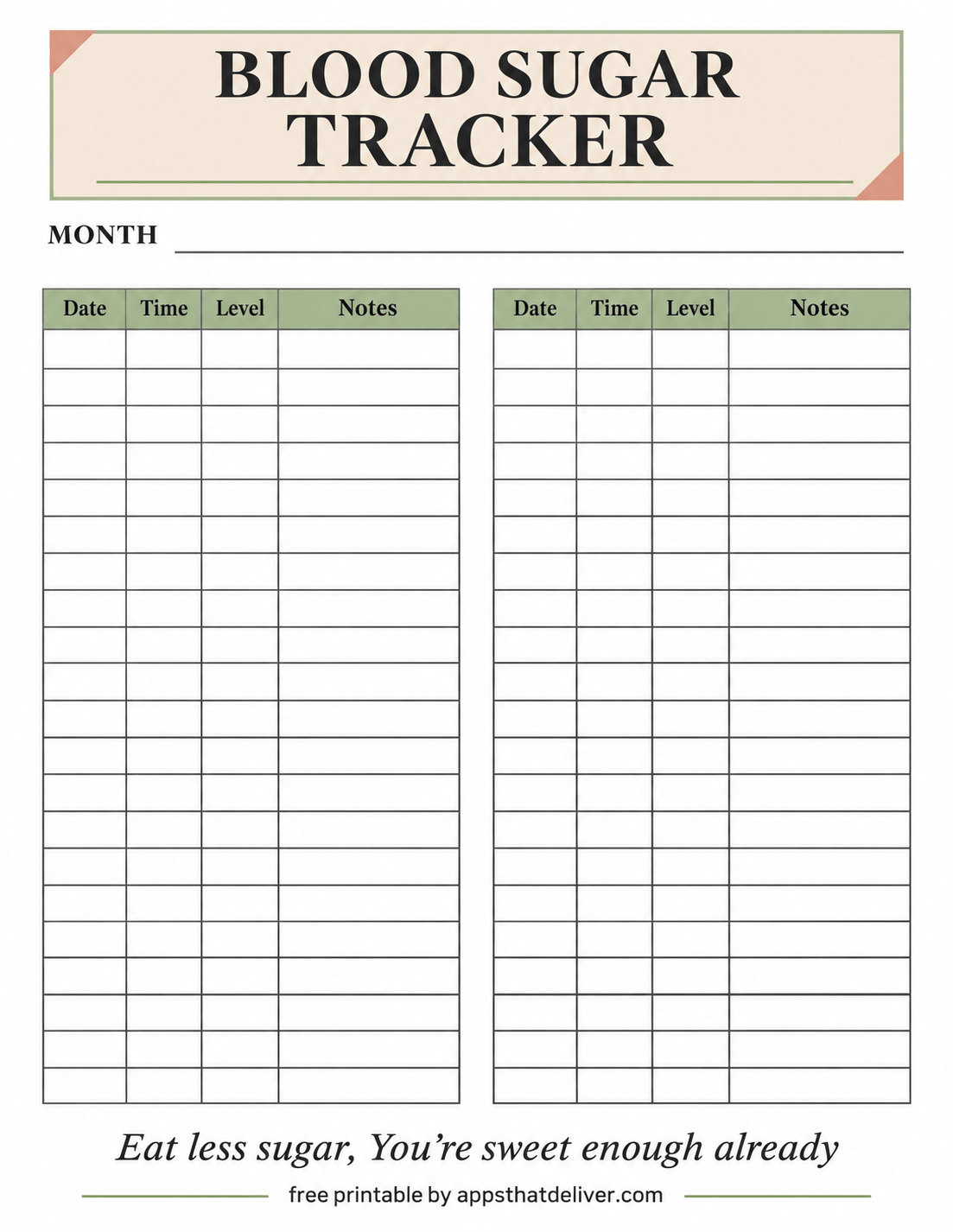
The top of the page includes a large Blood Sugar Tracker heading and a blank Month field.
Below the heading are two side-by-side tables, each containing Date, Time, Level, and Notes columns.
Unlike a tracker with fixed meal labels or numbered calendar days, this worksheet lets you enter dates and measurement times as needed.
You can use the rows for fasting readings, before-and-after meal measurements, bedtime readings, or other checks recommended by your healthcare professional.
The generous number of blank rows makes it useful for recording multiple measurements over time.
Its muted green and peach design includes a decorative header and a small motivational message at the bottom.
Best for: Flexible blood sugar recording without predefined meal times or daily schedules.
Which Blood Sugar Log Printable Should You Choose?
With nine different designs available, the best printable depends on what information you need to record and how often you check your blood sugar.
- For weekly meal-based tracking: Choose Printable 1 or Printable 2. Both provide separate rows for breakfast, lunch, dinner, and bedtime.
- For comparing readings across meals: Printable 3 arranges before-and-after glucose measurements in side-by-side columns.
- For a simple monthly record: Printable 4 includes 31 numbered rows with spaces for time, reading, meal timing, and notes.
- For blood sugar and blood pressure monitoring: Printable 5 combines glucose measurements with blood pressure and pulse records.
- For detailed weekly reviews: Printable 6 includes fasting readings, meal-related measurements, daily notes, and a weekly summary.
- For medication and symptom tracking: Printable 7 provides sections for insulin, carbohydrates, activity, symptoms, goals, and notes.
- For monthly insulin and carbohydrate records: Printable 8 combines blood sugar, insulin, and carbohydrate columns.
- For flexible tracking without fixed times: Printable 9 offers two simple tables with date, time, level, and notes fields.
You can also use more than one printable if different layouts help you organize different types of information.
What Should You Record in a Blood Sugar Log?
A useful blood sugar log includes enough information to help you understand when a measurement was taken and what may have been happening around that time.
The exact details you need depend on your monitoring plan, but several types of information are commonly useful.
1. Date and Time of the Reading
Record the date and time whenever you check your blood sugar.
Having this information makes it easier to compare measurements taken at similar times on different days.
For example, you may want to review fasting readings separately from measurements taken later in the day.
2. Blood Sugar Measurement
Write down the glucose value displayed by your monitoring device.
Make sure you know whether your device uses mg/dL or mmol/L. These are different measurement units, so readings should always be interpreted using the correct unit.
If your printable does not have a dedicated unit field, you can write the unit near the title or in the notes area.
3. Before or After Meals
Meal timing can provide important context for a blood sugar measurement.
Several printables in this collection include separate Before and After columns for breakfast, lunch, and dinner.
Use these fields to identify when the reading was taken relative to a meal, following the timing recommended by your healthcare professional.
4. Medication or Insulin Information
If your healthcare team has asked you to record medication or insulin use, a log with a dedicated medication column may be helpful.
Printables 7 and 8 include spaces for insulin-related information, making it easier to keep those details alongside your glucose readings.
Always follow your prescribed medication instructions. A written log is for recording information, not deciding medication changes independently.
5. Meals and Carbohydrates
Some people find it helpful to record what they ate or how many carbohydrates were included in a meal.
Printables 7 and 8 provide dedicated spaces for carbohydrate information.
Recording this information may make it easier to discuss meal-related glucose patterns with a dietitian or healthcare professional.
6. Symptoms and Other Notes
A notes section can help you record information that does not fit into the standard columns.
For example, you might document unusual symptoms, changes in physical activity, illness, or other circumstances relevant to a particular reading.
These notes may provide helpful context when reviewing your records with your healthcare team.
Weekly vs. Monthly Blood Sugar Logs
Two of the most useful formats for recording glucose measurements are weekly and monthly tracking sheets.
Both can help you maintain organized records, but they serve slightly different purposes.
When to Use a Weekly Blood Sugar Log
A weekly blood sugar log is especially useful when you need to record multiple measurements throughout the day.
Weekly layouts often provide separate spaces for fasting readings, meals, bedtime, and daily notes.
Because the information covers a shorter period, there’s usually more room for individual entries and additional observations.
Printables 1, 2, 5, and 6 are particularly useful for weekly tracking.
When to Use a Monthly Blood Sugar Log
A monthly blood sugar tracker is helpful when you prefer to see measurements organized over a longer period.
Monthly worksheets with numbered rows are convenient for recording a single entry per day or maintaining a basic overview.
Printables 4 and 8 include 31 numbered rows, while Printable 9 offers flexible blank tables that can be used throughout a month.
If your monitoring schedule requires several readings every day, a weekly sheet or a more detailed multi-entry log may provide enough room to record everything clearly.
Blood Sugar Monitoring Tips for Keeping Accurate Records
Keeping a useful glucose log does not need to be complicated. A few consistent habits can make your records easier to understand and review.
- Record measurements promptly. Write down readings soon after checking them so you don’t have to rely on memory.
- Use consistent measurement units. Make sure your recorded values clearly indicate mg/dL or mmol/L.
- Follow your recommended testing schedule. Check your glucose at the times advised by your healthcare team.
- Include relevant context. Note meal timing, medication, physical activity, or symptoms when those details matter to your care plan.
- Keep entries readable. Write clearly so your measurements can be reviewed later.
- Review patterns over time. Look at several readings rather than focusing only on a single number.
- Share your log at appointments. Bring completed pages when discussing glucose management with your healthcare professional.
- Store completed sheets safely. Keep your records in a private folder or binder, especially when they contain personal health information.
If you notice unexpected readings or experience symptoms that concern you, follow your healthcare team’s instructions rather than waiting until your next routine review.
How to Organize Your Printed Blood Sugar Logs
If you use these printable blood sugar tracking sheets regularly, keeping completed pages organized can make them easier to reference later.
A simple binder or folder is often enough to store your records.
You can arrange weekly logs chronologically or group monthly sheets by month and year.
If you track blood sugar alongside blood pressure, medication, or other measurements, you may prefer separate sections for each type of record.
Another helpful approach is to print several blank copies of your preferred design in advance. This way, you’ll have a fresh tracking sheet ready whenever you need one.
When attending a healthcare appointment, bring the most relevant completed pages so you can discuss your recorded measurements and any questions you have.
Frequently Asked Questions
Yes. This collection includes nine free blood sugar log designs intended for PDF download and printing.
There are nine unique designs, including weekly glucose logs, monthly trackers, meal-based charts, a combined blood sugar and blood pressure worksheet, and detailed monitoring sheets.
Depending on your monitoring plan, you may record the date, time, glucose reading, measurement unit, meal timing, medication, carbohydrates, symptoms, and other relevant notes.
Yes. Printables 1, 2, 3, 5, and 6 include separate before-and-after meal recording spaces.
Printables 4 and 8 include 31 numbered daily rows. Printable 9 provides flexible tables that can also be used for monthly records.
Yes. Printable 5 combines blood sugar readings with blood pressure measurements, including systolic and diastolic values and pulse.
Yes. Printables 7 and 8 include dedicated spaces for recording insulin and carbohydrate information alongside glucose measurements.
Both are units used to measure blood glucose. They use different numerical scales, so it is important to record and interpret readings using the unit displayed by your glucose monitoring device.
Yes. All nine designs include a notes column, notes row, or separate writing area for recording additional information.
Yes. You can print fresh copies of your preferred design whenever you need additional tracking pages.
The appropriate testing schedule depends on your individual health needs, treatment, and monitoring method. Follow the schedule recommended by your healthcare professional.
Yes. A completed log can help your healthcare professional review recorded readings, identify patterns, and discuss your monitoring routine.
Final Thoughts
Keeping a record of blood sugar measurements doesn’t have to involve a complicated tracking system.
Sometimes, a simple printable worksheet is enough to keep readings organized and make important information easier to review.
This collection includes 9 free blood sugar log printables, ranging from simple monthly glucose charts to detailed weekly worksheets with meal tracking, insulin records, blood pressure measurements, symptoms, and notes.
Choose the design that matches your monitoring routine, download the corresponding PDF, and fill in your readings as recommended by your healthcare professional.
You can stick with one favorite design or use different printables depending on the information you need to track.
Stay organized, take care of yourself, and make your daily health records easier to manage!