

Walking is one of the simplest ways to add more movement to your daily routine. But when you’re trying to become more consistent, it can be difficult to remember how much you’ve walked or whether you’re getting closer to your goals.
That’s where a step tracker printable can come in handy.
Instead of relying only on the numbers displayed on your phone, smartwatch, or pedometer, you can write down your daily step count and create a visual record of your progress.
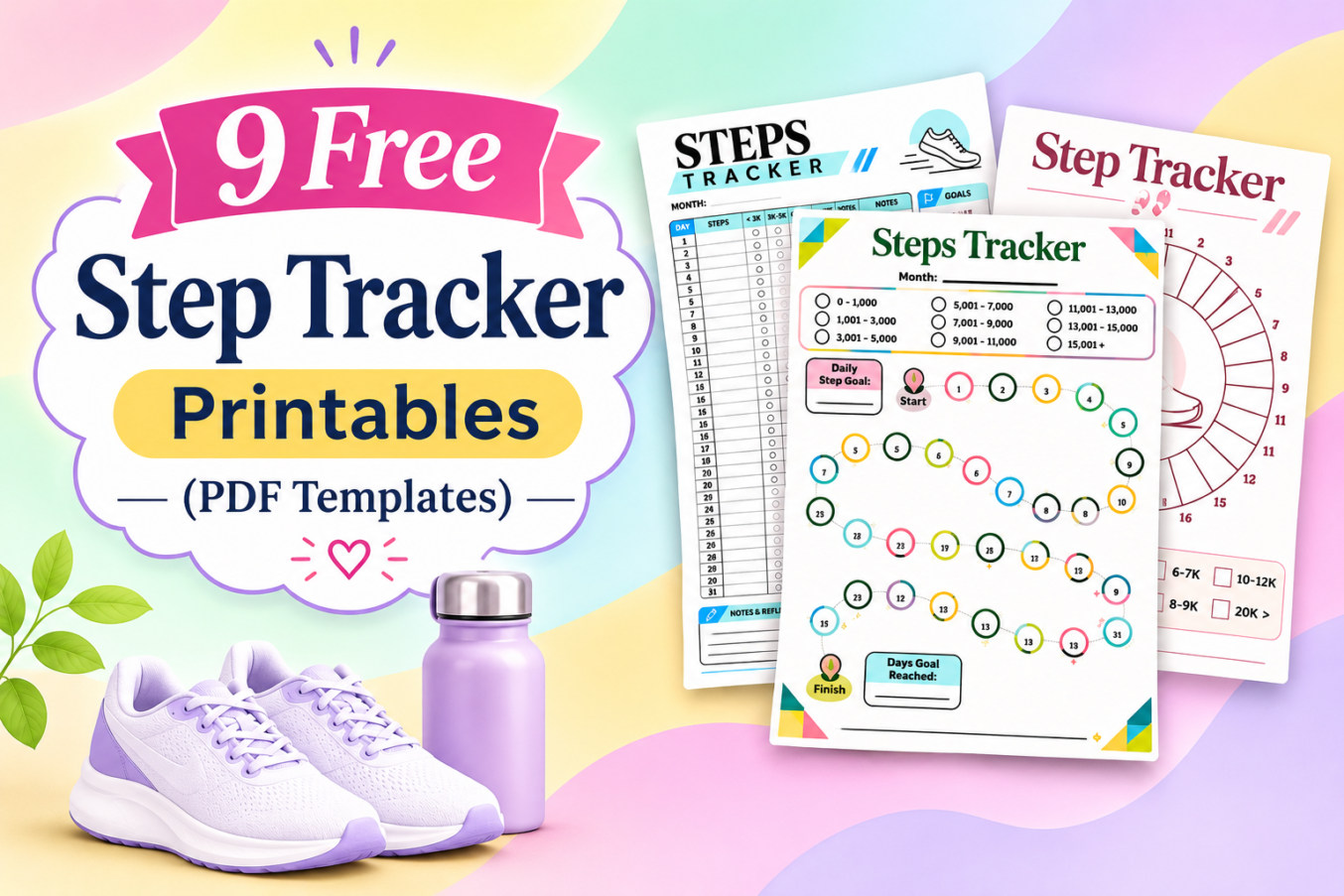
I’ve put together 9 free step tracker printables with different layouts and tracking methods. Some are designed for recording exact step counts, while others let you color circles, fill in grids, or complete a walking challenge.
Whether you’re starting a new walking routine, working toward a daily step goal, or simply trying to move more throughout the day, you can choose a printable that suits your preferences.
Free Step Tracker Printables
Everyone likes to track progress differently. Some people prefer a straightforward daily log, while others find it more motivating to color in a chart or complete a visual challenge.
That’s why this collection includes nine different printable step tracking designs:
- Daily Steps Tracker with goals, notes, and monthly summary
- Yearly Step Tracker with a 12-month tracking grid
- Step Count Tracker with monthly coloring circles
- Monthly Step Log with daily writing spaces
- Monthly Step Tracker with a step-count grid
- Shoe-Shaped Steps Tracker coloring challenge
- Colorful Walking Path Step Tracker
- Circular Step Tracker with 31 daily segments
- Simple Daily Steps Tracker with two-column log
All nine designs have blank tracking areas, so you can fill them in with your own step counts, goals, and progress. You can print a fresh copy whenever you’re ready to begin another tracking period.
Why Use a Printable Step Tracker?
A printable walking tracker gives you a simple way to turn your daily movement into something you can see and review.
Even if you already use a fitness watch or step-counting app, recording your results on paper can help you recognize patterns and stay engaged with your walking routine.
- See your progress: Compare your daily step counts and notice how your walking habits change over time.
- Set personal goals: Choose a realistic daily target and record how often you reach it.
- Build consistency: Make step tracking part of your daily routine.
- Stay motivated: Coloring a circle or completing another section of a tracker can make progress feel more rewarding.
- Identify patterns: Notice which days tend to involve more walking and which days are less active.
- Keep a written record: Save completed tracking sheets in a binder or folder to review later.
You don’t need to reach a particular number of steps to benefit from keeping a record. The most useful goal is one that makes sense for your current routine and circumstances.
How to Use These Printable Step Trackers
Using these templates is easy, even if you’ve never tracked your steps before.
- Choose your favorite design. Select a daily log if you want to write down exact numbers, or choose a coloring tracker if you prefer a visual challenge.
- Download the PDF. Use the download button beneath your chosen printable.
- Print your tracker. Print a blank copy and keep it somewhere convenient.
- Set your walking goal. If your printable includes a goal field, write down a realistic target.
- Count your steps. Use your phone, pedometer, smartwatch, or another step-counting device to check your daily total.
- Record your progress. Write your step count, mark the appropriate category, or color the matching section.
- Review your results. At the end of the month or tracking period, look back at your completed worksheet.
If you’re using a color-coded tracker, choose a different color for each step range and fill in the corresponding key. You can then use those colors to mark your daily results.
9 Free Step Tracker Printable PDF Templates
Below are all nine printable designs. Each one offers a different way to record your steps, from detailed daily tracking to creative coloring activities.
1. Daily Steps Tracker with Goals and Monthly Summary
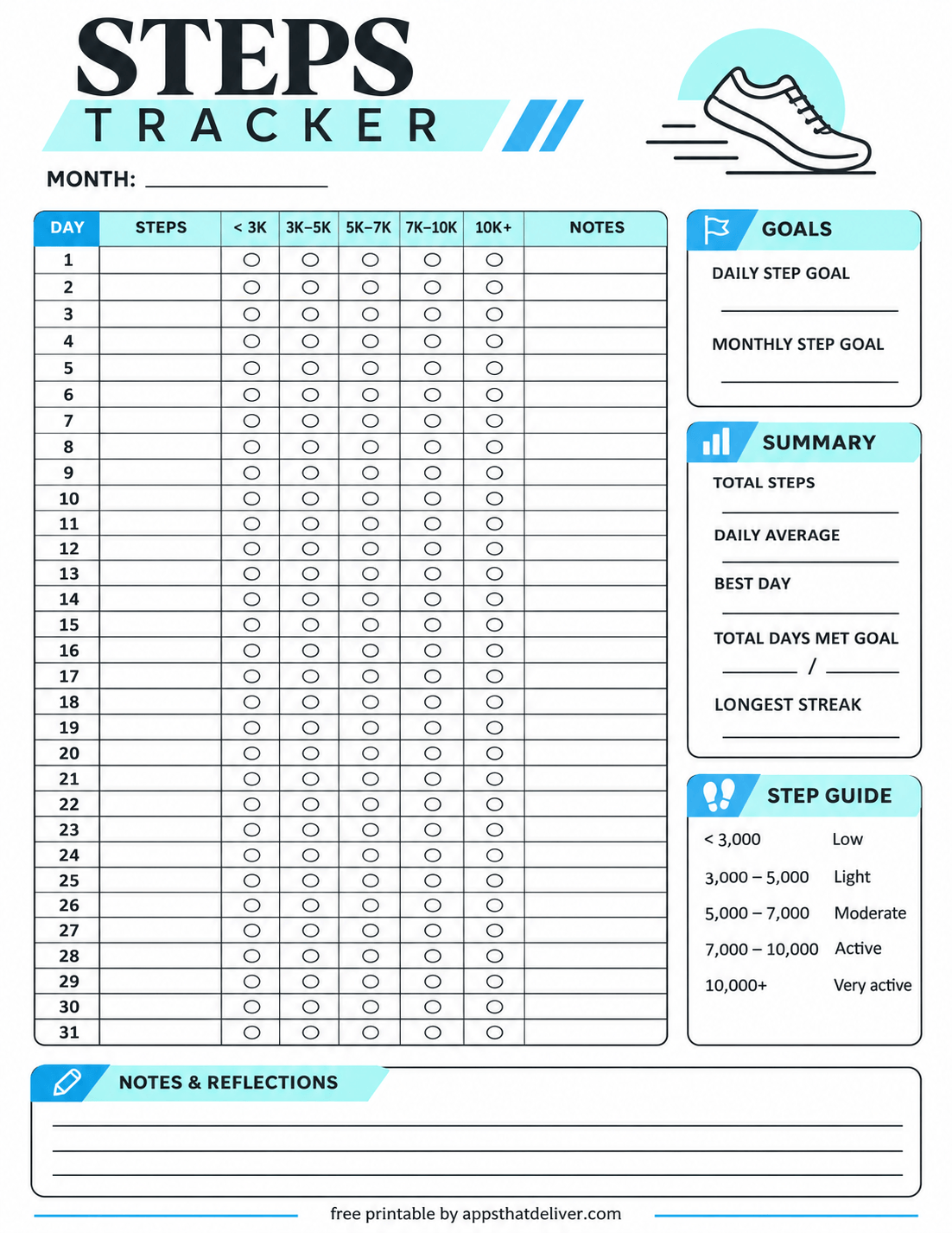
This Daily Steps Tracker is a great choice if you want to keep a detailed record of your walking activity throughout the month.
The main table includes rows for all 31 days, with separate columns for recording your step count, selecting a step range, and adding notes.
You can mark whether your daily total falls below 3,000 steps, between 3,000 and 5,000, between 5,000 and 7,000, between 7,000 and 10,000, or above 10,000 steps.
On the right side, you’ll find dedicated sections for your daily and monthly step goals. The summary area provides spaces for total steps, daily average, best day, number of days you met your goal, and longest streak.
A step guide explains the different activity ranges, while the notes and reflections section gives you room to record observations about your walking routine.
Choose this printable if you enjoy reviewing detailed statistics and want more than a simple daily step count.
2. Yearly Step Tracker with 12-Month Grid
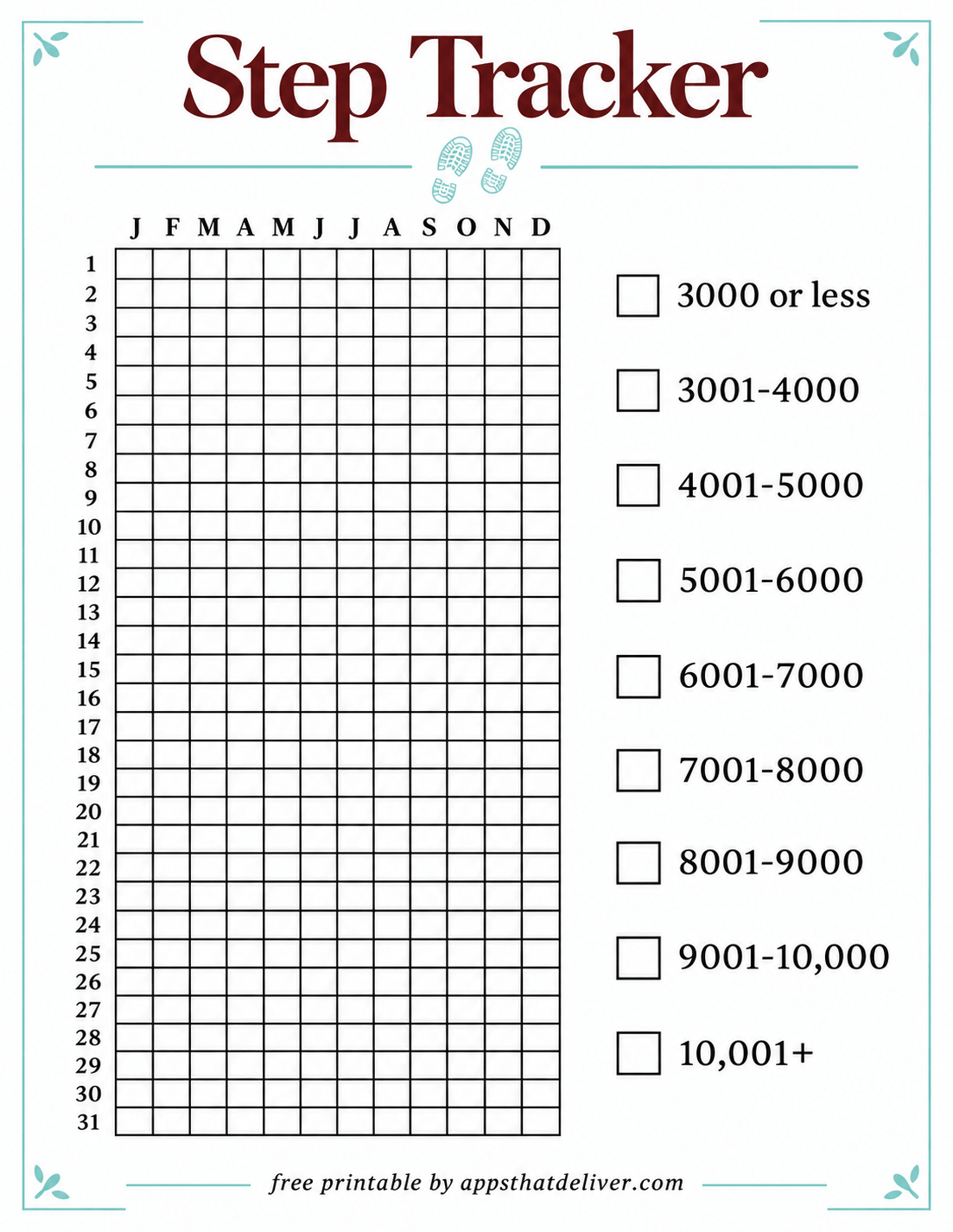
If you want to follow your walking habits over an entire year, this yearly step tracker printable offers a convenient way to keep everything on one page.
The main tracking grid includes 12 columns representing January through December and 31 numbered rows for the days of each month.
Beside the grid is a step-count legend with nine categories, beginning at 3,000 steps or less and continuing through 10,001 steps or more.
You can assign a different color to each step range and then color the appropriate square for every day you record.
As the months pass, the grid gradually becomes a colorful overview of your walking activity. It can help you notice seasonal patterns, changes in consistency, and periods when you were especially active.
This design is particularly useful if you prefer long-term habit tracking rather than printing a separate worksheet every month.
3. Step Count Tracker with Monthly Coloring Circles
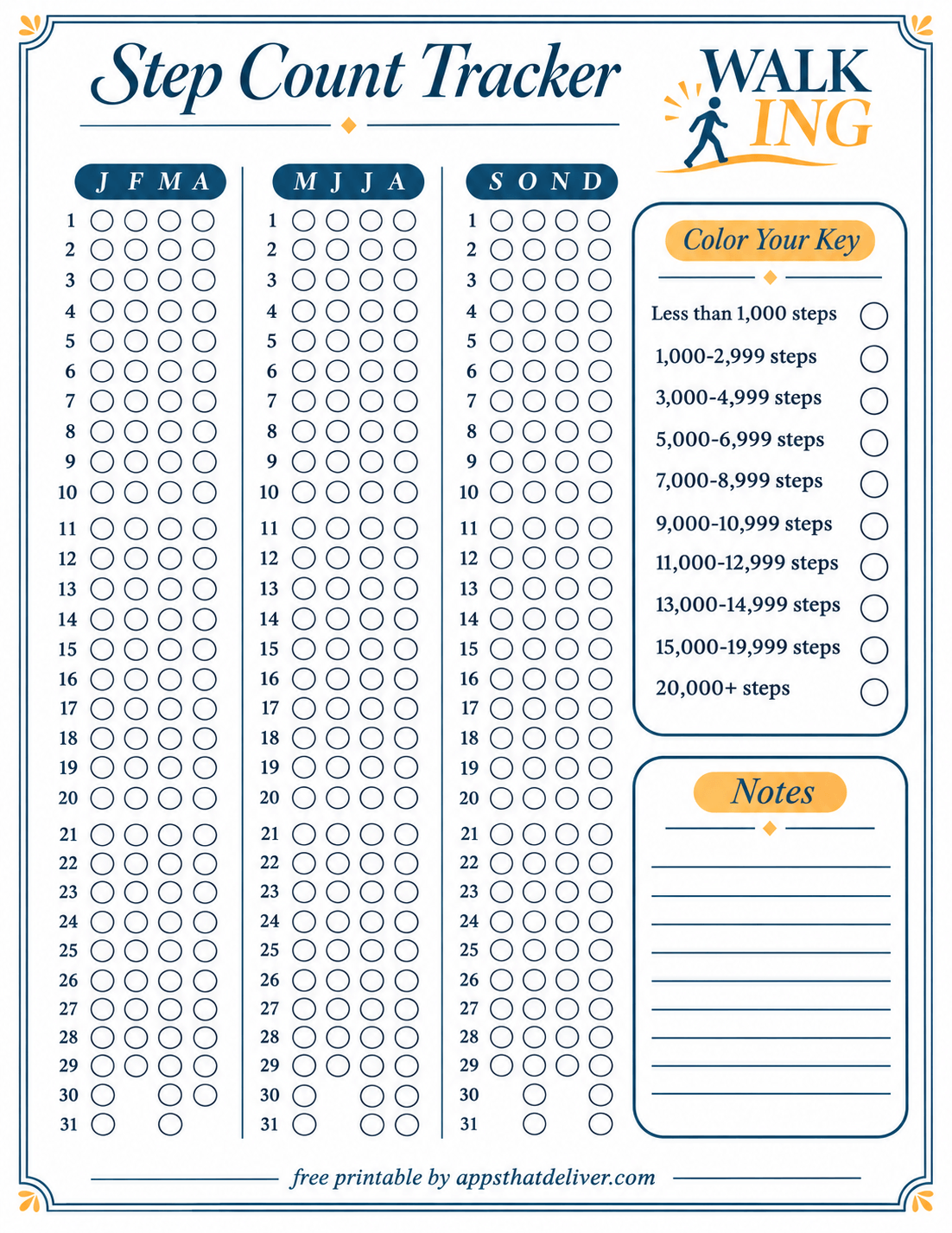
This Step Count Tracker combines a full year of tracking with a simple coloring system that makes recording your progress more enjoyable.
The page divides the year into three groups of four months. Each month has a column of blank circles numbered from 1 through 31.
On the right, the “Color Your Key” section includes ten step-count categories, ranging from fewer than 1,000 steps to 20,000 or more.
Start by assigning a color to each category. At the end of each day, check your step count and fill in the corresponding circle using the matching color.
Over time, you’ll create a visual picture of your walking activity across the year. The notes section also provides space for recording observations or reminders.
This printable is a good option if you like habit trackers, coloring activities, and seeing your progress build up gradually.
4. Monthly Step Log with Daily Writing Spaces
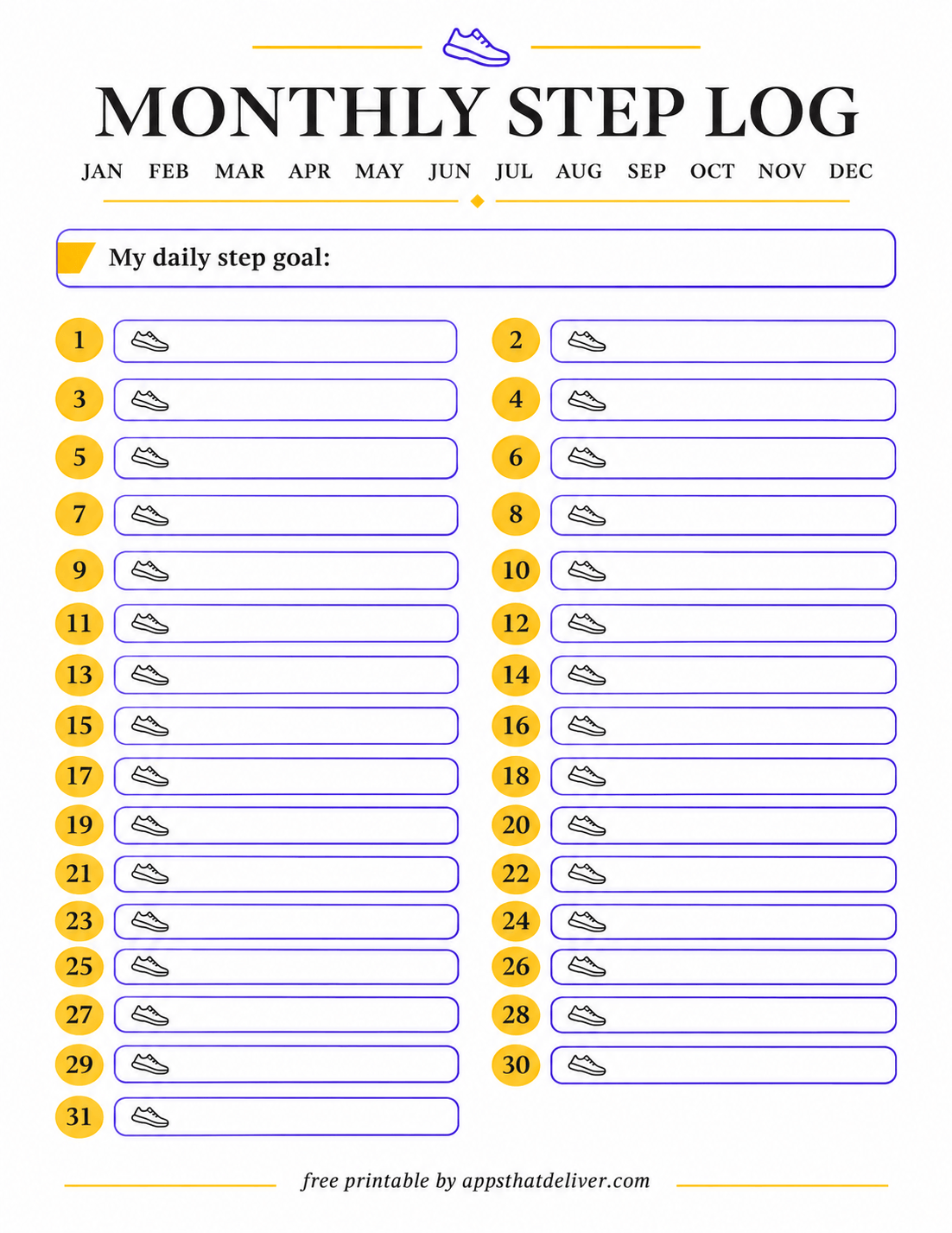
This Monthly Step Log is ideal if you want a simple worksheet for writing down your daily step totals without using a complicated tracking system.
At the top, you’ll find all twelve month abbreviations, allowing you to identify the month you’re tracking. There’s also a dedicated space for writing your daily step goal.
The main tracking area features 31 numbered days arranged in two columns. Each day has a long, rounded writing space where you can record your total steps.
Small walking shoe illustrations decorate the writing spaces, while the yellow day markers and purple outlines give the page a cheerful appearance.
Because the layout focuses on recording actual numbers, you can quickly compare one day with another without needing to interpret a color key.
Choose this printable if you prefer a straightforward monthly walking log with plenty of room to write.
5. Monthly Step Tracker with Step Count Grid
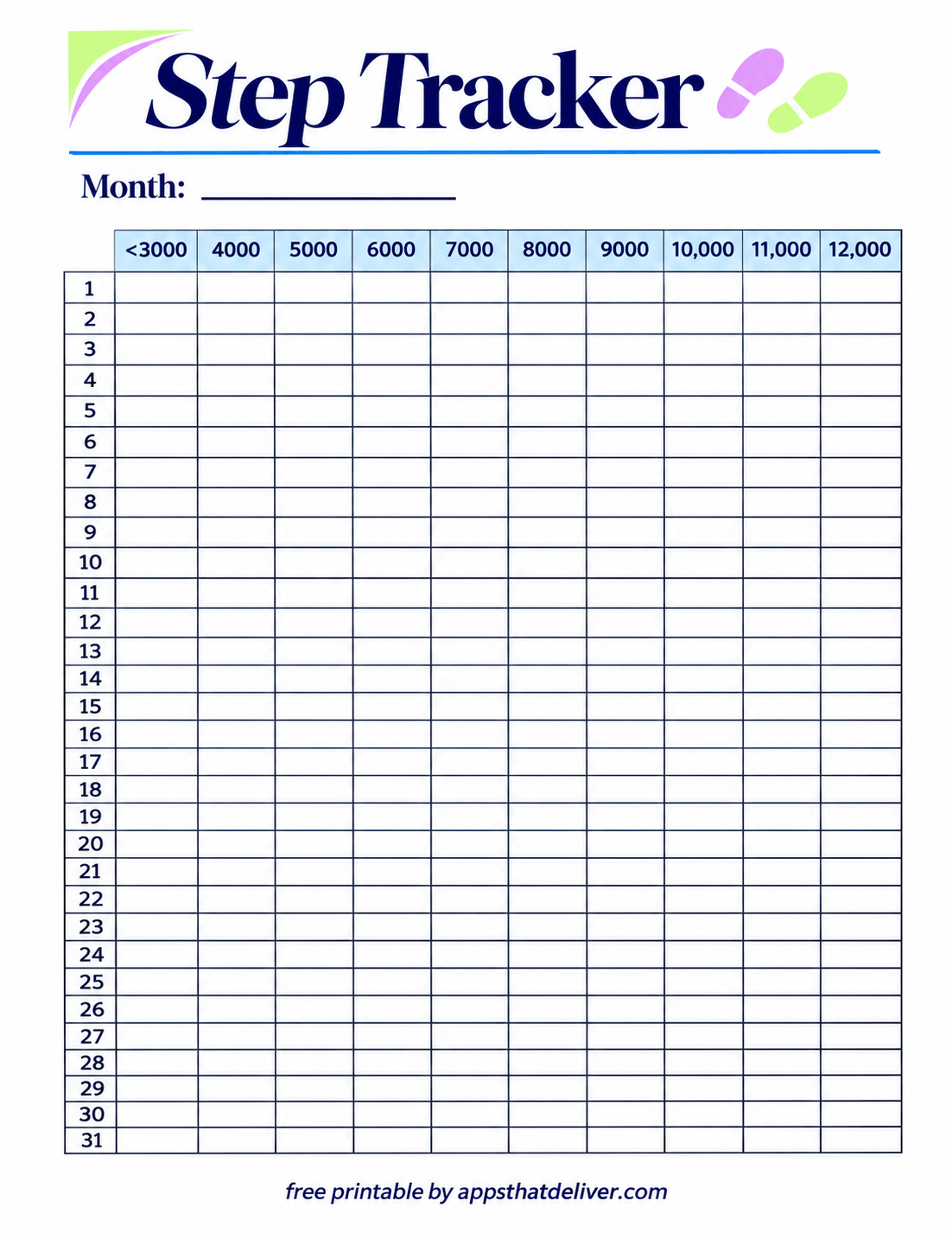
This monthly step tracker printable uses a traditional grid to help you record your daily walking progress in an organized format.
The page includes a blank month field and a large table with 31 numbered rows representing the days of the month.
Across the top are ten step-count categories, starting below 3,000 steps and continuing through 12,000 steps.
Each day, check your step count and mark the cell that corresponds to your result. You can use a checkmark, a dot, or a colored mark to indicate the appropriate category.
As you fill in the grid, you’ll be able to see how your daily step counts vary throughout the month.
The simple blue-and-white layout makes this a practical option for anyone who wants a clean, easy-to-follow tracking chart.
6. Shoe-Shaped Steps Tracker Coloring Challenge
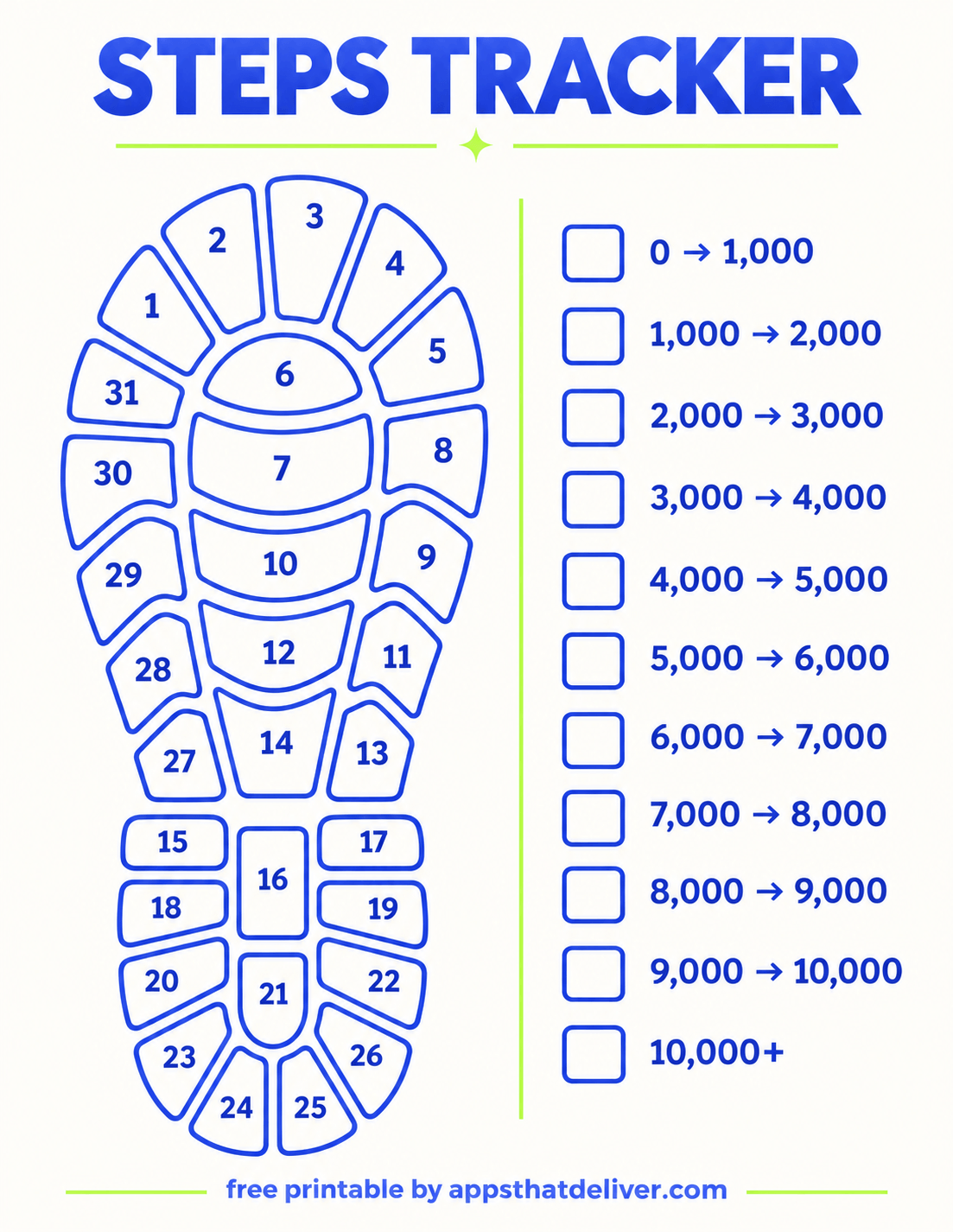
Looking for a more creative way to track your daily movement? This shoe-shaped Steps Tracker turns a month of walking into a fun coloring activity.
The main design features a large shoeprint made up of 31 numbered sections, one for each day of the month.
Beside the shoeprint is a step-count legend with eleven categories, beginning at 0 to 1,000 steps and ending at 10,000 steps or more.
You can assign a color to each category and fill in the matching square in the key. Then, at the end of each day, color the numbered shoeprint section according to your step count.
By the end of the month, the shoeprint becomes a colorful record of your walking activity.
This design is especially appealing if you enjoy coloring trackers or want something different from a traditional table or checklist.
7. Colorful Walking Path Step Tracker
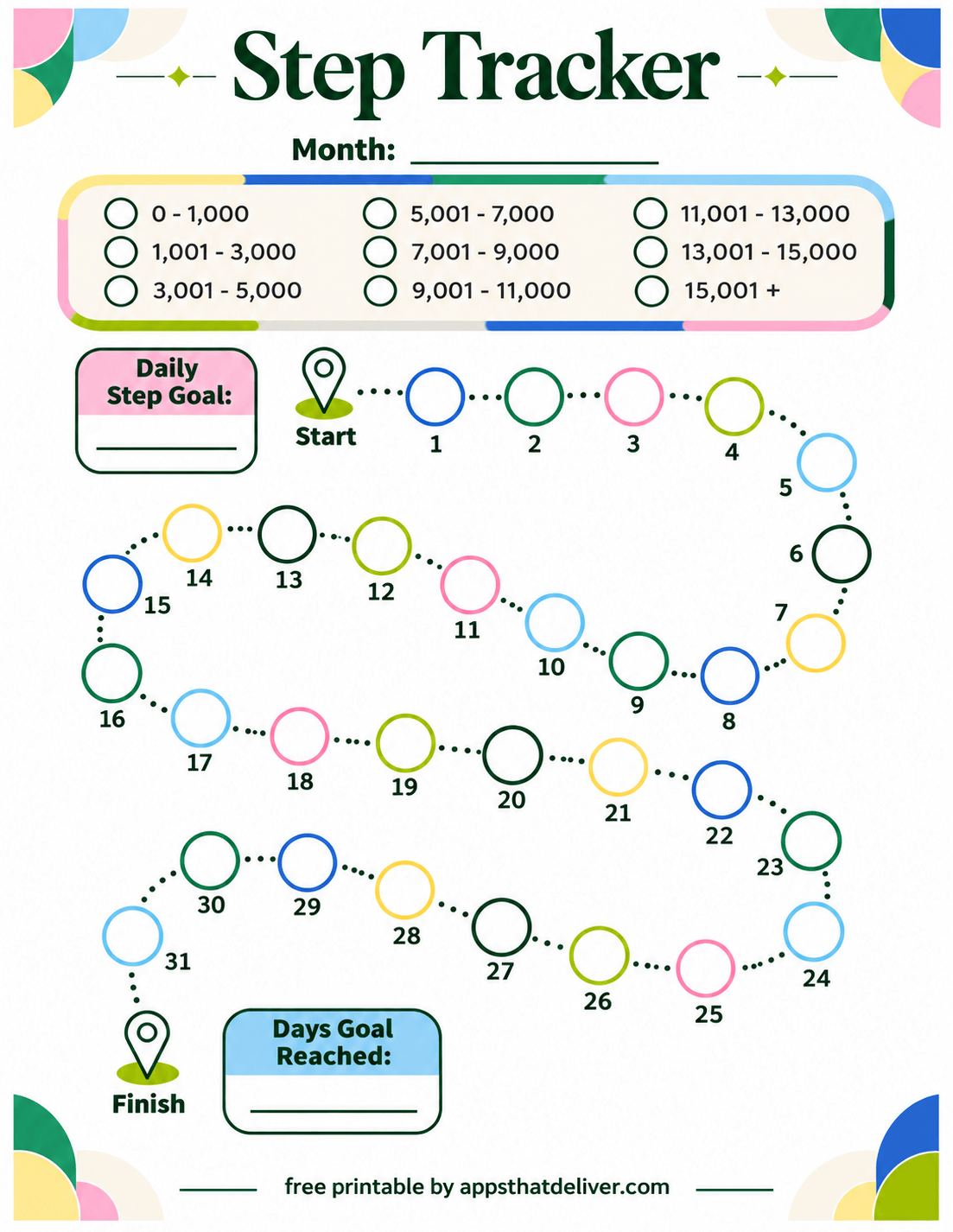
This Walking Path Step Tracker is designed to make your daily walking routine feel like a journey from start to finish.
The main illustration features a winding path with 31 numbered circles connected by dotted lines. The path begins at a Start marker and ends at a Finish marker.
At the top is a step-count legend with nine categories, ranging from 0 to 1,000 steps through 15,001 steps or more.
The printable also includes a space for recording your daily step goal and another for counting how many days you reached that goal.
To use it, check your daily step count and mark or color the circle corresponding to that day. You can follow the printed color scheme or use your own colors to make the tracker more personal.
As you complete the circles, you’ll see your progress move along the walking path toward the finish.
This design is a great choice for a 31-day walking challenge or anyone who finds visual progress especially motivating.
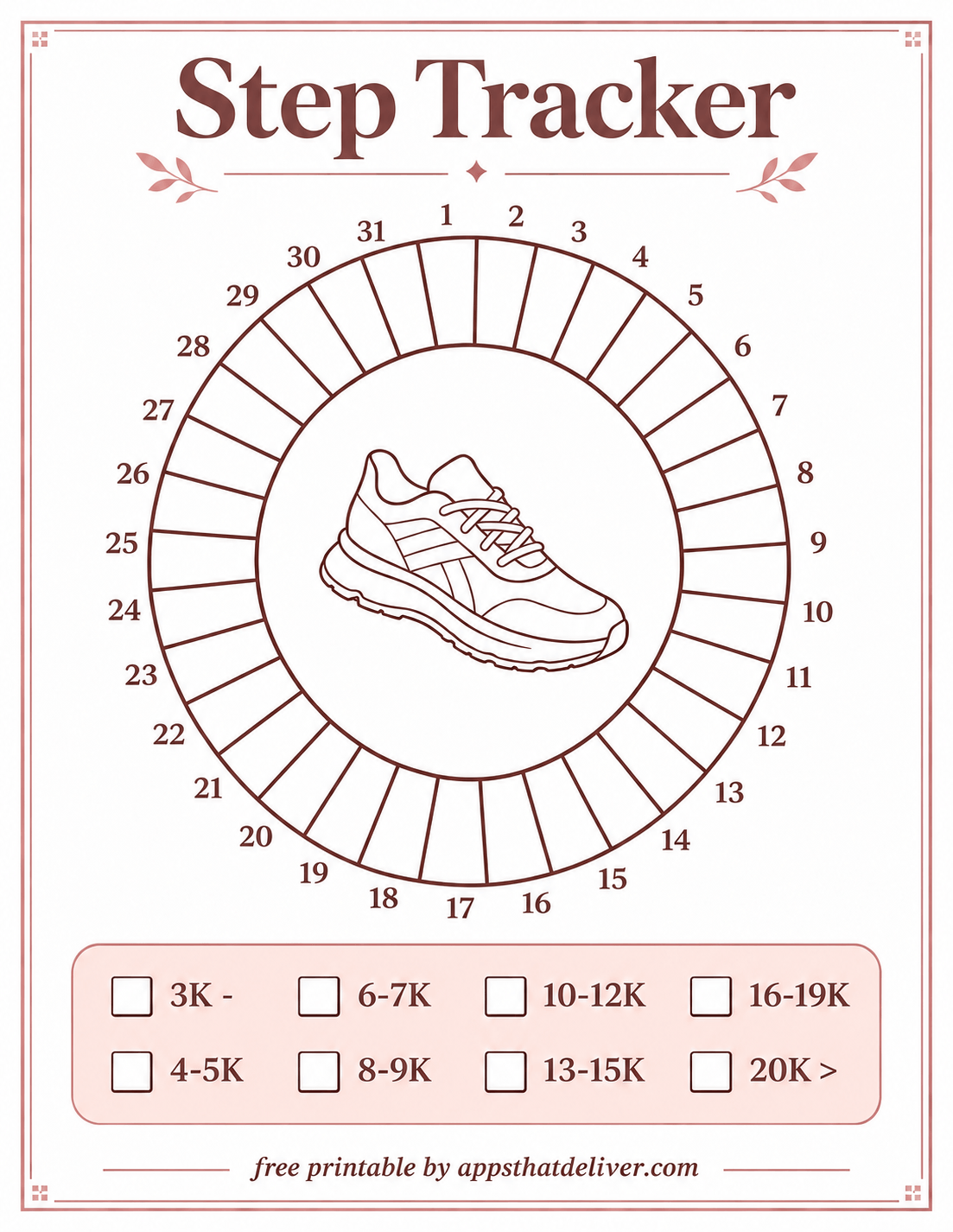
8. Circular Step Tracker with 31 Daily Segments
This elegant circular Step Tracker offers a decorative way to monitor your walking progress throughout the month.
The main feature is a large circular chart divided into 31 sections, with one numbered segment for each day.
A walking shoe illustration sits in the center of the circle, while the outer sections provide blank spaces that you can fill in as you record your daily results.
Below the chart is a step-count legend with eight categories, beginning at 3K and below and continuing through more than 20K steps.
Choose a different color for each category and use the matching color to fill in the numbered segment for each day.
By the end of the month, the completed circular chart will give you an attractive visual summary of your daily walking activity.
This printable works well for people who enjoy decorative habit trackers and want a simple monthly coloring challenge.
9. Simple Daily Steps Tracker with Two-Column Log
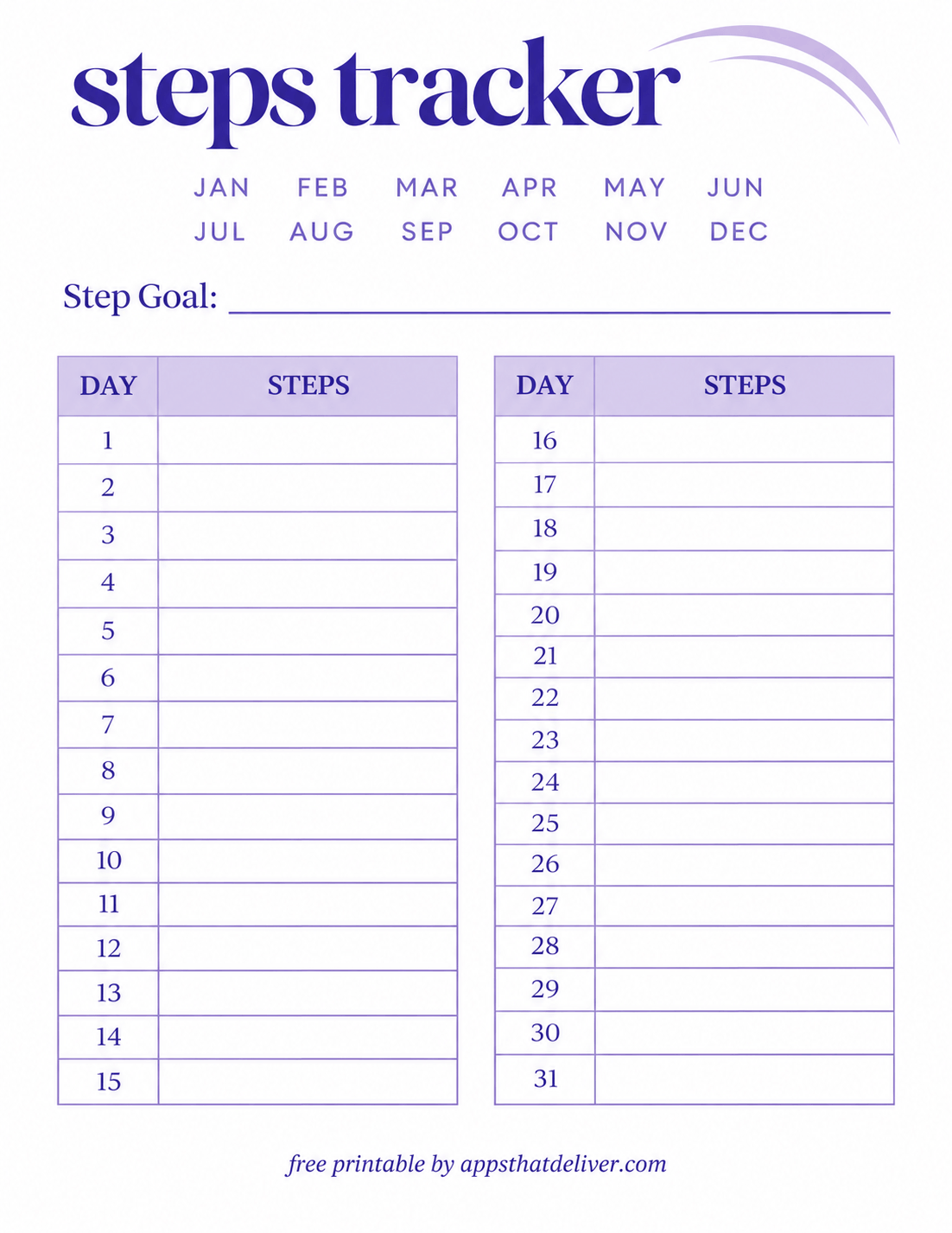
If you prefer a clean and uncomplicated layout, this simple daily steps tracker is an excellent choice.
The printable features a large Steps Tracker heading, a month selection area, and a blank line for writing your step goal.
The main tracking area is divided into two tables. The left table covers days 1 through 15, while the right table covers days 16 through 31.
Each table includes a Day column and a Steps column, giving you plenty of room to record your daily totals by hand.
The soft purple accents and straightforward layout make the worksheet easy to read without unnecessary decorations or complicated tracking categories.
This printable is particularly useful for beginners, people who prefer minimal designs, or anyone who simply wants to write down their daily step count.
Which Step Tracker Printable Should You Choose?
With nine different layouts available, the best printable depends on how you prefer to record your walking activity.
- For detailed daily tracking: Choose Printable 1, which includes step ranges, notes, goals, and monthly summary fields.
- For tracking an entire year: Printable 2 provides a 12-month grid, while Printable 3 uses coloring circles for every day of the year.
- For writing exact step counts: Printable 4 offers long writing spaces, and Printable 9 provides a simple two-column log.
- For a traditional monthly chart: Printable 5 lets you mark your daily results in a step-count grid.
- For a creative coloring activity: Printable 6 features a shoe-shaped tracker, while Printable 8 uses a circular chart.
- For a walking challenge: Printable 7 features a winding path with 31 numbered circles leading from Start to Finish.
You can also use different trackers for different purposes. For example, you might keep a detailed monthly log while using a yearly coloring chart to see your long-term progress.
How to Set a Realistic Daily Step Goal
One of the most useful things about keeping a walking log is that it allows you to set goals based on your own starting point.
While 10,000 steps is a popular target, it isn’t a requirement for everyone. Your ideal daily step goal depends on factors such as your current activity level, mobility, health, and personal circumstances.
1. Find Your Starting Point
Before choosing a new target, track your normal daily steps for several days.
This gives you a clearer picture of how much you currently walk without making major changes to your routine.
For example, if your typical daily total is around 3,000 steps, that number can serve as a starting point when deciding what goal feels manageable.
2. Choose a Manageable Goal
Instead of immediately aiming for a much higher step count, consider making a smaller increase that fits comfortably into your day.
You might add a short walk after lunch, take a few extra laps around your home, or walk during a break when it’s practical.
If you have a medical condition, mobility limitations, or concerns about increasing your activity, ask a qualified healthcare professional what level of walking is appropriate for you.
3. Track Your Progress Consistently
Use your chosen step tracker to record your results each day. Try to check your step count around the same time, such as before going to bed.
Keeping your tracking routine simple makes it easier to continue over several weeks or months.
4. Review Your Goal Regularly
At the end of the month, look back at your recorded step counts and consider whether your target still makes sense.
If your goal feels comfortable and sustainable, you may decide to maintain it or gradually increase it. If it feels too demanding, adjusting it is perfectly reasonable.
The purpose of tracking is to understand your activity and support your routine, not to turn every day into a competition.
Simple Ways to Add More Steps to Your Day
You don’t necessarily need a long workout to increase your daily step count. Short periods of walking throughout the day can add up.
- Take a short walk after breakfast, lunch, or dinner.
- Walk around your home during a break.
- Choose the stairs instead of the elevator when appropriate and comfortable.
- Walk while talking on the phone if you can do so safely.
- Park a little farther from your destination when practical.
- Take a brief walking break after spending a long time sitting.
- Visit a nearby park or walking path.
- Invite a friend or family member to join you for a walk.
- Walk indoors when outdoor weather isn’t suitable.
Choose activities that are safe and comfortable for you. Even on days when you don’t reach your target, you can still record your steps and continue tracking.
Daily vs. Monthly vs. Yearly Step Tracking
The different step tracker formats in this collection serve slightly different purposes.
Daily Step Tracking
Daily tracking focuses on recording how many steps you take each day. It works well if you want to compare your activity from one day to the next.
Printables 1, 4, and 9 are particularly useful for this approach because they provide spaces for recording actual step counts.
Monthly Step Tracking
Monthly tracking helps you see your progress over several weeks. You can review which days were more active, how often you reached your goal, and whether your routine became more consistent.
Printables 5, 6, 7, and 8 offer different ways to create a monthly visual record using grids, shoeprint sections, walking paths, or circular charts.
Yearly Step Tracking
A yearly step tracker gives you a broader picture of your walking habits. Instead of focusing on individual days, you can look for patterns across months and seasons.
Printables 2 and 3 are designed for this purpose, with enough tracking spaces to record daily progress throughout the year.
You don’t need to choose only one method. A daily log and a yearly coloring chart can work together if you enjoy both detailed records and visual summaries.
How to Use a Color-Coded Step Tracker
Several of these printables include step-count ranges and blank spaces for assigning colors.
A color-coded system is useful because it allows you to recognize your daily results at a glance without reading every number individually.
- Review the step-count legend. Look at the ranges printed on your chosen tracker.
- Choose your colors. Assign a different color to each category using colored pencils, markers, or highlighters.
- Fill in the key. Color the corresponding circle or square beside each step range.
- Check your daily total. Read the number of steps recorded by your tracking device.
- Find the matching category. Identify which printed step range includes your total.
- Color the daily section. Fill in the circle, square, or numbered segment using the color assigned to that range.
- Continue throughout the tracking period. Use the same color key so your completed chart remains consistent.
For months with fewer than 31 days, simply leave the extra dates unused. For yearly grids, you can also leave spaces blank for dates that don’t exist in a particular month.
There’s no need to make the chart perfect. The goal is to create a useful and enjoyable record of your activity.
Tips for Staying Consistent with Your Walking Tracker
A step tracker is most helpful when you use it regularly. Here are a few simple ways to make tracking part of your routine.
- Keep your printable visible. Place it on your desk, refrigerator, or another convenient location.
- Record your steps at the same time. Checking your total each evening can help you remember to update the chart.
- Use a realistic target. Choose a goal that suits your routine instead of comparing yourself with others.
- Celebrate consistency. Completing another day of tracking is worthwhile even when your step total is lower than expected.
- Don’t worry about missed days. If you forget to record a day, simply continue with the next one.
- Review your progress monthly. Look for patterns rather than focusing only on individual high or low totals.
- Choose a tracker you enjoy. A colorful shoeprint or walking path may be more motivating than a spreadsheet-style grid, or vice versa.
Remember that your step count is only one way to observe physical activity. It doesn’t capture every form of movement, and lower-step days can be part of a healthy, balanced routine.
How to Organize Your Completed Step Tracker Printables
If you enjoy tracking your walking activity over time, saving your completed printables can help you compare your progress.
You can keep monthly step logs in a binder, folder, or clipboard. Adding the month and year to each completed sheet makes it easier to identify later.
If you use a yearly tracker, keep it somewhere accessible so you can update it regularly without having to search for the page.
You might also keep a detailed monthly log alongside a yearly coloring tracker. This gives you both exact numbers and a visual overview of your activity.
When you’re ready to begin another month or year, print a fresh copy of your favorite template and start again.
Frequently Asked Questions
Yes. This collection includes nine free step tracker designs that you can download as printable PDFs.
There are nine unique designs, including daily step logs, monthly grids, yearly tracking charts, a shoeprint coloring tracker, a walking path, and a circular tracker.
Choose a design, print it, and check your daily step count using a phone, pedometer, or smartwatch. Then record the number or mark the matching category on your printable.
Printables 1, 4, and 9 include writing spaces for recording daily step totals. Printable 1 also includes goal tracking and a monthly summary.
Yes. Printables 2 and 3 provide daily tracking spaces across all twelve months, making them useful for recording walking activity throughout the year.
Yes. The shoe-shaped tracker, walking path tracker, and circular tracker each have 31 numbered sections that you can complete during a monthly walking challenge.
No. You can use any suitable step-counting device, including a pedometer or a phone with step-tracking capabilities. The printable itself is used to record the results.
No. Ten thousand steps is a popular goal, but it is not a universal requirement. A suitable target depends on your activity level, health, mobility, and personal circumstances.
Yes. Several designs include blank circles, squares, or numbered sections that you can color according to your daily step count. Colored pencils, markers, and highlighters can all be used.
If the month has fewer than 31 days, leave the extra tracking spaces blank. For yearly grids, skip dates that do not exist in a particular month.
Yes. You can print a new copy of your favorite design whenever you want to begin another month, walking challenge, or tracking period.
Printable 9 is a simple two-column daily log, while Printable 4 provides larger writing spaces for daily totals. Both are good choices if you want to start tracking without using a color-coded system.
Final Thoughts
Keeping track of your daily steps doesn’t have to be complicated. A simple printable worksheet can help you understand your walking habits, stay consistent, and see how your activity changes over time.
This collection includes 9 free step tracker printables, from straightforward daily logs and monthly grids to colorful shoeprint trackers, circular charts, and walking challenges.
Whether you want to record exact step counts or create a colorful visual record of your progress, there’s a design here to match your tracking style.
Choose your favorite printable, download the PDF, and start recording your daily steps. You can always switch to a different layout as your goals and preferences change.
Happy walking! ❤️